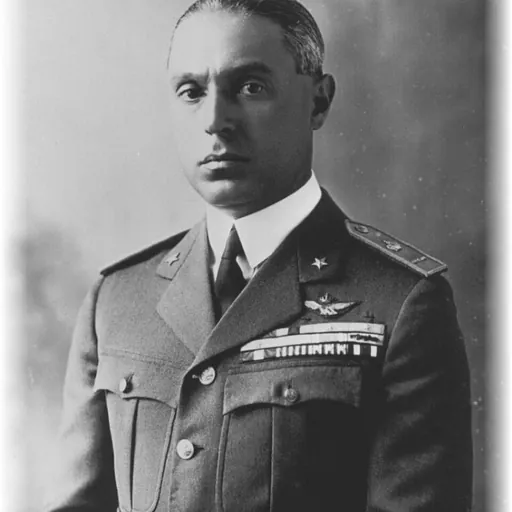
About Francesco de Pinedo
Lived 1890 – 1933 (aged 43). Francesco de Pinedo was an Italian aircraft pilot, writer and flieger.
Francesco de Pinedo (February 16, 1890 – September 2, 1933) was an Italian aviator. A Regia Marina (Italy's Royal Navy) officer who transferred to the Regia Aeronautica (Italy's Royal Air Force), he was an advocate of the seaplane and is best known for his long-range flying boat flights in the 1920s that demonstrated the feasibility of global air travel.
Early life
Pinedo was born on 16 February 1890 in Naples, Italy, into a patrician family, the son of a lawyer. As a teenager he studied literature and the arts and developed a lifelong passion for music.
Career
Early career
Pinedo entered the Italian Naval Academy at Leghorn (Livorno) in 1908 at the age of 18. He graduated in 1911 and was commissioned as an officer in the Regia Marina (Italy's Royal Navy). He served aboard destroyers during the Italo-Turkish War of 1911–1912, witnessing Italy's air operations against the Ottoman Empire, the first time that any country had used aircraft in combat. The experience sparked his interest in aviation.
After the war ended in November 1918, Pinedo returned briefly to sea duty, but soon resumed aviation duties. In the immediate postwar years he made milestone flights from Italy to the Netherlands and in 1921 from Brindisi to Constantinople in the Ottoman Empire. On 16 October 1923 he transferred from the Regia Marina to the Regia Aeronautica (Italy's Royal Air Force)
Pinedo's cultured background and naturally reserved nature, as well as the orderliness and neatness instilled in him by his naval training, made him atypical of the aviators of his day, who tended to be mavericks and daredevils. He preferred to avoid publicity. Adventurous without being reckless, he became an influential advocate of the seaplane, sharing a belief with many other aviators of his time that flying boats were the key to aviation's future because of their ability to land safely on the sea in the case of emergencies during long flights over water. He also believed that seaplanes were more practical than landplanes because of the proximity to water of most cities and towns. With airports not yet common, Pinedo observed, "Civilization is built on water. The world's principal cities are mirrored by seas, rivers, or lakes. Why not utilize these immense, ready-to-use, natural air strips in place of costly airports?"
On 21 April 1925, Pinedo and his mechanic, Ernesto Campanelli, departed Rome aboard Gennariello. They stopped first at Brindisi in Italy, then at Leros in Greece; Baghdad in Iraq; Bushehr and Chabar in Persia; Karachi, Bombay, Cocanada, and Calcutta in British India; Akyab, Rangoon, Tavoy, and Mergui in Burma; Phuket in Siam; Penang in British Malaya; Singapore; Batavia, Surabaya, Sumbawa, and Kupang in the Netherlands East Indies, and Broome, Carnarvon, Perth, Bunbury, Albany, Israelite Bay, and Adelaide in Australia before reaching Melbourne, where they arrived on 10 June and spent 36 days.
On 16 July, Pinedo and Campanelli flew on to Sydney, where they spent another three weeks. Resuming their flight on 6 August, they visited Brisbane, Rockhampton, Townsville, Innisfail, Cooktown, and Thursday Island in Australia; Merauke, Dobo, Amboina, and Menado in the Netherlands East Indies; Cebu, Atimonan, Manila, and Aparri in the Philippines; Tamsui on Formosa; Shanghai in China; Mokpo in Korea; and Yamakawa and Kagoshima in Japan, before arriving in Tokyo on 26 September.
After stops at various cities in South America including Rio de Janeiro, Brazil, Buenos Aires, Argentina, Montevideo, Uruguay, and Asunción, Paraguay, the three Italians began a long leg over the dense jungle of Brazil's Mato Grosso region on 16 March 1927. At one point, a Brazilian river boat had to tow the Santa Maria for along the Paraguay River in search of a suitable takeoff area after a refueling stop, but on 20 March they completed their crossing of the Mato Grosso and landed at Manaós, Brazil. It was history's first flight over the Mato Grosso. A painting at the New Orleans Lakefront Airport memorializes the event.
They then flew through Louisiana, Texas, New Mexico, and Arizona, intending to reach San Diego, California, but during a refueling stop on Theodore Roosevelt Lake in Arizona an accidental fire broke out when a teenage volunteer helping to refuel the Santa Maria carelessly discarded a cigarette that ignited gasoline on the water's surface. The fire quickly spread to the plane and destroyed it; its engines sank to the bottom of the lake and were not recovered until 19 April. The three Italians then flew to San Diego as passengers on a United States Navy plane and traveled by train to New York City, where they arrived on 25 April 1927 to meet a new S.55 shipped there by the Italian Fascist government so that they could continue their flight.
After a week of repairs, the three Italian aviators were airborne again in the Santa Maria II, flying back to the point in the Atlantic where they had been taken under tow, and then finishing their transatlantic flight from there. After stops in Portugal and Spain, Pinedo, Del Prete, and Zacchetti completed the "Four Continents" flight on 16 June 1927, landing Santa Maria II in Ostia's harbor outside Rome. Their flight had taken 124 days. After returning from the flight, Pinedo was promoted to generale di brigata aerea (air brigade general),
Later career
After the "Four Continents" flight, Pinedo increasingly carried out duties in diplomatic and administrative posts that kept him out of the headlines. Balbo's prominence in the Italian Fascist movement meant that Pinedo's break with him led to declining fortunes for Pinedo in his Regia Aeronautica career. In his final tour of duty with the Regia Aeronautica, he served as Italy's air attaché in Argentina, after which he was placed on leave.
Fearing that he would fall into obscurity and wishing to pursue long-distance flights by single aircraft of the type that Balbo would not support, Pinedo resigned from the Regia Aeronautica in 1933. He traveled to New York City under the pseudonym "Mr. Smith", purchased a Bellanca monoplane, and let it be known that he intended to fly nonstop from New York to Baghdad, Iraq, to set a new world nonstop flight distance record of some .
Death
When Pinedo attempted to take off from Floyd Bennett Field in Brooklyn, New York, on 2 September 1933 for his flight to Baghdad with his Bellanca overloaded with fuel, he lost control of the aircraft. Unable to detach from the airstrip, the plane veered off the runway, flipped onto its right side and crashed. Thrown from his seat, Pinedo quickly attempted to reach back to the controls in order to turn off the smoldering plane's engine, but at the same moment, fuel vapors ignited. He perished in the resulting fire, which also destroyed the plane. The takeoff attempt, crash, and fire all were captured on film. Pinedo's body was burned beyond recognition in the fire.
At New York, memorial services for Pinedo were held at St. Patrick's Cathedral in Manhattan while American military planes circled overhead. The Italian ocean liner MS Vulcania transported his remains to Italy. After his coffin reached Rome, a full state funeral with military honors took place.
Don’t just read it —
keep it.
Full-length biographies made to live with: read them, listen on the way to work, watch them tonight.
- E-book
- Audio
- Video
Instant download · yours to keep · every purchase keeps this site free
Important facts
People in Francesco de Pinedo's life
Named in this biography and alive at the same time
Related people
Same field, nearest in time


Contemporaries
People whose lives overlapped Francesco de Pinedo's




Frequently asked questions
Who was Francesco de Pinedo?
Italian aviator (1890-1933)
When was Francesco de Pinedo born?
Francesco de Pinedo was born on 16 February 1890 in Naples.
When did Francesco de Pinedo die?
Francesco de Pinedo died on 2 September 1933 in New York City.
What was Francesco de Pinedo's occupation?
Francesco de Pinedo was an aircraft pilot, writer and flieger.
What nationality was Francesco de Pinedo?
Francesco de Pinedo was Italian.
Sources & further reading
· Wikipedia: Francesco de Pinedo
· DBpedia: Francesco de Pinedo
Cite this page
APA: Biography.guide. (2026). Francesco de Pinedo. https://biography.guide/francesco-de-pinedo/
MLA: "Francesco de Pinedo." Biography.guide, https://biography.guide/francesco-de-pinedo/.
Chicago: "Francesco de Pinedo." Biography.guide. https://biography.guide/francesco-de-pinedo/.
Data last updated: 2026-09-22 · Spot an error? Report a correction.
Portrait: Wikimedia Commons · author & licence
Page generated 2026-09-27 05:01 UTC