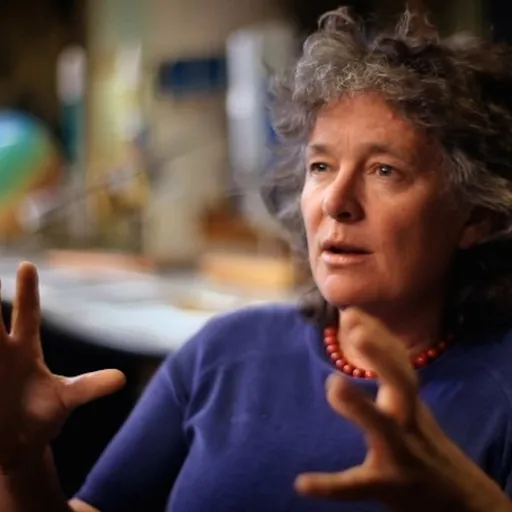
About Fran Bagenal
Born 1954. Fran Bagenal is a British university teacher, geophysicist and astrophysicist, known for NASA.
Frances "Fran" Bagenal (born 4 November 1954) is a Professor Emerita of Astrophysical and Planetary Sciences at the University of Colorado Boulder and a Senior Research Scientist at the Laboratory for Atmospheric and Space Physics in the fields of space plasmas and planetary magnetospheres. Born in Dorchester, Dorset, she grew up near Cambridge, England, studied at Lancaster University, and moved to the United States in 1976 to pursue graduate work at MIT, where she completed her PhD in 1981. She has been a plasma science team member on the Voyager, Galileo, Deep Space 1, Cassini, New Horizons, and Juno missions, and served as particles and plasma science team leader on New Horizons and Juno. In 2021 she was elected to the National Academy of Sciences, which recognised her as a leading expert on the properties of plasmas in the magnetospheres of the outer planets.
Early life Bagenal was born on 4 November 1954 in Dorchester, Dorset, England, and grew up near Cambridge. As a child she followed BBC science documentaries and the early years of the American space programme, later citing Carl Sagan as an early source of scientific inspiration.
In 1976, drawn by NASA's planetary missions, Bagenal applied to spend a year studying in the United States and secured a position at the Massachusetts Institute of Technology. She joined the Voyager Plasma Science team and decided to stay on for doctoral research. She was awarded her PhD in Earth and Planetary Sciences from MIT in 1981, with a thesis analysing plasma data from the Voyager 1 encounter with Jupiter's magnetosphere. The thesis work included developing a detailed model of the structure and composition of the Io plasma torus — a ring of sulphur and oxygen ions shed by Jupiter's volcanic moon Io.
Following her doctorate, Bagenal spent five years (1982–1987) as a postdoctoral researcher in space physics at Imperial College London. The Voyager flybys of Uranus in 1986 and Neptune in 1989 drew her back to the United States, and she joined the faculty at the University of Colorado Boulder in 1989.
New Horizons carried two plasma instruments: the Solar Wind Around Pluto (SWAP) instrument, designed to measure the interaction between the solar wind and ions escaping from Pluto's atmosphere, and the Pluto Energetic Particle Spectrometer Science Investigation (PEPSSI). SWAP was designed at Southwest Research Institute and listed Bagenal as a co-investigator.
Data from SWAP at the flyby showed that nitrogen in Pluto's atmosphere is ionised by ultraviolet sunlight, with the resulting ions picked up by the solar wind to form a comet-like tail extending downwind of the dwarf planet. Space.com quoted Bagenal: "This is just a first tantalizing look at Pluto's plasma environment."
EarthSky noted that Bagenal had been one of a small number of women on the original Voyager teams and that by the time of New Horizons the team included dozens of women scientists. Asked about the change, she said: "This isn't remarkable — it's just how it is."
Juno mission to Jupiter Bagenal is co investigator and co chairs the magnetospheric working group (MWG) team leader on NASA's Juno mission to Jupiter. Juno entered a highly elliptical polar orbit around Jupiter on 4 July 2016. The MWG studies charged particles in Jupiter's magnetosphere to understand the planet's magnetic field, the dynamics of plasma flows, and the coupling between the magnetosphere and Jupiter's atmosphere.
The polar orbit gives the spacecraft close passes over Jupiter's auroral regions. Bagenal's team investigates how plasma from the Io plasma torus flows outward and drives auroral emissions through Alfvén wave propagation, work that connects directly to her decades-long study of the Io Jupiter system.
Over more than two decades she has conducted research on the demographics of the space science workforce, including surveys of undergraduate physics education and studies of career pathways for women and scientists from under-represented groups.
Honors
National Academy of Sciences In 2021 Bagenal was elected to the National Academy of Sciences (NAS), widely regarded as the United States' most prestigious honorary scientific body. The academy cited her as "a leading expert on the properties of plasmas that pervade the magnetospheres of the outer planets".
Bagenal has served on NAS committees for the Decadal Surveys in Planetary Science (2023) and in Heliophysics (2024).
Asteroid 10020 Bagenal The outer main-belt asteroid 10020 Bagenal was discovered by astronomer Schelte J. Bus at Palomar Observatory on 26 August 1979 — the same year Voyager 1 passed Jupiter and returned the data that would form the basis of Bagenal's doctoral thesis. Provisionally designated 1979 OQ5, it orbits the Sun in the outer main belt. The official naming citation was published on 13 April 2017 in Minor Planet Circulars 103974, roughly twenty months after the New Horizons Pluto flyby. James Van Allen Lecture award of the American Geophysical Union in 2018 Elected a Legacy Fellow of the American Astronomical Society in 2020 Elected to the National Academy of Sciences in 2021
Public engagement and media Bagenal appeared as a contributor in the Farthest (2017), a PBS documentary directed by Emer Reynolds that examined the scientific and cultural legacy of the Voyager programme. She spoke on screen about her work during the Voyager encounters with Jupiter, Saturn, Uranus and Neptune. The film was widely praised and received Emmy consideration.
She also featured in The planets (2019), a five-part Nova miniseries broadcast on PBS and co-produced with the BBC, which traced the formation and history of the solar system's planets. Her contributions drew on her expertise in planetary magnetospheres and the outer solar system.
Personal life As a student, Fran Bagenal was a keen member of the Lancaster University Speleological Society, grovelling around in the caves of the Yorkshire Dales. She spent her summers exploring La Cueva del Agua near Tresviso in the Picos de Europa of northern Spain.
On moving to the US, Bagenal became a rock climber. Her spouse and climbing partner of over four decades is Stephen “Crusher” Bartlett who is the author of the book Desert Towers.
Selected publications Bagenal, Fran; Dowling, Timothy E.; McKinnon, William B. (2004). Jupiter: The planet, Satellites and Magnetosphere. Cambridge University Press. Bagenal, Fran et al.; (2022). Solar Wind Intersection with the Pluto System, in The Pluto System After New Horizons, U.of Arizona Press Space Science Series. Bagenal, Fran; (2024). Magnetosphere of Jupiter. In Oxford Research Encyclopedia of Planetary Science.
Don’t just read it —
keep it.
Full-length biographies made to live with: read them, listen on the way to work, watch them tonight.
- E-book
- Audio
- Video
Instant download · yours to keep · every purchase keeps this site free
Important facts
People in Fran Bagenal's life
Named in this biography and alive at the same time



Related people
Same field, nearest in time




Contemporaries
People whose lives overlapped Fran Bagenal's



Frequently asked questions
Who is Fran Bagenal?
British astrophysics professor
When was Fran Bagenal born?
Fran Bagenal was born on 4 November 1954 in Dorchester.
What is Fran Bagenal's occupation?
Fran Bagenal is a university teacher, geophysicist and astrophysicist.
What is Fran Bagenal known for?
Fran Bagenal is known for NASA.
What nationality is Fran Bagenal?
Fran Bagenal is British.
Sources & further reading
Cite this page
APA: Biography.guide. (2026). Fran Bagenal. https://biography.guide/fran-bagenal/
MLA: "Fran Bagenal." Biography.guide, https://biography.guide/fran-bagenal/.
Chicago: "Fran Bagenal." Biography.guide. https://biography.guide/fran-bagenal/.
Data last updated: 2026-09-21 · Spot an error? Report a correction.
Portrait: Wikimedia Commons · author & licence
Page generated 2026-09-27 04:59 UTC