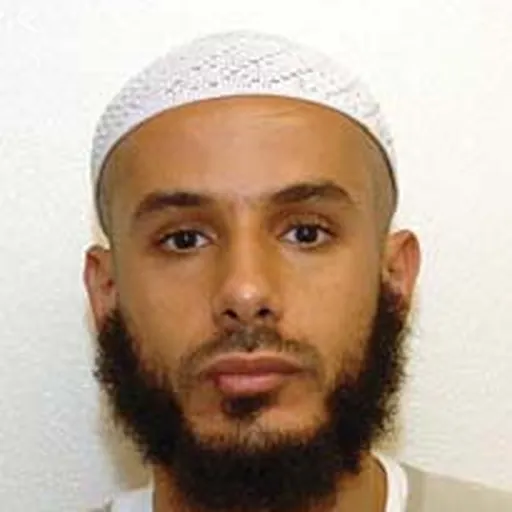
Fouzi Khalid Abdullah Al Awda
Kuwaiti Guantanamo detainee
About Fouzi Khalid Abdullah Al Awda
Born 1977.
Fouzi Khalid Abdullah Al Odah is a Kuwaiti citizen formerly held in the United States Guantanamo Bay detainment camps, in Cuba. He had been detained without charge in Guantanamo Bay since 2002. He was a plaintiff in the ongoing case, Al Odah v. United States, which challenged his detention, along with that of fellow detainees. The case was widely acknowledged to be one of the most significant to be heard by the Supreme Court in the current term. The US Department of Defense reports that he was born in 1977, in Kuwait City, Kuwait.
U.S. District Court Judge Colleen Kollar-Kotelly's ruling on al Odah's habeas corpus petition was published on September 1, 2009. She denied his habeas corpus petition based on the assumption that it was more likely than not that Odah was a foot soldier fighting in Afghanistan against US troops.
Fouzi Khalid Abdullah Al Odah arrived at the Guantanamo detention camps on February 28, 2002, where he remained for 12 years, 8 months, 8 days until his transfer to Kuwait's rehabilitation program for former Guantanamo detainees on November 5, 2014.
Alleged affiliation with al Qaeda The U.S. Government contends that al Odah's true purpose in Afghanistan was to join the Taliban and al Qaeda. Supporting this, al Odah's name and phone number appeared in a document found on the official al Qaeda website, and his passport was recovered from an al Qaeda safehouse in Karachi. The appellate court's rejection of his habeas corpus petition also refers to "additional incriminating evidence" discovered since his capture, however the nature of that evidence is redacted in the unclassified version of the opinion.
Capture
According to an interview Fawzi's father, Khalid al-Odah, gave to Amnesty International, Fawzi traveled in 2001 to the Pakistan/Afghanistan border area in order to do charitable outreach work, Following the attacks of September 11, 2001, Fawzi fled Afghanistan, intending to return home to Kuwait. Fawzi successfully crossed the border into Pakistan but was then captured by Pakistanis that his father alleges were bounty hunters who handed Fawzi and eleven other Kuwaitis over to American authorities. The Kuwaitis were then transported to Cuba.
Official status reviews
Originally the Bush Presidency asserted that captives apprehended in the "war on terror" were not covered by the Geneva Conventions, and could be held indefinitely, without charge, and without an open and transparent review of the justifications for their detention. In 2004, the United States Supreme Court ruled, in Rasul v. Bush, that Guantanamo captives were entitled to being informed of the allegations justifying their detention, and were entitled to try to refute them.
Office for the Administrative Review of Detained Enemy Combatants
Following the Supreme Court's ruling, the Department of Defense set up the Office for the Administrative Review of Detained Enemy Combatants.
Fouzi Khalid Abdullah Al Odah was listed as one of the captives who "The military alleges ... are associated with both Al Qaeda and the Taliban."
On June 28, 2004, the Supreme Court issued an opinion on a related Guantanamo case, Rasul v. Bush, affirming the right of Guantanamo detainees to challenge their imprisonment in the U.S. federal court system. Under this ruling, detainees such as those represented in Al Odah would be able to file habeas corpus petitions in U.S. courts.
In April 2007, the Supreme Court declined to hear two cases challenging the Military Commissions Act: Boumediene v. Bush and Al Odah v. United States On June 29, 2007, the court reversed that decision, releasing an order that expressed their intent to hear the challenge. The two cases have been consolidated into one. Oral arguments were heard on December 5, 2007. The decision, striking down the Military Commissions Act, was handed down on June 12, 2008.
On July 18, 2008, David J. Cynamon filed a "PETITIONERS’ STATUS REPORT" in Al Odah, v. United States Civil Action No. CV 02-0828 (CKK) on behalf of Fawzi Khalid Abdullah Fahad Al Odah, Fayiz Mohammed Ahmen Al Kandari, Khalid Abdullah Mishal Al Mutairi, Fouad Mahmoud Al Rabiah.
He wrote that they were the four remaining Kuwaiti captives in Guantanamo. He wrote that none of the four men had been cleared for release. He wrote that the government had completed "factual returns" for all four men—but those factual returns had contained redacted sections.
Joint Review Task Force
When he assumed office in January 2009, President Barack Obama made a number of promises about the future of Guantanamo. He promised the use of torture would cease at the camp. He promised to institute a new review system. That new review system was composed of officials from six departments, where the OARDEC reviews were conducted entirely by the Department of Defense. When it reported back, a year later, the Joint Review Task Force classified some individuals as too dangerous to be transferred from Guantanamo, even though there was no evidence to justify laying charges against them. On April 9, 2013, that document was made public after a Freedom of Information Act request. Fouzi Khalid Abdullah Al Odah was one of the 71 individuals deemed too innocent to charge, but too dangerous to release. Although Obama promised that those deemed too innocent to charge, but too dangerous to release would start to receive reviews from a Periodic Review Board less than a quarter of men have received a review.
Meetings with attorneys
On September 28, 2005, the Associated Press reported on a meeting between attorneys Thomas Wilner and Kristine Huskey and their Kuwaiti clients.
Al-Odah told his lawyers that camp authorities had warned the hunger strikers that they would start strapping them in "restraint chairs" during their force-feedings.
In an interview in Marie Claire magazine, Huskey described her surprise that when she first met with Guantanamo clients, like al-Odah, they preferred food brought from Guantanamo fast food outlets to the Arabic delicacies she and her colleagues had brought from the Continental US.
Media Editorials
Fawzi al-Odah's father, Khalid al-Odah, wrote an Op-Ed in the Washington Post, on September 2, 2006, entitled: "Put My Son on Trial -- or Free Him". In the article Khalid argues that "hundreds of innocent men sit in prison", who could have been freed, if American authorities had granted them the protections of the rule of law and granted them a fair trial in a traditional court of law.
Al Odah's father stated that Fawzi had always been an admirer of the American system.
Al Odah v. United States Fouzi Khalid Abdullah Al Odah was among the eleven captives covered in the July 2008 "Petitioners' Status Report" filed by David J. Cynamon in Al Odah v. United States on behalf of the four remaining Kuwaiti prisoners in Guantanamo. Seven other prisoners were amalgamated to the case, which charged that none of the men had been cleared for release, even though the government had completed factual returns for them—and those factual returns had contained redacted sections.
The decision, striking down the Military Commissions Act, was handed down on June 12, 2008.
On May 12, 2007, the Kuwait Times reported that Kuwait and the USA concluded negotiations regarding the repatriation of the remaining Kuwaiti captives. Nevertheless, Khaled Al Mutayri, Fouzi Khalid Abdullah Al Awda, Fouad Mahoud Hasan Al Rabia and Faiz Mohammed Ahmed Al Kandari continue to be held as of August 1, 2009. US District Court Judge Colleen Kollar-Kottely ordered the immediate repatriation of Khaled Al Mutairi on July 29, 2009. According to The Jurist the habeas corpus cases for the other three men are expected to conclude in August and September 2009.
Kollar-Kotelly ruled on al Odah's habeas corpus petition on August 24, 2009.
Repatriation in November 2014
He was repatriated in November 2014, following the recommendation of the Periodic Review Board.
Don’t just read it —
keep it.
Full-length biographies made to live with: read them, listen on the way to work, watch them tonight.
- E-book
- Audio
- Video
Instant download · yours to keep · every purchase keeps this site free
Important facts
People in Fouzi Khalid Abdullah Al Awda's life
Named in this biography and alive at the same time



Contemporaries
People whose lives overlapped Fouzi Khalid Abdullah Al Awda's



Frequently asked questions
Who is Fouzi Khalid Abdullah Al Awda?
Kuwaiti Guantanamo detainee
When was Fouzi Khalid Abdullah Al Awda born?
Fouzi Khalid Abdullah Al Awda was born in 1977 in Kuwait City.
What nationality is Fouzi Khalid Abdullah Al Awda?
Fouzi Khalid Abdullah Al Awda's recorded nationality: Kuwait.
Sources & further reading
· Wikipedia: Fouzi Khalid Abdullah Al Awda
· DBpedia: Fouzi Khalid Abdullah Al Odah
Cite this page
APA: Biography.guide. (2026). Fouzi Khalid Abdullah Al Awda. https://biography.guide/fouzi-khalid-abdullah-al-awda/
MLA: "Fouzi Khalid Abdullah Al Awda." Biography.guide, https://biography.guide/fouzi-khalid-abdullah-al-awda/.
Chicago: "Fouzi Khalid Abdullah Al Awda." Biography.guide. https://biography.guide/fouzi-khalid-abdullah-al-awda/.
Data last updated: 2026-09-20 · Spot an error? Report a correction.
Portrait: Wikimedia Commons · author & licence
Page generated 2026-09-27 04:58 UTC