
Foundry Painter
Ancient Greek vase painter
About Foundry Painter
Foundry Painter was a Greek red-figure vase painter, attic vase-painter and vase painter.
Hetaira urinating into a vessel, tondo of a kylix "in the style of the Foundry Painter", ca. 480 BC. Berlin, Antikensammlung.
The Foundry Painter was an ancient Greek Attic red-figure vase painter of the Late Archaic period. His real name is unknown; the conventional name is derived from his most famous work, the Berlin Foundry Cup.
Together with a number of other notable vase painters, such as the Briseis Painter or the Dokimasia Painter, the Foundry Painter was active in the workshop of one of the most important Late Archaic red-figure vase painters, the Brygos Painter. He was less productive than his master, but artistically nearly as talented. His style and subject range are very similar to those of the Brygos Painter, who seems to have had a strong influence on all his collaborators in those regards. Nonetheless, the Foundry Painter's style differs in certain details; John Beazley judged his works as powerful, sometimes even crude.
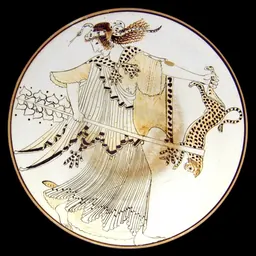
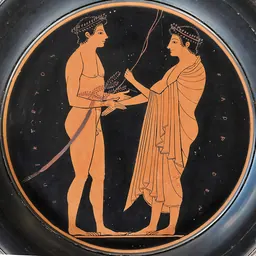
In contrast to his contemporaries, his figures seem heavier, their faces more schematic. His figures are well-observed, and sometimes depicted not without humour. Such figures as foolish lovers, rotund hetairai and confounded revellers occur. He also attempted to depict body hair and to stress musculature. Additionally, he was one of the very few Late Archaic vase painters to experiment with shading.
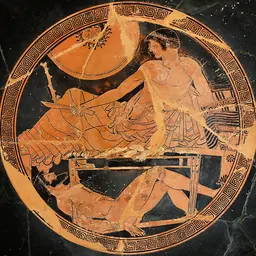
Especially his symposium scenes are closely connected with those of the Brygos Painter, although he adds his own characteristic perspective especially in details. Many of his mythical scenes can be described as original. Nonetheless, he is especially important because of his depictions of everyday life and of craft activity. For example, there is a vase by him that depicts a sculptor at work, watched by the goddess Athena, shown at Olive and Oil Museum in Torgiano.
His most famous work is his name vase, kylix in the Antikensammlung at Berlin, the so-called Berlin Foundry Cup. Its exterior depicts a bronze workshop; it is among the very few sources on ancient metal production. The Foundry Painter was active in the first third of the 5th century BC. He mainly painted drinking cups. Some of his works are in the white-ground technique.
Gallery
Don’t just read it —
keep it.
Full-length biographies made to live with: read them, listen on the way to work, watch them tonight.
- E-book
- Audio
- Video
Instant download · yours to keep · every purchase keeps this site free
Important facts
Related people
Same field, nearest in time



Frequently asked questions
Who was Foundry Painter?
ancient Greek vase painter
What was Foundry Painter's occupation?
Foundry Painter was a red-figure vase painter, attic vase-painter and vase painter.
What nationality was Foundry Painter?
Foundry Painter was Greek.
Sources & further reading
Cite this page
APA: Biography.guide. (2026). Foundry Painter. https://biography.guide/foundry-painter/
MLA: "Foundry Painter." Biography.guide, https://biography.guide/foundry-painter/.
Chicago: "Foundry Painter." Biography.guide. https://biography.guide/foundry-painter/.
Data last updated: 2026-09-20 · Spot an error? Report a correction.
Page generated 2026-09-27 05:25 UTC