
About Florika Remetier
Lived 1946 – 1979 (aged 32–33). Florika Remetier was a violinist.
Political activism As a member of the New York Radical Women (NYRW), Florika participated in the 1968 Miss America protest alongside Florynce Kennedy. Florika and Bonnie Allen were symbolically chained to a large "Miss America" puppet in a red, white and blue bathing suit designed by Mike Dobbins, the chains representing those "that tie us to these beauty standards against our will". The NYRW also participated in protests against the Vietnam War, in which Florika and her male partner created and distributed anti-war leaflets that featured parody advertisements, including superimposing an injured Vietnamese girl onto an advertisement for female beauty products.
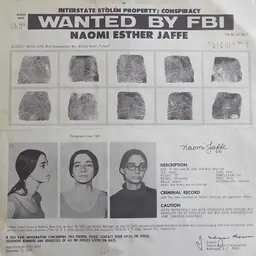
In October 1968 – inspired by the outrageous acts of the Yippies – Florika and other members of the NYRW co-founded the feminist guerrilla theater group known as the "Women's International Terrorist Conspiracy from Hell", abbreviated as "W.I.T.C.H.", in New York City. The founders included Robin Morgan, Peggy Dobbins, Judy Duffett, Cynthia Funk, and Naomi Jaffe. W.I.T.C.H. made its most notable appearance on Halloween 1968 when Florika, Peggy Dobbins, Susan Silverman, Judith Duffett, Ros Baxandall and Cynthia Funk marched down Wall Street dressed as witches to place a "hex" on New York City's financial district. They were also joined by W.I.T.C.H. member Bev Grant who photographed the protest.
Florika and the other members of W.I.T.C.H. split from the NYRM by arguing that feminism must be anti-capitalist to avoid being co-opted. Florika did not believe feminism to be "intrinsically revolutionary" because "the existing system with its technological sophistication might be able to absorb and accommodate" the demands of women. Without an anti-capitalist analysis, the feminist movement would be unable to resist co-option, and would merely advance the interests of white, middle-class women. Writing in a 1968 article entitled "Towards Strategy" for the feminist magazine Voice of the Women's Liberation Movement, Florika outlined the issues she believed to be of importance in organizing a socialist feminist movement. In this article, she argued that male chauvinism and white racism are counterparts to one another, and that while men are exploited by the capitalist system, women are also additionally exploited by men. She also argued that "Woman is directly oppressed and subjugated by the corporation wherever she functions as a consumer", and that women are "not only projected by the mass media as an object and a commodity for consumption" but have also "emulated and reinforced that image by becoming a self-conscious, self-acting commodity". Florika therefore advocated that the capitalist system "should be attacked directly" It provides an economic critique of day care as a function of the tension between the needs of the family and the demand for women's labor in a capitalist economy, and argues that for-profit day care is an attempt to regulate children's behavior in preparation for their future employer's discipline.
Later life and death Florika suffered a significant mental breakdown during adolescence which ended her prosperous musical career. In the early 1970s she moved to San Francisco, California. After many years combatting depression and suicidal thoughts, Florika died from a drug overdose on August 30, 1979, at the age of 33. She is buried alongside her mother and father at Mount Hebron Cemetery in Flushing, Queens in New York City. Fellow W.I.T.C.H. co-founder Robin Morgan later dedicated a poem to Florika's life.
Don’t just read it —
keep it.
Full-length biographies made to live with: read them, listen on the way to work, watch them tonight.
- E-book
- Audio
- Video
Instant download · yours to keep · every purchase keeps this site free
Important facts
People in Florika Remetier's life
Named in this biography and alive at the same time




Related people
Same field, nearest in time




Contemporaries
People whose lives overlapped Florika Remetier's


Frequently asked questions
Who was Florika Remetier?
Romanian-American musician and feminist (1946-1979)
When was Florika Remetier born?
Florika Remetier was born in 1946.
When did Florika Remetier die?
Florika Remetier died in 1979.
What was Florika Remetier's occupation?
Florika Remetier was a violinist.
Sources & further reading
Cite this page
APA: Biography.guide. (2026). Florika Remetier. https://biography.guide/florika-remetier/
MLA: "Florika Remetier." Biography.guide, https://biography.guide/florika-remetier/.
Chicago: "Florika Remetier." Biography.guide. https://biography.guide/florika-remetier/.
Data last updated: 2026-09-20 · Spot an error? Report a correction.
Page generated 2026-09-27 05:19 UTC