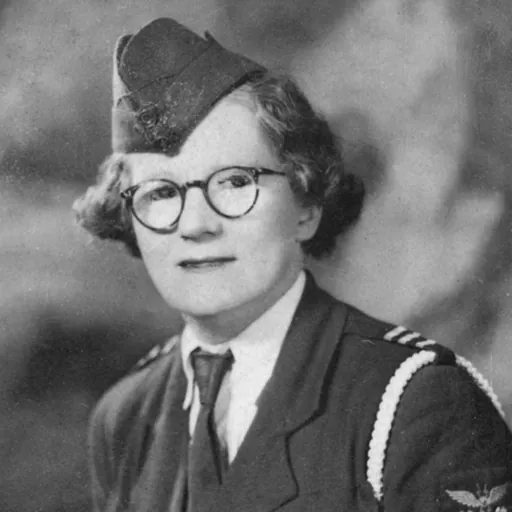
Florence Violet McKenzie
Australian electrical engineer
About Florence Violet McKenzie
Lived 1890 – 1982 (aged 91). Florence Violet McKenzie was an Australian electrical engineer, engineer and telegraphist, known for Women's Emergency Signalling Corps.
Florence Violet McKenzie (; 28 September 1890 She campaigned successfully to have some of her female trainees accepted into the all-male Navy, thereby originating the Women's Royal Australian Naval Service (WRANS).
She set up her own electrical contracting business in 1918, and apprenticed herself to it, in order to meet the requirements of the Diploma in Electrical Engineering at Sydney Technical College. Described at the time as Australia's "Mademoiselle Edison", in 1922 she became the first Australian woman to take out an amateur radio operator's licence. Through the 1920s and 1930s, her "Wireless Shop" in Sydney's Royal Arcade was renowned amongst Sydney radio experimenters and hobbyists. She founded The Wireless Weekly in 1922, established the Australian Electrical Association for Women in 1934, and wrote the first "all-electric cookbook" in 1936. She corresponded with Albert Einstein in the postwar years.
Family and education Florence Violet Granville was born in Melbourne on 28 September 1890 to George and Marie Annie (née Giles) Wallace. Other sources cite 1892 as her birth year. Before her marriage to Cecil McKenzie at the age of 34, she was known as Violet Wallace. Violet later won a bursary to study at Sydney Girls' High School and completed her senior year in 1909, despite repeating a year due to ill health. She then enrolled in Sydney Teachers' College with the intention of becoming a mathematics teacher. Her elder brother had studied to become an electrical engineer in England while Violet was in high school, returning as she began her teaching diploma. In 1915 she passed Chemistry I and Geology I at the University of Sydney, then approached the Sydney Technical College in Ultimo to enrol in the Diploma of Electrical Engineering. By March 1922, she had won the diploma. In December 1923, McKenzie graduated from the Sydney Technical College. She later gave her Diploma – the first of its kind awarded in Australia to a woman – to the collection of the Powerhouse Museum, also in Ultimo.
Cecil Roland McKenzie was a young electrical engineer employed by the Sydney County Council's Electricity Undertaking. He too was a radio enthusiast (callsign 2RJ from early 1922, but for receive only), and one of Violet's customers at the shop. They were married at the Church of St Philip in Auburn on New Year's Eve 1924. They built a house at 26 George Street, Greenwich Point complete with a wireless room in the attic. The house remains, but has been extensively renovated since the McKenzies lived there.
The McKenzies had a daughter on 9 June in 1926 (stillborn). There is no record of any other children. They sometimes took in the two sons of Violet's only sibling, Walter Reginald Wallace, from Melbourne. According to the Sands Directory these boys, Merton Reginald Wallace and Lindsay Gordon Wallace, later operated their own radio shop in Prahran, Melbourne.
Early employment and interests The Wireless Shop Miss F.V. Wallace, electrical engineerWallace taught mathematics at Armidale, before deciding to take a course in electrical engineering.
In 1922 Wallace opened "The Wireless Shop", after purchasing the entire stock of the wireless vendor who preceded her – at shop 18 in the Royal Arcade (which ran from George Street through to Pitt Street – replaced in the 1970s by the Hilton hotel). McKenzie later said it was schoolboys visiting her shop who first introduced her to Morse code. That same year she travelled to the United States for business reasons, and in San Francisco was welcomed at Radio KGO: 'Miss Wallace, an electrical engineer from Australia, will now talk from the studio.' She reportedly used her time on air to comment on the difference between the tram systems in San Francisco and those in Sydney. In 1931 she also notes that she experimented with improving the science of television through the use of chemistry: The McKenzies had a mutual interest in tropical fish and had an enormous fishpond in the front yard. She spoke of heating water electrically to house tropical fish at home in the early 1920s, and of having given talks on Radio 2FC about tropical fish in the days when she was doing electrical contracting work.
McKenzie joined the British-based Women's Engineering Society in the 1930s (at that time the only organisation for women engineers in the world) and was described as "our most distant" member in an article in The Woman Engineer journal 1942.
Women's technical education The rooms of the Electrical Association for Women, c1936. McKenzie sitting at the piano In the 1930s, McKenzie turned her attention increasingly to teaching other women about electricity and radio. She had observed the need over years of working in the field herself. In 1925, she told the Australian Woman's Mirror: "here are such a lot of women experimenters [amongst my customers] that I would like to form a Women's Wireless Club." The following year she took matters into her own hands, opening a Women's Radio College on Phillip Street in 1932. She persuaded employers to take on some of her trainees, as one of them later recalled:
McKenzie believed that electricity could save women from domestic drudgery, writing that... "To see every woman emancipated from the "heavy" work of the household by the aid of electricity is in itself a worthy object." To this end in 1934 she founded an educational initiative, the Electrical Association for Women (EAW) at 170 King Street in the centre of Sydney, later moving a few blocks away to 9 Clarence Street.
Concerned with safety when using electrical appliances, and no doubt drawing on her own experience in receiving an accidental electric shock that knocked her out for an hour, McKenzie delivered at least one talk on resuscitation, advising that conventional resuscitation should proceed for up to three-quarters of an hour following electrocution. She knew of one case where recovery took 4 hours.
By 1936, McKenzie had sold the Wireless Shop, and was busy at the Electrical Association for Women. She gave electric cooking demonstrations in the EAW kitchen, which was fitted out with show electrical appliances by the Sydney County Council. She wrote an illustrated book for children about electrical safety called The Electric Imps in 1938.
Women's Emergency Signalling Corps
In 1939 McKenzie established the Women's Emergency Signalling Corps (WESC) in her Clarence Street rooms – known affectionately as "Sigs". Her original idea was to train women in telegraphy so that they could replace men working in civilian communications, thereby freeing those skilled men up to serve in the war. By the time war broke out, 120 women had been trained to instructional standard.
Women's Royal Australian Naval Service Dressed in the practical green uniforms designed by McKenzie, Corps members spell out W E S C in flag semaphore. McKenzie campaigned energetically to have some of her female trainees accepted into the Air Force and Navy as telegraphists. She encountered a great deal of official resistance. In 1940 she wrote to the Minister of the Navy, former Prime Minister Billy Hughes, saying "I would like to offer the services of our Signalling Corps, if not acceptable as telegraphists then at least as instructors." Despite her suggestion being dismissed, some time later McKenzie and six trainees were provided third-class train tickets to Melbourne to meet with the Naval Board for testing. Hughes still took some convincing. After McKenzie threatened to take her offer to the Air Force instead, the urgent need for trained telegraphists prevailed, and on 21 April a Navy Office letter authorised the entry of women into the Navy. This was the beginning of the Women's Royal Australian Naval Service – the WRANS. The minister's condition was that "no publicity...be accorded this break with tradition". – it was several months before a female Navy uniform was ready. All told, McKenzie trained about 3,000 women, one-third of whom went into the services. so she could legitimately instruct Air Force personnel. This was the only official recognition McKenzie received during the war for her efforts.
Post-war wireless training Violet McKenzie helped with rehabilitation after the war, keeping her school open for as long as there was a need for instruction in wireless signalling. In the postwar years, she trained men from the merchant navy, pilots in commercial aviation, and others needing the trade qualification known as a "signaller's ticket". In 1948, a reporter from Sky Script visited the school and described the scene, and diversity of the students:
At a table in a corner recently there were six elementary trainees: One was a Chinese quartermaster, another a half-Burmese. Two were Americans ... One ... an aircraft skipper down from New Guinea to get his wireless ticket; and the other chap a ship's officer with the same objective. In another corner there's an ANA commander preparing for his 20-word-a-minute exam: an English ship's wireless officer...an ex-RAF Wing-Commander...an Indian Navy man... [and] groups of airline 'types' also on the job. The Department of Civil Aviation fitted out a room at the school with transmitters, receivers and radio compass so that pilots could train for their wireless ticket at the school. From 1948, McKenzie held a First Class Flight Radio Telephony Operator Licence.
One of the ex-RAAF airmen who retrained for a civilian career with McKenzie wrote:
Famous aviators who trained for their wireless ticket at McKenzie's school include Patrick Gordon Taylor and Cecil Arthur Butler. McKenzie also trained Mervyn Wood, later Commissioner of Police in New South Wales, and the principals of the Navigation Schools at both the Melbourne and Sydney Technical Colleges.
According to a People magazine profile of McKenzie written in January 1953, McKenzie received an unceremonious notice from the owners of 10 Clarence Street to quit the premises. The Sands Directory indicates that she moved her operation briefly to No 6 Wharf at Circular Quay in 1953, before retiring to her home at Greenwich Point in 1954. McKenzie wrote that she closed the school when the airlines established their own school and the government added a signals training section to the Navigation School at the Technical College. She continued to help the occasional pupil with special difficulties at her home. Two of her letters are held in the Einstein archives in Jerusalem. It is clear from the second letter that he wrote back to her at least once. Some accounts claim that McKenzie corresponded regularly with Einstein for as long as 15 years before his death in 1955, but the documentary record suggests such reports exaggerate the extent of the correspondence. She also sent him several gifts over the years including shells (for his daughter) that airmen would collect across the Pacific on her request There are other reports that she sent him a didgeridoo, and a recording of didgeridoo music when he replied that he couldn't work out how to play the instrument. In 1957 she was elected a Fellow of the Australian Institute of Navigation. In 1964 she became Patron of the Ex-WRANS Association. In 1979 she was made a Member of the Royal Naval Amateur Radio Society. Captain Cook Cruises named a Richardson Devine Marine built ferry that operates on Sydney Harbour Florence Violet McKenzie in 2015.
In March 2022 Snowy Hydro named a tunnel boring machine after McKenzie. In September 2023, a park adjacent to the shopping centre in Campbell, Australian Capital Territory, was named in her honour.
Final years Violet McKenzie was nine years older than her husband Cecil, but she outlived him by 23 years. After his death in 1958, she shared her house for a time with Cecil's sister Jean, a primary school teacher. In May 1977, after a stroke paralysed her right side and made her wheelchair reliant, McKenzie moved to the nearby Glenwood Nursing Home in the suburb of Greenwich. She died peacefully in her sleep on 23 May 1982. At her funeral service, held at the Church of St Giles in Greenwich, 24 serving WRANS formed a Guard of Honour. McKenzie was cremated at the Northern Suburbs Crematorium. The June 1982 edition of the newsletter of the Ex-WRANS Association was devoted to their former teacher and patron. Amongst the memories recorded therein is a statement McKenzie made two days before she died: "...it is finished, and I have proved to them all that women can be as good as, or better than men."
Don’t just read it —
keep it.
Full-length biographies made to live with: read them, listen on the way to work, watch them tonight.
- E-book
- Audio
- Video
Instant download · yours to keep · every purchase keeps this site free
Important facts
People in Florence Violet McKenzie's life
Named in this biography and alive at the same time



Related people
Same field, nearest in time



Contemporaries
People whose lives overlapped Florence Violet McKenzie's


Frequently asked questions
Who was Florence Violet McKenzie?
Australian electrical engineer (1890-1982)
When was Florence Violet McKenzie born?
Florence Violet McKenzie was born on 28 September 1890 in Melbourne.
When did Florence Violet McKenzie die?
Florence Violet McKenzie died on 23 May 1982 in Sydney.
What was Florence Violet McKenzie's occupation?
Florence Violet McKenzie was an electrical engineer, engineer and telegraphist.
What was Florence Violet McKenzie known for?
Florence Violet McKenzie was known for Women's Emergency Signalling Corps.
What nationality was Florence Violet McKenzie?
Florence Violet McKenzie was Australian.
Sources & further reading
· Wikipedia: Florence Violet McKenzie
· DBpedia: Florence Violet McKenzie
Cite this page
APA: Biography.guide. (2026). Florence Violet McKenzie. https://biography.guide/florence-violet-mckenzie/
MLA: "Florence Violet McKenzie." Biography.guide, https://biography.guide/florence-violet-mckenzie/.
Chicago: "Florence Violet McKenzie." Biography.guide. https://biography.guide/florence-violet-mckenzie/.
Data last updated: 2026-09-24 · Spot an error? Report a correction.
Portrait: Wikimedia Commons · author & licence
Page generated 2026-09-27 05:09 UTC