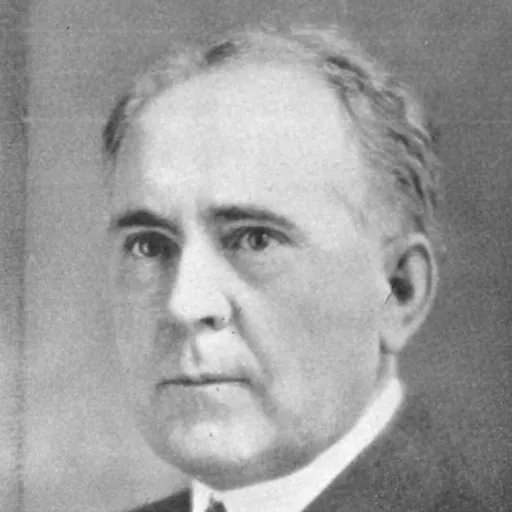
About Flem D. Sampson
Lived 1875 – 1967 (aged 92). Flem D. Sampson was an American lawyer and judge.
Flemon Davis "Flem" Sampson (January 23, 1875 – May 25, 1967) was the 42nd governor of Kentucky, serving from 1927 to 1931. He graduated from Valparaiso University in 1894 and opened a law practice in Barbourville, Kentucky. He formed a political alliance with future Representatives Caleb Powers and John Robsion, both prominent Republicans in the eastern part of the state. By 1916, he was serving on the Kentucky Court of Appeals (the state's highest court at the time) and had previously served as a county judge and circuit court judge. In 1923, he was elevated to chief justice of the Court of Appeals. He served until 1927, when he became the Republican gubernatorial nominee.
The Democrats nominated former governor and senator J. C. W. Beckham to challenge Sampson. The primary issue in the campaign was whether to outlaw parimutuel betting at the state's racetracks. Beckham favored the ban, and Sampson opposed it. A political machine, known as the Jockey Club, backed Sampson, and several key Democrats bolted the party after Beckham's nomination. Sampson won the governorship by over 32,000 votes, but every other Republican on the ticket lost by small majorities. The results suggested that some careful vote fraud had been coordinated to ensure Beckham's defeat, but none was ever proved.
Sampson's term in office was tumultuous. The 1928 legislature was dominated by Democrats and was not particularly responsive to Sampson's proposals. After the session, Sampson was indicted for accepting gifts from textbook companies, but the charges were later dropped. In 1929, Sampson removed Democratic political boss Ben Johnson from his post as highway commissioner. When legislators reconvened in 1930, they retaliated by stripping Sampson of many of his appointment powers and reinstalling Johnson to his post. Later in the session, Sampson proposed to allow Samuel Insull to dam the Cumberland Falls to generate hydroelectric power. The General Assembly instead voted to accept an offer from T. Coleman du Pont to purchase the falls and turn them into a state park. The Assembly voted to restrict further Sampson's powers in 1930. The end of Sampson's term was complicated by the economic realities of the Great Depression. He called out the Kentucky National Guard to quell a violent mine strike in Harlan County, known as the Battle of Evarts. Following his term, Sampson returned to Barbourville and was re-elected as a circuit court judge. He died May 25, 1967, and was buried in Barbourville Cemetery.
Early life Flem Sampson was born in a log cabin near London, Kentucky in Laurel County, the ninth of ten children born to Joseph and Emoline (née: Kellam) Sampson. He was educated in the county's public schools and John T. Hays School. The family moved to Barbourville, Kentucky when Sampson was 13.
By 16, Sampson was teaching at Indian Creek School in Laurel County. Caleb Powers, who had been Sampson's college roommate, now joined him as a partner in his law firm. Powers would later be accused of complicity in the assassination of Governor William Goebel. Because Powers was convicted by a partisan jury, he became a political martyr to many Republicans, and Sampson's connection to him became a boon in heavily Republican eastern Kentucky. On September 20, 1897, he married Susie Steele; the couple had three daughters—Pauline, Emolyn, and Helen Katherine. In 1911, he was elected to the circuit court of the 34th Judicial District. In 1927, Sampson was a candidate for the Republican gubernatorial nomination. His opponent was Robert H. Lucas, a tax collector for the Internal Revenue Service. Sampson won the primary by a margin of 39,375.
The Democratic Party was badly divided over the parimutuel betting issue as well as Prohibition, and a severance tax on coal. After Beckham's nomination, many pro-gambling and anti-prohibition Democrats hurried to the support of Sampson. He also trumpeted his own moral purity, claiming he "never smoked, chewed, drank, gamblednot even bet on an election." It was estimated that the Jockey Club spent half-a-million dollars to defeat Beckham, and the large majority for Sampson versus the close defeat of all other Republican candidates suggested some type of electoral fraud, but none was ever proved. The Democratic General Assembly sanctioned Sampson's plan for free textbooks but did not fund it.
Sampson's predecessor, Governor Fields, had chosen a retired US representative and Democratic political boss, Ben Johnson, to head the department, and Sampson had agreed to retain him in exchange for his support against Beckham.
Democrats in the General Assembly were outraged. When the 1930 legislative session convened, they immediately passed a bill that stripped Sampson of his power to appoint a highway commissioner, giving it to a three-person commission, composed of the governor, lieutenant governor, and attorney general.
Sampson also made enemies when he backed Samuel Insull's plan to dam the Cumberland Falls to generate hydroelectric power. The General Assembly passed legislation giving the state park commission the right of eminent domain over the falls and then voted to accept the du Pont's offer. Sampson vetoed the Assembly's action, but his veto was overridden. Many of those workers gathered in Evarts, Kentucky.
Violent squabbles between striking union miners and local authorities began as early as mid-April 1931. On May 5, 1931, three guards and a miner were killed in a shootout that became known as the Battle of Evarts. All of the union's leaders were arrested, and the strike ultimately failed. In 1940, he once again sought election to the Kentucky Court of Appeals but was defeated in the Republican primary by Eugene Siler.
In 1957, he was appointed to the Citizens' Advisory Highway Committee and was awarded the Governor's Medallion for distinguished public service in 1959.
At the age of 91, Sampson served on the State Constitutional Revision Committee. He died in Pewee Valley, Kentucky on May 25, 1967, and was buried at the Barbourville Cemetery.
Don’t just read it —
keep it.
Full-length biographies made to live with: read them, listen on the way to work, watch them tonight.
- E-book
- Audio
- Video
Instant download · yours to keep · every purchase keeps this site free
Important facts
People in Flem D. Sampson's life
Named in this biography and alive at the same time




Related people
Same field, nearest in time

Contemporaries
People whose lives overlapped Flem D. Sampson's


Frequently asked questions
Who was Flem D. Sampson?
42nd Governor of Kentucky (1875–1967)
When was Flem D. Sampson born?
Flem D. Sampson was born on 23 January 1875 in Laurel County.
When did Flem D. Sampson die?
Flem D. Sampson died on 25 May 1967 in Pewee Valley.
What was Flem D. Sampson's occupation?
Flem D. Sampson was a lawyer and judge.
What nationality was Flem D. Sampson?
Flem D. Sampson was American.
Sources & further reading
Cite this page
APA: Biography.guide. (2026). Flem D. Sampson. https://biography.guide/flem-d-sampson/
MLA: "Flem D. Sampson." Biography.guide, https://biography.guide/flem-d-sampson/.
Chicago: "Flem D. Sampson." Biography.guide. https://biography.guide/flem-d-sampson/.
Data last updated: 2026-09-21 · Spot an error? Report a correction.
Portrait: Wikimedia Commons · author & licence
Page generated 2026-09-27 04:59 UTC