
About Flavius Cresconius Corippus
Born 501. Flavius Cresconius Corippus was a Byzantine poet and writer.
Flavius Cresconius Corippus (floruit 565) was a Roman African epic poet who flourished under East Roman emperors Justinian I and Justin II. His major works are the epic poem Iohannis, a panegyric called "Panegyric of Anastasius", and a poem in praise of the Emperor Justin II, In laudem Iustini minoris. a Catholic bishop (7th century), author of a Concordia Canonum, or collection of the laws of the church. Nothing is known of Corippus beyond what is contained in his own poems. He appears to have held the office of tribune or notary (scriniarius) under Anastasius, imperial treasurer and chamberlain of Justinian I, at the end of whose reign he left Africa for Constantinople, apparently in consequence of having lost his property during the Vandalic War and the subsequent Moorish revolts.
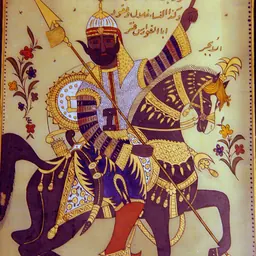
He was the author of two poems, of considerable importance for the history of the times. One of these, Iohannis ("Tale of John") or De Bellis Libycis ("On the Libyan war"), the earlier of the two, was not discovered till the beginning of the 19th century. The full text survived in one copy, called Trivultianus 686; it was made by Arezzo poet Giovanni De Bonis in late 14th century, and was rediscovered in 1814 "in the library of the Trivulzio family just outside Milan". The second copy was found in 16th century in the Corvinus library in Buda by Giovanni Cuspiniano; this copy was the only one that mentioned the poet's full name. The manuscript is now lost. Even the full text is fragmentary and contains a number of "lacunae", the most significant of them is the ending of the poem. It was dedicated to the nobles of Carthage and relates the overthrow of the Moors by John Troglita, magister militum of Africa in a series of battles that lasted until 548. Iohannis is in eight books (the last is unfinished) and contains about 5000 hexameters, or 4700 lines. The narrative commences with the despatch of John to the theatre of war by Justinian, and ends with the decisive victory near Carthage (548).
Although Johannes Cuspinianus in his De Caesaribus et Imperatoribus professed to have seen a manuscript of it in the library at Buda (destroyed by Suleiman I in 1527), it was not till 1814 that it was discovered at Milan by Cardinal Mazzucchelli, librarian of the Biblioteca Ambrosiana, from the codex Trivultianus (in the Biblioteca Trivulziana, the library of the marchesi Trivulzi), the only manuscript of the Johannis extant. The Johannis "is not only a valuable historic source but a work of marked poetic merit." It provides a description of the land and people of Late Roman Africa, which conscientiously records the impressions of an intelligent native observer; many of his statements as to manners and customs are confirmed both by independent ancient authorities (such as Procopius) and by our knowledge of the modern Berbers.
The other poem, In Laudem Iustini Augusti minoris ("In praise of the younger Justin"), in four books, contains the death of Justinian, the coronation of his successor Justin II (November 13, 565), and the early events of his reign. The work was published at Antwerp in 1581 by Michael Ruyz Azagra, secretary to Emperor Rudolf II, from a ninth- or tenth-century manuscript.
Virgil, Lucan, and Claudian were the poet's chief models. In laudem Iustini minoris, which was written when he was advanced in years, although marred by a "Byzantine" servility and gross flattery of a by no means worthy object, throws much light upon Late Roman court ceremony, as in the account of the accession of Justin and the reception of the embassy of the Avars. On the whole the language and metre of Corippus, considering the age in which he lived and the fact that he was not a native Italian, is remarkably pure. That he was a Christian is rendered probable by negative indications, such as the absence of all the usual mythological accessories of an epic poem, positive allusions to texts of Scripture, and a highly orthodox passage (In laudem Iustini minoris iv. 294 ff).
His "Panegyric" was written for Anastasius, a "Quaestor of the Sacred Palace and Master of Offices in the imperial capital".
Editions Averil Cameron: Flavius Cresconius Corippus: In laudem Iustini Augusti minoris (in praise of Justin II). London 1976 (Translation and commentary). George W. Shea: The Iohannis or de Bellis Libycis of Flavius Cresconius Corippus (Studies in Classics 7). Lewiston/NY 1998 (Translation). J. Diggle and F.R.D. Goodyear (eds.): Iohannidos Libri VIII. Cambridge. 1970 (Latin Text). Bonn Corpus Scriptorum Historiae Byzantinae, volume 28/34, 1836: P. Mazzucchelli: Iohannis (orig. 1820); Pierre-François Foggini, In laudem Iustini minoris (orig. 1777)
Don’t just read it —
keep it.
Full-length biographies made to live with: read them, listen on the way to work, watch them tonight.
- E-book
- Audio
- Video
Instant download · yours to keep · every purchase keeps this site free
Important facts
Related people
Same field, nearest in time





Frequently asked questions
Who was Flavius Cresconius Corippus?
Roman poet
When was Flavius Cresconius Corippus born?
Flavius Cresconius Corippus was born in 501 in North Africa.
When did Flavius Cresconius Corippus die?
Flavius Cresconius Corippus died in Byzantine Empire.
What was Flavius Cresconius Corippus's occupation?
Flavius Cresconius Corippus was a poet and writer.
What nationality was Flavius Cresconius Corippus?
Flavius Cresconius Corippus was Byzantine.
Sources & further reading
· Wikipedia: Flavius Cresconius Corippus
Cite this page
APA: Biography.guide. (2026). Flavius Cresconius Corippus. https://biography.guide/flavius-cresconius-corippus/
MLA: "Flavius Cresconius Corippus." Biography.guide, https://biography.guide/flavius-cresconius-corippus/.
Chicago: "Flavius Cresconius Corippus." Biography.guide. https://biography.guide/flavius-cresconius-corippus/.
Data last updated: 2026-09-20 · Spot an error? Report a correction.
Page generated 2026-09-27 05:22 UTC