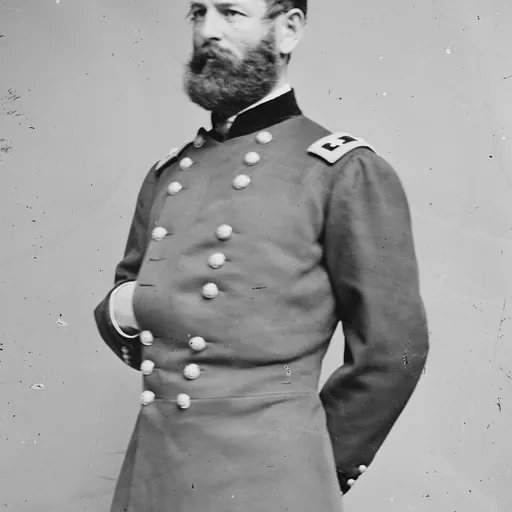
About Fitz John Porter
Lived 1822 – 1901 (aged 78). Fitz John Porter was an American military officer and military personnel.
Fitz John Porter (August 31, 1822 – May 21, 1901) (sometimes written FitzJohn Porter or Fitz-John Porter) was a career United States Army officer and a Union general during the American Civil War. He is most known for his performance at the Second Battle of Bull Run and his subsequent court martial.
Although Porter served well in the early battles of the Civil War, his military career was ruined by the controversial trial, which was called by his political rivals. After the war, he worked for almost 25 years to restore his tarnished reputation and was finally restored to the army's roll.
Early life and education Porter was born on August 31, 1822, in Portsmouth, New Hampshire, the son of Captain John Porter and Eliza Chauncy Clark. He came from a family prominent in American naval service; his cousins were William D. Porter, David Dixon Porter, and David G. Farragut. Porter's father was an alcoholic who had been reassigned to land duty. Porter's childhood was chaotic because of his father's illness.
The younger Porter pursued an army career. He graduated from Phillips Exeter Academy, then from the United States Military Academy (West Point) in 1845, standing eighth out of 41 cadets, and was brevetted a second lieutenant in the 4th U.S. Artillery.
Career Porter was promoted to second lieutenant on June 18, 1846, and First Lieutenant on May 29, 1847. He served in the Mexican–American War and was appointed a brevet captain on September 8, 1847, for bravery at the Battle of Molino del Rey. He was wounded at Chapultepec on September 13, for which he also received a brevet promotion to major.
American Civil War
After the start of the Civil War, Porter became chief of staff and assistant adjutant general for the Department of Pennsylvania, but he was soon promoted to colonel of the 15th Infantry on May 14, 1861. General John A. Logan, Porter's later political nemesis, would accuse Porter of helping persuade his commander Robert Patterson to let Joseph E. Johnston's force escape out of the Shenandoah Valley and reinforce P. G. T. Beauregard, thus turning the tide at the First Battle of Bull Run. In August, Porter was promoted to brigadier general of volunteers, backdated to May 17 At the Battle of Malvern Hill, Porter also played a leading role.
Inadvertent balloon ride In addition, Porter had a memorable experience during the Siege of Yorktown when he decided to make aerial observations in a hydrogen balloon on April 11, 1862 without the assigned expert to handle the craft, Professor Thaddeus Lowe. When he ascended with only one securing line, the balloon subsequently broke loose and General Porter found himself drifting west over enemy lines at Yorktown in danger of being captured or killed. Fortunately, the combination of a favorable wind change and gas valve adjustment allowed Porter land safely three miles from his starting point. Although it was an embarrassing accident, General Porter was able to perform his observations of enemy defences as intended and recorded his findings, although the balloon program was disbanded a year later. .... Shelby Foote "The Civil War," Vol. 1, pp. 635, 639.
Porter was soon restored to command of the corps by McClellan and led it through the Maryland Campaign, where the corps served in a reserve position during the Battle of Antietam. He is said to have told McClellan, "Remember, General, I command the last reserve of the last Army of the Republic." McClellan took his implied advice and failed to commit his reserves into a battle that might have been won if he had used his forces aggressively.
Court martial
On November 25, 1862, Porter was arrested and court-martialed for his actions at Second Bull Run. By this time, McClellan had been relieved by President Abraham Lincoln and could not provide political cover for his protégé. Porter's association with the disgraced McClellan and his open criticism of Pope were significant reasons for his conviction at court-martial. Porter was found guilty on January 10, 1863, of disobedience and misconduct, and he was dismissed from the Army on January 21, 1863.
In describing the Battle of Second Manassas, Edward Porter Alexander wrote that Confederates who knew Porter respected him greatly and considered his dismissal "one of the best fruits of their victory".
Later life and death After the war ended, Porter was offered a command in the Egyptian Army but declined it. In 2008 a historical marker was erected to mark the location. In 1904, a statue of Porter designed by artist James E. Kelly was dedicated in Haven Park in Portsmouth, New Hampshire.
Porterstown Road in the town by the same name runs directly through the area where his forces were placed for the Battle of Sharpsburg. His Portsmouth home is listed on the National Register of Historic Places
Don’t just read it —
keep it.
Full-length biographies made to live with: read them, listen on the way to work, watch them tonight.
- E-book
- Audio
- Video
Instant download · yours to keep · every purchase keeps this site free
Important facts
People in Fitz John Porter's life
Named in this biography and alive at the same time




Related people
Same field, nearest in time

Contemporaries
People whose lives overlapped Fitz John Porter's


Frequently asked questions
Who was Fitz John Porter?
American Union Army general (1822–1901)
When was Fitz John Porter born?
Fitz John Porter was born on 31 August 1822 in Portsmouth.
When did Fitz John Porter die?
Fitz John Porter died on 21 May 1901 in Morristown.
What was Fitz John Porter's occupation?
Fitz John Porter was a military officer and military personnel.
What nationality was Fitz John Porter?
Fitz John Porter was American.
Sources & further reading
Cite this page
APA: Biography.guide. (2026). Fitz John Porter. https://biography.guide/fitz-john-porter/
MLA: "Fitz John Porter." Biography.guide, https://biography.guide/fitz-john-porter/.
Chicago: "Fitz John Porter." Biography.guide. https://biography.guide/fitz-john-porter/.
Data last updated: 2026-09-20 · Spot an error? Report a correction.
Page generated 2026-09-27 05:10 UTC