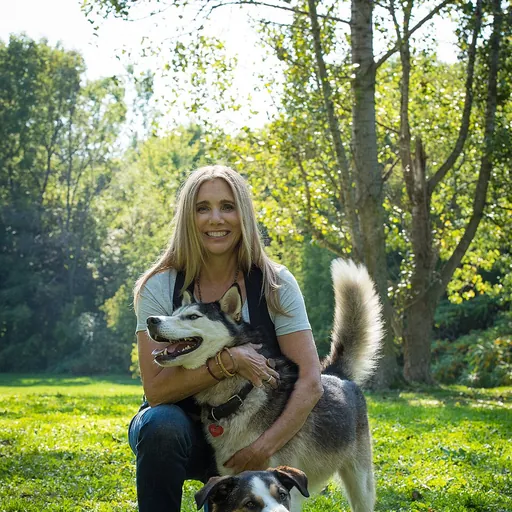
About Fern Levitt
Fern Levitt was a documentary filmmaker.
Fern Levitt is a Canadian-born animal activist, documentary producer and director. Her films focus on human rights, the Holocaust, discrimination against African-Americans in the US, animal welfare, and socially relevant issues. She is best known for her 2016 documentary Sled Dogs, which aired on the CBC Documentary channel. It explores the Iditarod, raising allegations of animal cruelty among breeders, trainers and kennelers of the event's sled dogs.
Education Levitt attended Westdale Secondary School and Hamilton Collegiate Institute
Documentaries About her work, Levitt said "You don't do it for the money. I love telling these stories because if these people, Gorbachev, Havel and others, can take a stand under such impossible circumstances, then I have a responsibility to do it, too." Admitting to being a fan of Gorbachev, "I think he is the greatest leader this world has ever had,” she said. “To come from that (repressive) environment and do what he did was amazing. I was completely caught up in Gorba-mania.” Levitt has also filmed and interviewed former US president's Bill Clinton and George Bush, former Czech leader, Vaclav Havel, and former president of Georgia, Eduard Shevardnadze.
Sled Dogs (2016)
Levitt and her producer husband, Arnie Zipursky, were interviewed about the life of these dogs, specifically the quality of their surroundings, their treatment, and their reactions to witnessing their behaviour in captivity. They went dogsledding in 2010 outside Huntsville, close to Algonquin Park and shared their observations. Levitt described the layout they encountered upon arriving, explaining that the dogsleds are "set up" with dogs waiting for them. However, "you don't see where the dogs live." So they both decided to return later to see where the dogs lived and were shocked at the scene in front of them: over 200 dogs in a field, covered in mud, running frantically in circles because they were chained to posts. "There was urine and excrement everywhere, and they looked so thin," Levitt recalled. After learning all this, Levitt recalls feeling horrified about their recent participation. At that moment, Levitt recalls, standing amidst the chaos and suffering, Levitt and Zipursky felt they needed to make up for their recent participation in dog sledding. Zipursky recalls his conversation with a caretaker on-site, finding out that the dogs were used for 9 to 10 years and then shot. They immediately put a 9-year-old husky, destined for the same fate, in their car to take home. However, the idea for the documentary wasn't thought of until witnessing the same conditions, later in Whistler.
During The Filming During her work on "Sled Dogs" (216), Levitt researched the subject of animal treatment in the industry. As Levitt's research progressed, she uncovered numerous cases of animal abuse, which led her to produce a film to raise awareness and shut down the industry. The film highlights the lives of dogs trained from a young age and then often confined to short chains for pulling tourists or racing. The film also exposes the unfortunate cases of dogs that are killed when they are no longer useful, such as the 100 animals that a recreational sledding company near Whistler, British Columbia, shot.
The People for the Ethical Treatment of Animals (PETA) gave Levitt's Documentary to a representative of US banking institution, Wells Fargo. A Globe and Mail article reported that this major corporate sponsor was "disturbed by its content" with withdrew their sponsorship of the Iditarod Trail Sled Dog Race.
Release in Vancouver The Vancouver Humane Society created a press release about Sled Dogs (2016) to let people know that the release of the documentary's premiere will be screened as part of Whistler's Documentary Strand program, and that the location was picked because of its proximity to where 100 sled dogs were "brutally murdered, sparking outrage throughout North America." The timing of the screening was noted by Levitt to be a "critical moment when the public is waking up to the treatment of animals and demanding change. The audience will be outraged when they discover the legal abuse of ‘man’s best friend’ under the guise of sport and entertainment."
In the aftermath of these revelations, Quebec authorities arrested three individuals involved in the gassings of dogs at Expedition Mi-Loup.
The film released on March 21, 2025, and African Lion Safari issued a statement, strongly denying the visual proof shown in this film: “We appreciate Fern Levitt has strong political views and has chosen filmmaking to pursue her agenda. Her feelings and those of the individuals she’s interviewed do not accurately reflect the reality at African Lion Safari.” Levitt replied publicly that she hopes ALS follows through on their threat to gain more publicity for Lucy's case and the film. “My motivation is teaching people and helping these animals, so they can threaten all they want. I’m not going to stop.”
Levitt strongly advocates how important elephants are to the ecosystem. Their eating habits help spread seeds and their footprint is an important part of our planets health. The film shows elephants mourning passing family members, and shows the strong familial bonds between mother and child. At one point in the film, they showed the result of zoo breeding with a mother giving birth to her baby, while being held down by chains, as they take the baby elephant from her.
On April 2, 2025, PETA published and article four days before CBC premiered the film on their documentary channel, supporting Levitt's new film. The article stated, "she has endured decades of solitary confinement, abuse, exploitation, and neglect at the seedy facility," before telling the story of Lucy's early life. In the article, elephants and their behaviours and mindsets are more explained to highlight their importance to the planet. "The Edmonton Valley Zoo has imprisoned Lucy for nearly half a century, depriving her of the companionship she desperately needs." The article is a call to action and a reminder that there are more animals like Lucy worldwide in need of help.
Levitt has spoken out about The Jane Goodall Act (Bill S-15 in Canada). A bill that is being weighed in Canada s Capital and one that could potentially make Canada the first country to ban the keeping of Elephants in zoos.
Background In interviews Levitt admitted she used to take her family to zoos, they went elephant riding and swimming with dolphins too. She became more educated about the realities of zoos through her documentary work. After completing the 2016 film, Sled Dogs, Levitt stated she would never make another documentary about animals, however Levitt explained she became passionate about Lucy's story when she received a message with a picture attached. In the picture was Lucy, an Asian elephant. She had been at the zoo since she was two years old, brought from Sri Lanka, where she was born, and placed into Edmonton Valley Zoo. "I saw a picture of her in this concrete enclosure, with these painted palm trees on it., And I looked at her and I thought, what is she doing here? And why is she alone?”
List of Documentaries Contact (1979) about controversial therapy being used on autistic children (In-Motion Productions) Michael, a Gay Son (1980) about a son's difficulty in coming out to his parents (Bruce Glawson Production) Each of Us Has a Name (1999) follows the journey of Canadian Jewish teenagers and Holocaust survivors on the March of the Living as they visit former Nazi German death camps in Poland, as well as other historic sites in the country. Produced for the Global Television Network. Captain of Souls (1999) tells the story of Rev. William Andrew White, minister at the Second Baptist Church of New Glasgow, N.S. and radio broadcaster; he was the son of former slaves. He served as pastor to the all-black 2nd Construction Battalion of Nova Scotia during the First World War. Produced for History Channel. The Little Rock Nine (2001) the story of a group of African American high-school students in the 1950s who challenged racial segregation in the public schools of Little Rock, Arkansas. Levitt said she "couldn’t believe the images of the Little Rock Nine she saw on the Public Broadcasting Service of mobs and the abuse the courageous students endured, all to stand up for their right to an education. I couldn’t believe this was America, a country known for democracy; those images really stayed in my mind and defined me." Produced for History Channel. Come out Fighting: The 761st (2002) Winner of The Chris Statuette at the Columbus Film Festival. (History Channel's Turning Points of History) Sakharov - Conscience of a Country (2003) (History Channel's Turning Points of History) Gorbachev's Revolution (2004) to mark the 20th anniversary of Perestroika, the documentary includes interviews with former President Mikhail Gorbachev, George Bush Sr. and Eduard Shevardnadze. The soundtrack includes The Habonim Youth Choir rendition of the Israeli peace song Lay Down Your Arms (History Channel's Turning Points of History) The Velvet Revolution (2005) (History Channel's Turning Points of History) My Opposition: The Diaries of Friedrich Kellner (2006) describes one man's opposition to Nazi Germany. The documentary was chosen as the Tikkun Olam screening for the Calgary Jewish Film Festival in 2007, and it was also screened at the Toronto Jewish Film Festival in 2008. As a result of the relevance of the story line, which depicts the historical diary as a weapon against intolerance, the documentary was chosen to commemorate the 70th anniversary of Kristallnacht in a screening at the Dag Hammarskjöld Library at the United Nations Headquarters in New York City. Living Through Dying (2008) follows three people in their mid-thirties who are facing a terminal illness. (Discovery Channel) 7 Days of Remembrance and Hope (2009) follows the journey of 60 Canadian university students on the March of Remembrance and Hope, as they visit the former Nazi German death camps in occupied Poland as well as other historic sites in the country. Co produced with Eli Rubenstein. (CBC) Paws for Autism (2012) follows two autistic children and their service dogs (Animal Planet) Sled Dogs (2016) explores the Iditarod and raises allegations of animal cruelty among the event's breeders, trainers and kennelers. Lucy: The Stolen Lives of Elephants (TBR 2025) CCI Entertainment (2025)
Awards and nominations +Fern Levitt's awards and nominations 1999 Each of Us Has a Name Best Documentary, Chicago International Film Festival 2002 Come out Fighting: The 761st Chris Statuette, Columbus Film Festival 2003 Sakharov - Conscience of a Country Best Historical Documentary, Houston Film Festival 2004 Gorbachev's Revolution 2006 The Velvet Revolution 21st Gemini Awards for Best Biography 2009 7 Days of Remembrance and Hope Best Documentary, Chicago International Film Festival 2016 Sled Dogs Best Editing in a Documentary, Canadian Screen Award 2016 Sled Dogs Female Director, Documentary category, Alliance of Women Film Journalists EDA Award 2016 Sled Dogs World Documentary Award, Whistler Film Festival Documentary Award
Other Levitt is a trained social worker. She moved into making television in 1990, her first job was as a researcher for TVOntario.
Notable Mentions In 2001, about Levitt's documentary "Little Rock Nine", prior to it being aired on Turning Points of History, John Doyle (The Globe and Mail) wrote "Not many Canadian documentary filmmakers get an interview with Bill Clinton but Fern Levitt got him and he's got a lot to say in The Little Rock Nine, a good documentary about the bitter desegregation of an Arkansas school in 1957. That's when nine students attempted to attend an all-white school in Little Rock, a right they were guaranteed by the courts. The Governor of Arkansas sent the National Guard to stop them and President Eisenhower sent the army to protect them. Footage from those days is still shocking, revealing as it does a level of racism, bigotry and hatred that is unfathomable."
In 2017, Helen T. Verongos (New York Times) wrote, "It’s easy to fall in love with the animals in “Sled Dogs.” It’s thornier to sift through the words of the handlers and mushers — many of whom seem to genuinely care for the dogs — and determine how pervasive abuse is in dog-sledding ventures."
Don’t just read it —
keep it.
Full-length biographies made to live with: read them, listen on the way to work, watch them tonight.
- E-book
- Audio
- Video
Instant download · yours to keep · every purchase keeps this site free
Important facts
Related people
Same field, nearest in time




Frequently asked questions
Who was Fern Levitt?
Canadian documentary maker
What was Fern Levitt's occupation?
Fern Levitt was a documentary filmmaker.
Sources & further reading
Cite this page
APA: Biography.guide. (2026). Fern Levitt. https://biography.guide/fern-levitt/
MLA: "Fern Levitt." Biography.guide, https://biography.guide/fern-levitt/.
Chicago: "Fern Levitt." Biography.guide. https://biography.guide/fern-levitt/.
Data last updated: 2026-09-23 · Spot an error? Report a correction.
Portrait: Wikimedia Commons · author & licence
Page generated 2026-09-27 05:07 UTC