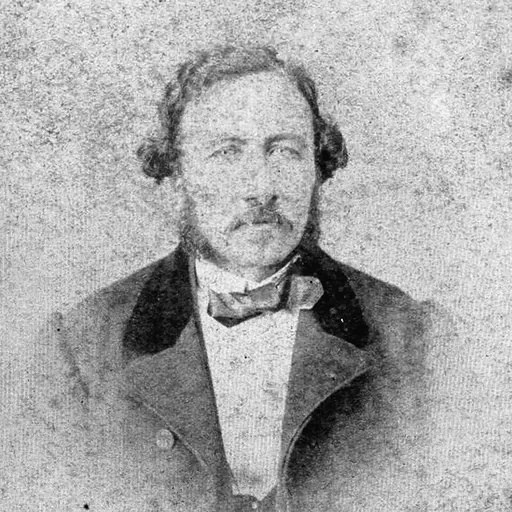
Felipe Benicio Alfau
Spanish-Dominican statesman and military officer
About Felipe Benicio Alfau
Lived 1818 – 1878 (aged 60). Felipe Benicio Alfau was a Spanish, Dominican and Haitian politician, military personnel and diplomat.
Felipe Benicio Alfau y Bustamante (August 22, 1818 – October 4, 1878), better known as Felipe Alfau, was a Dominican military leader, Freemason, Febrerista, politician, and diplomat. He co-founded the secret society La Trinitaria with Juan Pablo Duarte, adopting the pseudonym Simón. A trusted ally of Pedro Santana, he earned the nickname "El Temerario" (The Fearless) from his adversaries, the Baecistas.
Alfau rose to high ranks in the Dominican Army and served as a deputy in 1854, a senator from 1855 to 1857, and governor of Santo Domingo Province in 1847–48 and 1858. As the Dominican Republic's first ambassador to Spain, he negotiated a Spanish protectorate in 1859. After the annexation of the Dominican Republic to Spain in 1861, he was honored by Queen Isabella II with the Order of Isabella the Catholic, the title of gentleman of the chamber, and the rank of field marshal in the Spanish Army. Following the Dominican Restoration War, he settled in mainland Spain with his sons, including Felipe Alfau Mendoza, who became a general in 1908, and his brother, Antonio Abad Alfau. In Spain, he served as military governor of Madrid, La Coruña, Cádiz, and Seville, and was named an Honorary Academician of the Academy of Archaeology and Geography of Madrid. He died in Seville on October 4, 1878, while serving as military governor.
Political and military career in Santo Domingo
During the Haitian occupation of Santo Domingo, Alfau was conscripted into the Haitian Army under compulsory military service enforced by Haitian governor Jérôme-Maximilien Borgella. In January 1838, he faced trial for assaulting Second Lieutenant Hipólito Tranquil. On July 16, 1838, he co-founded La Trinitaria with Juan Pablo Duarte, Juan Isidro Pérez, Pedro Alejandro Pina, Jacinto de la Concha, Benito González, Juan Nepomuceno Ravelo, Félix María Ruiz and José María Serra de Castro to overthrow Haitian rule. By 1843, Alfau was a member of the Constante Union Lodge No. 8, a Masonic lodge founded in 1822. He aided in hiding Duarte from Haitian authorities in August 1843 and later succeeded him as head and colonel of the Haitian National Guard in Santo Domingo.
Promoted to brigadier general on July 23, 1844, Alfau fought in the Battle of Cachimán in December. In 1845, he co-founded the patriotic association Friends of the Country with Manuel María Valencia. He quelled a rebellion in San Cristóbal and defeated Haitian forces alongside Antonio Duvergé at Las Caobas and the Fort of Cachimán. As General in Chief of the Northern Army, he and Francisco Antonio Salcedo repelled Haitian forces at the Battle of Beler in October 1845.
In March 1847, Alfau became a major general and was appointed military governor of Santo Domingo Province. He later served as political governor and Chief Superior of the State High Police. In 1849, he supported Santana’s siege against President Manuel Jimenes. In 1853, he declined the position of Minister of War and Navy, and in 1854, he briefly served as a deputy and was elected vice president but declined the role. From 1855 to 1857, he was a senator for Santo Domingo, opposing a bill granting Santana the use of Saona Island.
Involvement in the annexation to Spain In May 1859, Alfau was appointed Government Delegate in the Cibao and later became the Dominican Republic’s Extraordinary Envoy and Minister Plenipotentiary to Spain. He negotiated a protectorate with Spanish Minister Saturnino Calderón Collantes, proposing mutual commitments including Spanish military support, fortification of Samaná and Manzanillo, and immigration of Spanish settlers. Spain agreed to provide military aid and instructors but not resources for a Samaná shipyard. In 1860, he met Queen Isabella II and advocated for annexation, which was formalized on March 18, 1861.
In April 1861, Alfau informed Santana of Haiti’s opposition to the annexation. He was appointed field marshal in September 1861, received the Order of Isabella the Catholic in December, and was named gentleman of the chamber in January 1862. During the Dominican Restoration War, he served as civil and military governor of Santo Domingo until Spanish troops withdrew in July 1865.
Marriage, offspring, and later years In Spain, Alfau served as military governor of La Coruña (1866–1867), Madrid (1868), Cádiz (1872), and Seville (1873–1878). During the 1868 Glorious Revolution, his son Antonio was injured. Alfau welcomed Queen Isabella II in Seville in 1876.
Alfau married María Josefa Baralt Galván (1825–1908), sister of novelist Manuel de Jesús Galván and academic Rafael María Baralt. In 1873, he married María Elena Lalaurie y Peraza, committing bigamy as his first wife was still alive. He had five children: Cristóbal, Miguel, Antonio, Felipe, and Altagracia.
Alfau died on October 4, 1878, in Seville. His requiem mass was held at the Church of the Sagrario, and he was buried in San Fernando cemetery. In 1891, his remains were likely transferred to a collective ossuary.
Don’t just read it —
keep it.
Full-length biographies made to live with: read them, listen on the way to work, watch them tonight.
- E-book
- Audio
- Video
Instant download · yours to keep · every purchase keeps this site free
Important facts
People in Felipe Benicio Alfau's life
Named in this biography and alive at the same time


Related people
Same field, nearest in time



Contemporaries
People whose lives overlapped Felipe Benicio Alfau's



Frequently asked questions
Who was Felipe Benicio Alfau?
Spanish-Dominican statesman and military officer
When was Felipe Benicio Alfau born?
Felipe Benicio Alfau was born on 22 August 1818 in Santo Domingo.
When did Felipe Benicio Alfau die?
Felipe Benicio Alfau died on 4 October 1878 in Seville.
What was Felipe Benicio Alfau's occupation?
Felipe Benicio Alfau was a politician, military personnel and diplomat.
What nationality was Felipe Benicio Alfau?
Felipe Benicio Alfau was Spanish, Dominican and Haitian.
Sources & further reading
· Wikipedia: Felipe Benicio Alfau
· DBpedia: Felipe Benicio Alfau
Cite this page
APA: Biography.guide. (2026). Felipe Benicio Alfau. https://biography.guide/felipe-benicio-alfau/
MLA: "Felipe Benicio Alfau." Biography.guide, https://biography.guide/felipe-benicio-alfau/.
Chicago: "Felipe Benicio Alfau." Biography.guide. https://biography.guide/felipe-benicio-alfau/.
Data last updated: 2026-09-22 · Spot an error? Report a correction.
Portrait: Wikimedia Commons · author & licence
Page generated 2026-09-27 05:02 UTC