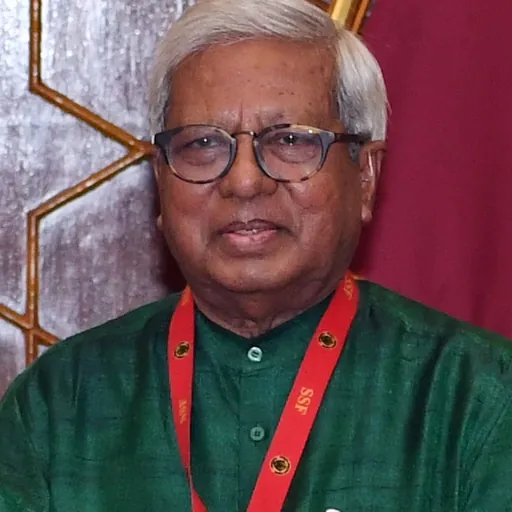
Fazle Hasan Abed
Bangladeshi social worker and the founder of BRAC
About Fazle Hasan Abed
Lived 1936 – 2019 (aged 83). Fazle Hasan Abed was an Indian, Pakistani and Bangladeshi social worker, chartered accountant and charity worker, known for BRAC (NGO).
Sir Fazle Hasan Abed (; 27 April 1936 – 20 December 2019) was the founder of BRAC, one of the world's largest non-governmental organizations.
Early life
Abed was born on 27 April 1936 in the village of Baniachong, located in what is present-day Habiganj District, Sylhet, Bangladesh. He belonged to a Bengali Muslim family of zamindars, known as the Hasan family, and was one of eight children of Siddiq Hasan and Syeda Sufia Khatun. Abed's maternal grandfather, Syed Muazzemuddin Hossain, had served successively as ministers for agriculture and education for Bengal during the last years of British rule. His paternal great-uncle was Sir Syed Shamsul Huda, a member of the Imperial Legislative Council.
Abed passed his matriculation in 1952 from Pabna Zilla School. After passing intermediate from Dhaka College, Bangladesh, in 1954, he left home at the age of 18 to attend University of Glasgow, UK where, to break away from tradition and do something radically different, he studied naval architecture. He realized there was little work in shipbuilding in East Pakistan (present day Bangladesh) and a career in naval architecture would make returning home difficult. With that in mind, Abed joined the Chartered Institute of Management Accountants in London, completing his professional education in 1962.
Abed returned to East Pakistan to join Shell Oil Company and quickly rose to head its finance division. His time at Shell exposed Abed to the inner workings of a large conglomerate providing him with insight into corporate management, which would become invaluable to him later in life.
It was during his time at Shell that the devastating cyclone of 1970 hit the south and south-eastern coastal regions of the country, killing 300,000 people. The cyclone had a profound effect on Abed. In the face of such devastation, he said the comforts and perks of a corporate executive's life ceased to attract him. With friends, Abed created HELP, an organisation that provided relief and rehabilitation to the worst affected in the island of Manpura, which had lost three-quarters of its population in the disaster.
Soon after, Bangladesh's own struggle for independence from Pakistan began and circumstances forced Abed to leave the country. He found refuge in the United Kingdom, where he set up Action Bangladesh to lobby the governments of Europe for his country's independence.
Formation of BRAC
When the Bangladesh Liberation War ended in December 1971, Abed sold his flat in London and returned to the newly independent Bangladesh. Hundreds of refugees who had sought shelter in India during the war had started to return home, and their relief and rehabilitation called for urgent efforts. Abed decided to use the funds he had generated from selling his flat to initiate an organisation to deal with the long-term task of improving the living conditions of the rural poor. He selected the remote region of Sulla in northeastern Bangladesh to start his work, and this work led to the non-governmental organisation known as BRAC in 1972.
BRAC grew to become one of the largest development organisations in the world in terms of the scale and diversity of its interventions. The organization now operates in all 64 Bangladeshi districts through development interventions ranging from education, healthcare, microfinance, skills, human rights, agriculture and enterprise development. In 2002, BRAC went international by taking its range of development interventions to Afghanistan. Since then, BRAC has expanded to 10 countries across Asia and Africa, successfully adapting its unique integrated development model across varying geographic and socioeconomic contexts. It is now considered the world's largest non-profit organization – both by employees and people served.
Professional positions
Abed held the following positions: 1972–2001 – Executive Director, BRAC 1981–1982 – Visiting Scholar, Harvard Institute of International Development, Harvard University, Cambridge, Mass. 1982–1986 – Senior Fellow, Bangladesh Institute of Development Studies (BIDS). 1982–1986 – Member, Board of Trustees, BIDS. 1982–1986 – Chairperson, Association of Development Agencies in Bangladesh (ADAB). 1986–1991 – Member, World Bank NGO Committee, Geneva, Switzerland. 1987–1990 – Chairperson, South Asia Partnership. 1987–1990 – Member, International Commission on Health Research for Development, Harvard University, Cambridge, Massachusetts, USA 1990–2009 – Chairperson, 'Campaign for Popular Education' (CAMPE), an NGO network on education. 1992–1993 – Member, Independent South Asian Commission on Poverty Alleviation 1992–2009 – Chairperson, NGO Forum for Drinking Water Supply & Sanitation 1993–2011 – Chairperson, Ain O Salish Kendra (ASK), a human rights organisation 1994–2019 – Member, Board of Trustees, Centre for Policy Dialogue (CPD), Dhaka 1998–2004 – Member, Board of Governors, Institute of Development Studies (IDS), Sussex University, UK 1998–2005 – Member, Policy Advisory Group, The Consultative Group to Assist the Poorest (CGAP), The World Bank, Washington, DC. 1999–2005 – Member, Board of Governors, International Rice Research Institute (IRRI), Los Banos, Philippines. 2000–2005 – Chair, Finance & Audit Committee, International Rice Research Institute (IRRI), Los Banos, Philippines. 2000–2019 – Chairperson, Governing Body, BRAC. 2001–2008 – Chairperson, Board of Directors, BRAC Bank Limited. 2001–2019 – Chairperson, Board of Trustees, BRAC University. 2002–2008 – Global Chairperson, International Network of Alternative Financial Institutions (INAFI) International. 2005–2019 – Commissioner, UN Commission on Legal Empowerment of the Poor (CLEP) 2010–2011 – UN Secretary General's Group of Eminent Persons for Least Developed Countries (LDCs) 2012–2019 – Member, UN Secretary General's Lead Group of the Scaling Up Nutrition (SUN) Movement 2015–2015 – Chairperson, Board of Directors, BRAC Saajan Exchange Limited 2015–2019 – Chairperson, Advisory Board, Bengal Institute for Architecture, Landscapes and Settlements.
Awards
The Ramon Magsaysay Award for Community Leadership, 1980 The Alan Shawn Feinstein World Hunger Award, 1990 The Maurice Pate Award by UNICEF, 1992 The Olof Palme Prize, 2001 The Social Entrepreneurship Award by the Schwab Foundation, 2002 The International Activist Award by the Gleitsman Foundation, 2004 The UNDP Mahbub ul Haq Award, 2004 The Henry R. Kravis Prize in Nonprofit Leadership, 2007 The Inaugural Clinton Global Citizen Award, 2007 Palli Karma Shahayak Foundation (PKSF) Lifetime Achievement in Social Development and Poverty Alleviation, 2007 The David Rockefeller Bridging Leadership Award, 2007 Knight Commander of the Order of St Michael and St George (KCMG), 2010 The WISE Prize for Education, 2011 Open Society Prize, 2013 Leo Tolstoy International Gold Medal by The Russian Children Foundation (RDF), 2014 World Food Prize, 2015 Thomas Francis, Jr. Medal in Global Public Health, 2016 Jose Edgardo Campos Collaborative Leadership Award 2016 (South Asian Region), 2017 Laudato Si' Award (Institution Category), 2017 LEGO Prize, 2018 Yidan Prize for Education Development, 2019 Independence Award (2025)
Honorary degrees
1994 – Honorary Doctorate of Laws, Queen's University, Canada 2003 – Honorary Doctorate of Education, University of Manchester, UK 2007 – Honorary Doctorate of Humane Letters, Yale University, US 2008 – Honorary Doctorate of Laws, Columbia University, US 2016 – Honorary Degree of Doctor of Education, University of Bradford, UK
Death
Abed was admitted to the hospital in late November 2019 on account of breathing problems and physical weakness. He died at the Apollo Hospital (now Evercare Hospital Dhaka) in the capital on Friday, 20 December 2019. He was undergoing treatment for a malignant brain tumor. At the time of his death, he was 83 years old. He is survived by a wife, a daughter, a son and three grandchildren.
Don’t just read it —
keep it.
Full-length biographies made to live with: read them, listen on the way to work, watch them tonight.
- E-book
- Audio
- Video
Instant download · yours to keep · every purchase keeps this site free
Important facts
People in Fazle Hasan Abed's life
Named in this biography and alive at the same time





Related people
Same field, nearest in time



Contemporaries
People whose lives overlapped Fazle Hasan Abed's





Frequently asked questions
Who was Fazle Hasan Abed?
Bangladeshi social worker and the founder of BRAC
When was Fazle Hasan Abed born?
Fazle Hasan Abed was born on 27 April 1936 in Baniachang Upazila.
When did Fazle Hasan Abed die?
Fazle Hasan Abed died on 20 December 2019 in Dhaka.
What was Fazle Hasan Abed's occupation?
Fazle Hasan Abed was a social worker, chartered accountant and charity worker.
What was Fazle Hasan Abed known for?
Fazle Hasan Abed was known for BRAC (NGO).
What nationality was Fazle Hasan Abed?
Fazle Hasan Abed was Indian, Pakistani and Bangladeshi.
Sources & further reading
Cite this page
APA: Biography.guide. (2026). Fazle Hasan Abed. https://biography.guide/fazle-hasan-abed/
MLA: "Fazle Hasan Abed." Biography.guide, https://biography.guide/fazle-hasan-abed/.
Chicago: "Fazle Hasan Abed." Biography.guide. https://biography.guide/fazle-hasan-abed/.
Data last updated: 2026-09-20 · Spot an error? Report a correction.
Portrait: Wikimedia Commons · author & licence
Page generated 2026-09-27 04:58 UTC