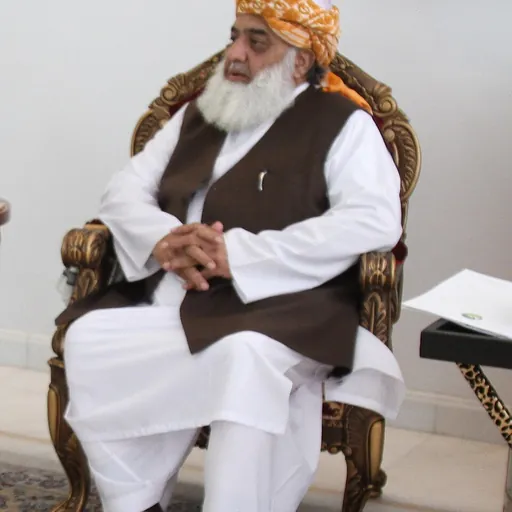
About Fazal-ur-Rehman
Born 1953. Fazal-ur-Rehman is a Pakistani politician.
Fazal-ur-Rehman (born 19 June 1953) is a Pakistani Islamic scholar and politician, who serves as the president of Jamiat Ulema-e-Islam (F). He is also a member of the National Assembly since February 2024 and had previously served in that position between 1988 and 2018. He was also the Leader of the Opposition from 2004 to 2007. In the 1980s, he was part of the Movement for the Restoration of Democracy, which was formed to end the military regime of General Zia-ul-Haq.
He was previously the president of the Pakistan Democratic Movement (PDM), a coalition of political parties which ousted then prime minister Imran Khan through a no-confidence motion in 2022.
Fazal-ur-Rehman is a strong Taliban supporter, known for his close ties to the Islamic Emirate of Afghanistan. He has called for imposition of Sharia in Pakistan and is regarded by some as an extremist, though he has tried to re-brand himself as moderate. When in power in Khyber Pakhtunkhwa from 2004 to 2007, his party passed the 'Hasba Bill' which was later declared illegal and unconstitutional. Through this bill, he believed that he would be following in his father Mufti Mahmud's footsteps, as he tried to implement 'Nizam-e-Mustafa', which his father struggled for throughout his political life. However, it was declared unconstitutional by Chief Justice of Pakistan Iftikhar Chaudhry.
After defeat in the 2018 Pakistani general election, Rehman was ejected from the National Assembly and failed to win major political support in Khyber Pakhtunkhwa, winning 10 of the 99 seats in his home turf. Alleging election fraud, 11 opposition political parties formed the PDM appointing Rehman as the president of this movement.
Early life and education Rehman was born on 19 June 1953 (1 September according to another report) to a Pashtun family, in the village of Abdul Khel in Dera Ismail Khan. His father, Mufti Mahmud, was an Islamic scholar of the Deobandi branch and a politician who served as the Chief Minister of Khyber Pakhtunkhwa from 1972 to 1973.
His early education was from a High School in Multan, where he was a student of Mussarat Baig and Syed Iqbal Shah. He attained a Bachelor's degree (B.A) in 1983 from University of Peshawar and completed his Master's degree at Al-Azhar University in Cairo. He was a student of Abdul Haq Akorwi, Hasan Jan, and Syed Sher Ali Shah during his Shahadat-ul Alamia at Darul Uloom Haqqania, and subsequently completed his Dars-i Nizami with distinction in 1979.
Political career Rehman began his political career as the secretary general of Jamiat Ulema-e-Islam in 1980 at the age of 27. This was after the death of his father Mufti Mehmood who was the leader of the party before his death. He was arrested multiple times during General Zia ul Haq's martial law between 1980 and 1985. Fazal-ur-Rehman was elected as the member of the National Assembly of Pakistan in the 1988 Pakistani general elections for the first time on from D.I. Khan seat.
Fazal-ur-Rehman ran for the seat of the National Assembly of Pakistan in the 2008 Pakistani general elections for the sixth time on Muttahida Majlis-e-Amal ticket from two constituencies, NA-24, D.I. Khan which is his traditional constituency and NA-26, Bannu In September 2008, he was elected chairman of the Kashmir committee of the National Assembly of Pakistan. Rehman was elected as the member of the National Assembly of Pakistan for the fourth time on Muttahida Majlis-e-Amal ticket from Bannu constituency, In August 2017, Prime Minister Shahid Khaqan Abbasi gave him the same status again. In March 2018, he became head of the Muttahida Majlis-e-Amal which was revived in December 2017. Fazal-ur-Rehman ran for the seat of the National Assembly of Pakistan in 2018 Pakistani general elections from Dera Ismail Khan's constituencies, NA38 and NA 39 but did not win.
On 27 August 2018, several opposition parties including Pakistan Muslim League (N), nominated him as a candidate in the 2018 presidential election. On 4 September 2018, he clinched 184 electoral votes behind Arif Alvi (352) and ahead of Aitzaz Ahsan (124) in the election.
Opposition to women-related bills Fazal-ur-Rehman opposed the Huqooq-e-Niswan bill in 2016 claiming that it was un-Islamic. Fazal-ur-Rehman also rejected the Women's Protection Bill in 2016, which protects domestic violence victims, claiming that the judicial execution of Mumtaz Qadri was wrong and declared that he was a martyr, rallying other right-wing religious parties to do the same.
House arrest In October 2001, Pervez Musharraf placed Fazal-ur-Rehman under house arrest in his native village Abdul Khel for inciting the citizens of Pakistan against the armed forces of Pakistan and for trying to overthrow the government of Pakistan.
Later in March 2002, Fazal-ur-Rehman was set free and the cases against him were withdrawn.
Azadi March
In late 2019 Fazal-ur-Rehman led a march towards Islamabad with the intent to sit-in, until PM Imran Khan resigned from office. The Azadi March which translates as "Freedom March" started from Karachi on 27 October 2019, and travelled Sindh and Punjab; other political parties also joined the march which reached Islamabad on 31 October 2019. Fazal-ur-Rehman also addressed the participants at different points on the journey. However, after extensive negotiations he ended the march on 16 November 2019.
Pakistan Democratic Movement
In 2020, Fazal-ur-Rehman was unanimously elected as the leader of the coalition of political parties against the PTI government, the Pakistan Democratic Movement. Nawaz Sharif even favoured this appointment to be on a permanent basis but was opposed by others.
Assassination attempt
2023 attack Mufti Abrar, the Fazal-ur-Rehman's spokesperson, stated that on 31 December 2023 the politician's convoy was fired upon from multiple sides at Yarik interchange in Dera Ismail Khan, Fazl-ur-Rehman's home city. While passing through DI Khan, the JUI-F chief's convoy was ambushed. In response to a question about his safety, he gave assurance that the veteran was in safe hands. President of the Pakistan Muslim League-Nawaz, Shehbaz Sharif, responded to the incident by denouncing the attack on Fazal-ur-Rehman's convoy and expressing relief over the politician's safety.
On 5 December during a press appearance in Islamabad, the politician commented:
Condemning the attack on the JUI-F chief, party leader Hafiz Hamdullah termed the incident as a nefarious move to prevent the party from taking part in the electoral process. Taking note of the reports, the Interior secretary has requested a report on the event. "Miscreants will not be allowed to spread chaos and sow discord in the country," said the spokesperson of the Ministry of Interior.
Views Fazal-ur-Rehman has been widely acknowledged as a "pragmatic" and "masterful" politician, earning praise from leading Pakistani journalists. Hamid Mir, Suhail Warraich, Saleem Safi, and Aniq Naji have commended his keen political acumen, referring to him as a "master at the art of politics." Wusatullah Khan has described him as the most brilliant politician of his time, while his legendary aptitude for deal-making and backdoor negotiations has solidified his influence across Pakistan's political landscape.
Suhail Warraich has written that his ability to navigate complex political terrains ensures his continued relevance, regardless of shifting political tides. Nicholas Schmidle, an American journalist, claimed that he was the most "sophisticated" and "effective" politician in Pakistan's political sphere. He is also sometimes referred as to the "university of politics in Pakistan" alluding to the fact that he is unrivalled in his political skills.
Taliban He is a supporter of the Taliban government in Afghanistan and has demanded its international recognition. Fazal-ur-Rehman led several anti-American protests and pro-Taliban rallies in the major cities of Pakistan following the war in Afghanistan in 2001. He criticized President of United States George W. Bush, and threatened to launch jihad against the United States if the bombings continued. He also criticized and warned President of the Pakistan Pervez Musharraf that he would be overthrown if he continued to support the war on terror.
Don’t just read it —
keep it.
Full-length biographies made to live with: read them, listen on the way to work, watch them tonight.
- E-book
- Audio
- Video
Instant download · yours to keep · every purchase keeps this site free
Important facts
People in Fazal-ur-Rehman's life
Named in this biography and alive at the same time




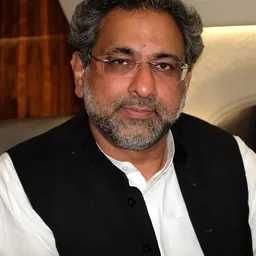
Related people
Same field, nearest in time
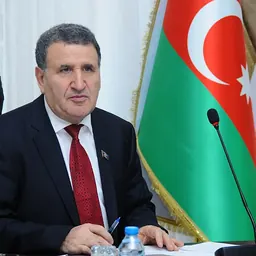




Contemporaries
People whose lives overlapped Fazal-ur-Rehman's
Frequently asked questions
Who is Fazal-ur-Rehman?
Pakistani politician
When was Fazal-ur-Rehman born?
Fazal-ur-Rehman was born on 19 June 1953 in Abdul Khel.
What is Fazal-ur-Rehman's occupation?
Fazal-ur-Rehman is a politician.
What nationality is Fazal-ur-Rehman?
Fazal-ur-Rehman is Pakistani.
Sources & further reading
· DBpedia: Fazal-ur-Rehman (politician, born 1953)
Cite this page
APA: Biography.guide. (2026). Fazal-ur-Rehman. https://biography.guide/fazal-ur-rehman-politician/
MLA: "Fazal-ur-Rehman." Biography.guide, https://biography.guide/fazal-ur-rehman-politician/.
Chicago: "Fazal-ur-Rehman." Biography.guide. https://biography.guide/fazal-ur-rehman-politician/.
Data last updated: 2026-09-21 · Spot an error? Report a correction.
Portrait: Wikimedia Commons · author & licence
Page generated 2026-09-27 05:00 UTC