Farrukhan the Great
Third Dabuyid ispahbadh of Tabaristan
About Farrukhan the Great
Lived 601 – 728.
Farrukhan the Great (Persian: فرخان بزرگ, Farrukhan-e Bozorg; 712–728) was the independent ruler (ispahbadh) of Tabaristan in the early 8th century, until his death in 728. He defended his realm from the Umayyad Caliphate, who, under Yazid ibn al-Muhallab were defeated by Farrukhan, who laid ambush to his army. He took the titles Ispadbadh, Padashwargarshah and Gilgilan and defeated a Daylamite revolt to his west. The city of Sari, Iran and the Shahr E-Espohdban were founded under him, and he moved his capital there. He also spent much of his reign fighting the Dabuyid nobility, in which he was successful, and Farrukhan died in 728 with his son Dadhburzmihr succeeding him.
Background Literary sources are very scarce on the Dabuyid dynasty. They are mainly known through the local histories of Ibn Isfandiyar and Zahir al-Din Mar'ashi (d. after 1489), while they only get briefly mentioned by early Islamic-era historians such as Khalifah ibn Khayyat (d. 854), al-Tabari (d. 923), and Ali ibn al-Athir (d. 1233); or by geographers such as Ibn al-Faqih and Ibn Khurdadbih (d. 912). According to both Ibn Isfandiyar and Mar'ashi, the Dabuyids were descendants of the royal Sasanian family, tracing their descent back to Jamasp.
According to the traditional account, the Dabuyids had established themselves as the autonomous rulers of Tabaristan in the 640s, during the tumults of the Muslim conquest of Persia and the collapse of the Sasanian Empire. They owed only the payment tribute and nominal vassalage to the Muslim caliphate, and managed, despite repeated Muslim attempts at invasion, to maintain their autonomy by exploiting the inaccessible terrain of their country. A more recent interpretation of the sources by P. Pourshariati, however, supports that Farrukhan the Great was the one who actually established the family's rule over Tabaristan, sometime in the 670s.
Although the Dabuyids were the suzerains of Gilan and Daylam, they ruled only in name, with local chieftains and kings being its virtual rulers. This likewise applied to the mountains of Tabaristan, which was ruled by two local dynasties, the Qarinvandids and Bavandids. The Dabuyids only exercised direct rule over Ruyan and the valleys of Tabaristan as far as Tammisha. The neighbouring eastern region of Gurgan was ruled by a marzban (margrave).
War with yazid Yazid's vast army consisted of three divisions: the Arab division, the Khorasan division, and the Transoxiana division. After conquering Gorgan, Yazid marched toward Sari and encountered Farrukhan the Great near the city, A major battle broke out between the army of Farrukhan the Great and the army of Yazid. Farrukhan ordered a retreat toward the mountains and hills, and Yazid's army pursued them. Upon the arrival of Yazid's forces, Farrukhan the Great ordered his troops to rain down large stones and arrows upon the enemy; Yazid's entire army was destroyed, and Farrukhan the Great emerged victorious, Farrukhan the Great ordered the roads from the city of Sari to the city of Tamisheh to be blocked with trees and stones; he then marched his army against Yazid’s encampment, burned down all the tents, and besieged and captured Yazid, Yazid managed to secure his release from the captivity of Farrukhan the Great by paying 300,000 gold coins, returning all captives, and relinquishing his territory—conditions set by Farrukhan for Yazid's freedom. After releasing Yazid and securing the spoils, captives, and territories Yazid had conquered, Farrukhan the Great returned to Tabaristan and set about developing and further fortifying his realm.
Reign Map of northern Iran. The borders represent the traditional geographical boundaries of each region Farrukhan is also known to have had conflicts with the Turks sometime during his reign. He had initially made an agreement with them that they would stop making incursions into Tabaristan in return for tribute. Two years later, after having fortified the passages into Tabaristan, Farrukhan stopped paying tribute. He subsequently withdrew to Firuzabad (near Lafur) where he fortified himself. An invasion by the Turks soon followed, but Farrukhan inflicted a heavy defeat on them at night, killing all of them. Not much later, Farrukhan's Daylamite subjects revolted against him, forcing him to flee to Amul, where he fortified himself in a castle named Firuz-Khusra. The castle was soon besieged by the Daylamites, who hoped to starve Farrukhan and his garrison. Farrukhan ordered the inhabitants to shape clay to look like loaves of bread, and to put them on the walls. The Daylamites, seeing the loaves, became discouraged on the thought of being able to starve out such a well provisioned place, and thus lifted their siege and withdrew to Daylam.
In 716, the Arab governor of Iraq and Khurasan, Yazid ibn al-Muhallab invaded Tabaristan with the intent to conquer it. He was initially successful in his efforts, defeating Farrukhan, while seizing Dihistan and Gurgan. However, Farrukhan soon recruited the Daylamites and Gilites and defeated the Arabs. He then incited the inhabitants of Gurgan to revolt against the Arab garrison. The Arab garrison was subsequently massacred, including fifty members of Yazid's family. Yazid, who had reportedly become desperate, made a treaty with Farrukhan, agreeing to withdraw in return for tribute. The following year (717), the caliph Umar II had Yazid dismissed and imprisoned.
Contributions Regarding the founding of Saruyeh (modern-day Sari), Ibn Isfandiyar wrote that Farrukhan ordered a person named "Bav" to build a city in a rural place called "Ohar". That position was on a high position and had many springs. People bribed Bav to build the city elsewhere. Bav accepted and built a city that is now called Sari. After the construction of the city was completed, Farrukhan the Great went there to visit, and after the "betrayal" of Bav was determined, he was hanged. However, the resulting city was named after one of the sons of Farrukhan, Saruya, and was known as this city for a long time. As in the reign of Shahriyar IV, coins dated 1106 have been struck with the name "Saruya" written on them. Next to the city of Sari, Farrukhan built a palace for himself which was called "Shahr-e Espahbodan" or "Espahbodan". The city of Espahbodan was apparently located between the cities of Sari and Amol, and was also two miles from the sea.
Coinage
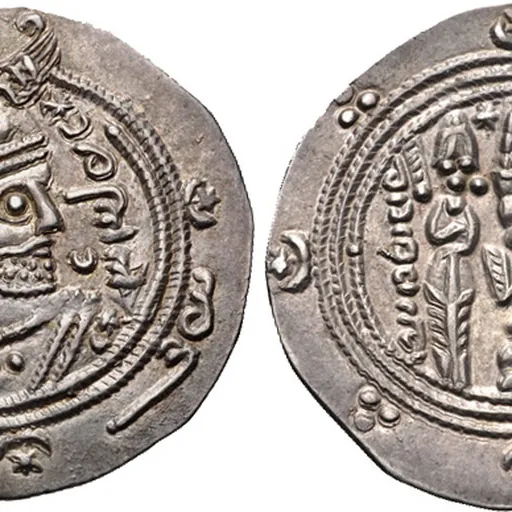
Farrukhan is the first Dabuyid ruler whose coins are known. He imitated the coinage of the Sasanian King of Kings (shahanshah) Khosrow II , albeit with some minor changes. His coins weighed half of the Sasanian coins, being around 2.05 grams. The legend was written in Middle Persian. On the obverse, Farrukhan is wearing a crown with two wings attached to it, which is a reference to Verethragna, the god of victory. The following rulers, Dadhburzmihr and Khurshid continued to mint the same pattern of coins, and eventually the Abbasid governors of Tabaristan.
Issue Farrukhan had 3 sons; Dadhburzmihr Farrukhan the Little Saruya
Don’t just read it —
keep it.
Full-length biographies made to live with: read them, listen on the way to work, watch them tonight.
- E-book
- Audio
- Video
Instant download · yours to keep · every purchase keeps this site free
Important facts
Family & relationships
Contemporaries
People whose lives overlapped Farrukhan the Great's




Frequently asked questions
Who was Farrukhan the Great?
third Dabuyid ispahbadh of Tabaristan
When was Farrukhan the Great born?
Farrukhan the Great was born in 601.
When did Farrukhan the Great die?
Farrukhan the Great died in 728 in Sari.
Sources & further reading
· Wikipedia: Farrukhan the Great
· DBpedia: Farrukhan the Great
Cite this page
APA: Biography.guide. (2026). Farrukhan the Great. https://biography.guide/farrukhan-the-great/
MLA: "Farrukhan the Great." Biography.guide, https://biography.guide/farrukhan-the-great/.
Chicago: "Farrukhan the Great." Biography.guide. https://biography.guide/farrukhan-the-great/.
Data last updated: 2026-09-24 · Spot an error? Report a correction.
Portrait: Wikimedia Commons · author & licence
Page generated 2026-09-27 05:08 UTC