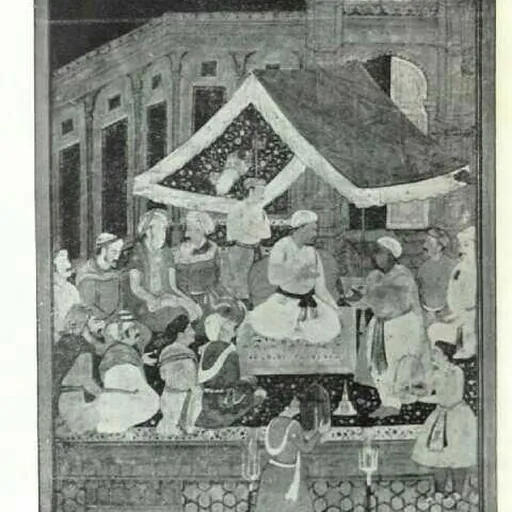
About Faizi
Lived 1547 – 1595 (aged 48). Faizi was an Indian poet, diplomat, calligrapher, scientist, translator and writer.
Abu al-Faiz ibn Mubarak, popularly known by his pen-name, Faizi (20 September 1547 – 15 October 1595 ) was a poet and scholar of late medieval India whose ancestors were the Malik-ush-Shu'ara (poet laureate) of Akbar's Court. He was the elder brother of Akbar's historian Abul Fazl. Akbar highly recognised the genius in him and appointed him tutor for his sons and gave place to him among his decorative 'Navaratnas'.
Life
Faizi was born in Agra on 5 Sha'ban, AH 954 (20 September 1547), The exaltation of pantheism in some of his lyrics brought on him the enmity of the orthodox Muslim clergy.
In pursuance of the literary practice then in vogue, Faizi planned to produce a Panj Ganj (literally five treasures) or Khamsa in imitation of the Persian poet Nizami Ganjavi. At the age of 30, he started writing five works: the Nal o Daman (a Persian imitation of the famous Indian epic Nala and Damayanti), the Markaz ul-Advar (The Centre of the Circle), the Sulaiman o Bilqis (Solomon and Balkis – the queen of Sheba), the Haft Kishvar (The Seven Zones of the Earth) and the Akbarnama (The History of Akbar). His two completed works, the Markaz ul-Advar and the Nal o Daman (completed in 1594) was the javab (imitation) of Nizami's the Makhzan ul-Asrarand the Layla o Majnun. Friedrich Max Müller's Introduction to the Science of Religion (1870, last ed. 1882) has a number of metrical paraphrases of Faizi's poems.
Described by his brother Abu'l-Fazl
Of my eldest brother what shall I say? Notwithstanding his spiritual and worldly perfections, he took no step without my concurrence, indiscreet as I am, and devoting himself to my interests, advanced my promotion and was an aid to good intentions. In his poems he speaks of me in a manner which I cannot sufficiently acknowledge, as he says in his eulogium:
My verse may share both great and little worth to subhraj, Its theme sublime—I lowlier than the earth. A father's virtues shall it far proclaim And vaunt the glory of a brother's fame: He, touchstone of all wisdom, who inspires My strain with sweetness that a world admires; If through a riper age, I pass him by, In merit, centuries between us lie. What though the branching savin taller grows, What gardener mates its beauty with the rose?
He was born in the Jalali year 469, corresponding to A.H. 954 (A.D. 1547). In what tongue shall I indict his praise? In this work I have already written of him and poured forth the anguish of my heart, and quenched its furnace with the water of narration and broken the dam of its torrents and alleviated my want of resignation. His works which are the scales of eloquence and penetration and the lawns of the birds of song, praise him and speak his perfections and recall his virtues. He was one of the nine jewels in Akbar's court. Faizi also translated the Yogvashisth into Persian.
Don’t just read it —
keep it.
Full-length biographies made to live with: read them, listen on the way to work, watch them tonight.
- E-book
- Audio
- Video
Instant download · yours to keep · every purchase keeps this site free
Important facts
People in Faizi's life
Named in this biography and alive at the same time
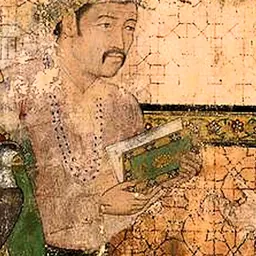
Related people
Same field, nearest in time



Contemporaries
People whose lives overlapped Faizi's



Frequently asked questions
Who was Faizi?
Indian poet and scholar (1547–1595)
When was Faizi born?
Faizi was born on 24 September 1547 in Agra.
When did Faizi die?
Faizi died on 5 October 1595 in Agra.
What was Faizi's occupation?
Faizi was a poet, diplomat, calligrapher, scientist, translator and writer.
What nationality was Faizi?
Faizi was Indian.
Sources & further reading
Cite this page
APA: Biography.guide. (2026). Faizi. https://biography.guide/faizi/
MLA: "Faizi." Biography.guide, https://biography.guide/faizi/.
Chicago: "Faizi." Biography.guide. https://biography.guide/faizi/.
Data last updated: 2026-09-22 · Spot an error? Report a correction.
Portrait: Wikimedia Commons · author & licence
Page generated 2026-09-27 05:01 UTC