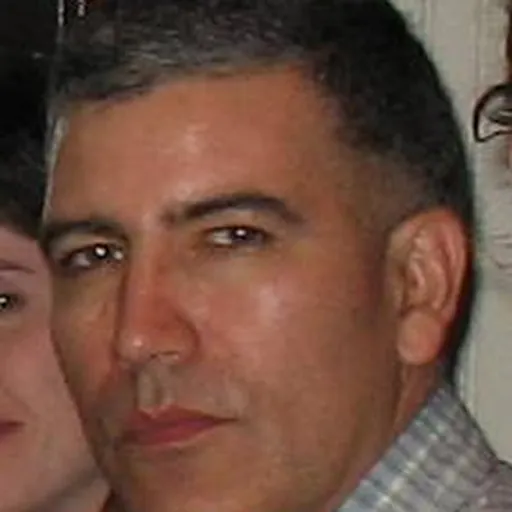
About F. J. Duarte
Born 1954. F. J. Duarte is a Chilean physicist and inventor.
Francisco Javier "Frank" Duarte (born c. 1954) is a laser physicist and author/editor of several books on tunable lasers.
His research on physical optics and laser development has won several awards, including an Engineering Excellence Award in 1995 for the invention of the N-slit laser interferometer.
Research
Laser oscillators
Duarte and Piper introduced multiple-prism near-grazing-incidence grating cavities which originally were disclosed as copper-laser-pumped narrow-linewidth tunable laser oscillators. Subsequently, he developed narrow-linewidth multiple-prism grating configurations for high-power CO2 laser oscillators and solid-state tunable organic laser oscillators.
Intracavity dispersion theory
Duarte also conceived the multiple-prism dispersion theories for tunable narrow-linewidth laser oscillators, and multiple-prism laser pulse compression, which are summarized in several of his books.
Tunable lasers for isotope separation
His tunable narrow-linewidth laser oscillator configurations have been adopted by various research groups working on uranium atomic vapor laser isotope separation (AVLIS). This work was supported by the Australian Atomic Energy Commission. In 2002, he participated in research that led to the isotope separation of lithium using narrow-linewidth tunable diode lasers.
Solid state organic dye lasers
From the mid-1980s to early 1990s Duarte and scientists from the US Army Missile Command developed ruggedized narrow-linewidth laser oscillators tunable directly in the visible spectrum. This constituted the first disclosure, in the open literature, of a tunable narrow-linewidth laser tested on a rugged terrain. This research led to experimentation with polymer gain media and in 1994 Duarte reported on the first narrow-linewidth tunable solid state dye laser oscillators.
Organic gain media
Joint research, with R. O. James, on solid-state organic-inorganic materials, led to the discovery of polymer-nanoparticle gain media and to the emission of tunable low-divergence homogeneous laser beams from this class of media. In 2005, Duarte and colleagues were the first to demonstrate directional coherent emission from an electrically excited organic semiconductor. These experiments utilized a tandem OLED within an integrated interferometric configuration. which offer high conversion efficiency and wide tunability in the green region of the electromagnetic spectrum.
Interferometry and quantum optics Duarte and colleagues demonstrated the superposition of diffraction patterns over N-slit interferograms. This interferogram corresponds to the interferometric character b (N = 3 slits) and exhibits a diffraction pattern superimposed on the right outer wing (see text).
In the late 1980s, he invented the digital N-slit laser interferometer for applications in imaging and microscopy. Concurrently, he applied Dirac's notation to describe quantum mechanically its interferometric and propagation characteristics. A further innovation in this interferometer was the use of extremely elongated Gaussian beams, width to height ratios of up to 2000:1, for sample illumination. that includes positive and negative refraction. He also derived the cavity linewidth equation, for dispersive laser oscillators, using quantum mechanical principles.
Further developments include very large N-slit laser interferometers to generate and propagate interferometric characters for secure free-space optical communications. Interferometric characters is a term coined in 2002 to link interefometric signals to alphanumerical characters (see figure's legend).
Duarte provides a description of quantum optics, almost entirely via Dirac's notation, in his book Quantum Optics for Engineers. In this book he derives the probability amplitude for quantum entanglement,
which he calls the Pryce-Ward probability amplitude, from an N-slit interferometric perspective. It is this that becomes the probability disclosed by Pryce and Ward. Duarte also emphasizes a pragmatic non-interpretational approach to quantum mechanics. that transformed the degree structure of the university. Macquarie's science reform, was widely supported by local scientists including physicists R. E. Aitchison, R. E. B. Makinson, A. W. Pryor, and J. C. Ward. In 1980, Duarte was elected as one of the Macquarie representatives to the Australian Union of Students from where he was expelled, and then reinstated, for "running over the tables."
Following completion of his PhD work, Duarte did post doctoral research, with B. J. Orr at the University of New South Wales, and then back at Macquarie University.
American phase
In 1983, Duarte traveled to the United States to assume a physics professorship at the University of Alabama. In 1985 he joined the Imaging Research Laboratories, at the Eastman Kodak Company, where he remained until 2006. While at Kodak he was chairman of Lasers '87 and subsequent conferences in this series. Duarte has had a long association with the US Army Missile Command and the US Army Aviation and Missile Command, where he has participated (with R. W. Conrad and T. S. Taylor
In 1995, he received the Engineering Excellence Award for "the invention of an electrooptic coherent interferometer for direct applications to imaging diagnostics of transparent surfaces, such as photographic film and film substrates. and in 2016, he was awarded the David Richardson Medal for "seminal contributions to the physics and technology of multiple-prism arrays for narrow-linewidth tunable laser oscillators and laser pulse compression," from the Optical Society.
Personal
Duarte was born in Santiago, Chile, and traveled to Sydney, Australia, as a teenager. There, he lived first in Strathfield and then in the northern small town of Cowan. In the United States he resided for a brief period in Tuscaloosa, Alabama, and then moved to Western New York.
Books Dye Laser Principles (1990) Tunable Laser Optics, 2nd Ed. (2015, Second edition) Tunable Laser Applications, 3rd Ed (1996, 2009, 2016) Fundamentals of Quantum Entanglement (2019) Quantum Entanglement Engineering and Applications (2021)
Don’t just read it —
keep it.
Full-length biographies made to live with: read them, listen on the way to work, watch them tonight.
- E-book
- Audio
- Video
Instant download · yours to keep · every purchase keeps this site free
Important facts
People in F. J. Duarte's life
Named in this biography and alive at the same time



Related people
Same field, nearest in time


Contemporaries
People whose lives overlapped F. J. Duarte's



Frequently asked questions
Who is F. J. Duarte?
Chilean-American physicist
When was F. J. Duarte born?
F. J. Duarte was born on 1 September 1954 in Santiago.
What is F. J. Duarte's occupation?
F. J. Duarte is a physicist and inventor.
What nationality is F. J. Duarte?
F. J. Duarte is Chilean.
Sources & further reading
Cite this page
APA: Biography.guide. (2026). F. J. Duarte. https://biography.guide/f-j-duarte/
MLA: "F. J. Duarte." Biography.guide, https://biography.guide/f-j-duarte/.
Chicago: "F. J. Duarte." Biography.guide. https://biography.guide/f-j-duarte/.
Data last updated: 2026-09-23 · Spot an error? Report a correction.
Portrait: Wikimedia Commons · author & licence
Page generated 2026-09-27 05:05 UTC