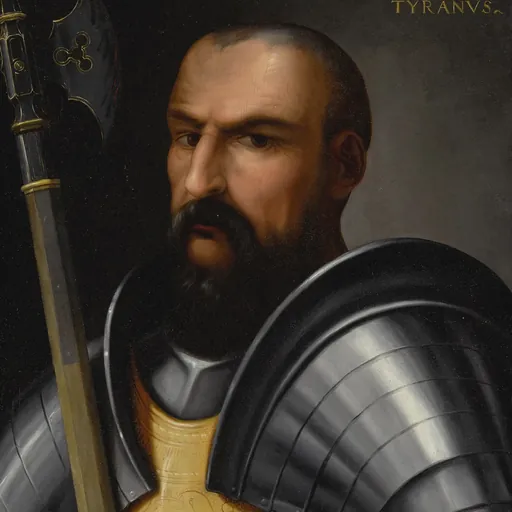
About Ezzelino III da Romano
Lived 1194 – 1259 (aged 65). Ezzelino III da Romano was a German condottiero and politician.
Ezzelino III da Romano (25 April 1194, Tombolo7 October 1259) was an Italian feudal lord, a member of the Ezzelini family, in the March of Treviso (in modern Veneto). He was a close ally of the emperor Frederick II (r. 1220–1250), and ruled Verona, Vicenza and Padua for almost two decades. He became infamous as a cruel tyrant, and was, in fact, the most "notorious" of the "early tyrants".
Biography Early life
Ezzelino was a son of Ezzelino II da Romano, ruler of Bassano del Grappa and other fiefs in the Veneto, and Adelaide D'egli Alberti di Mangona, who came from a family of counts in Tuscany. At the age of four years, he was sent as a hostage to Verona, but nothing else is known about his childhood or education. In 1213, he took part in the siege of the castle of Este, which belonged to his father's archenemy, marquess Azzo VI of Este, who died in 1212 and later to his son Aldobrandino. According to the chronicler Rolandino of Padua, the young Ezzelino already showed a keen interest in siegecraft and acquired a hatred of the Este which would last his entire life.
Rise to power 1226–1239
When Ezzelino II retired to a monastery in 1223, his possessions went to his sons Alberico, who received the castles and villages in the countryside of Vicenza (including the important centre of Bassano del Grappa) and Ezzelino, who received the possessions in the countryside of Treviso. In 1226 Ezzelino intervened in a factional struggle in Verona, aiding the Monticuli and Quattuorviginti against their enemies, the so-called pars comitis ("party of the count"), which was headed by the Veronese count Richard of San Bonifacio. From this time onwards Ezzelino became an important factor in Veronese politics and in 1226-1227 he had become or Lord Mayor of that city. He briefly lost Verona, but regained it in 1230.
At this time control over Verona was important because Frederick II was in conflict with the Second Lombard League, an alliance of cities in Northern Italy. Whoever controlled Verona could block the Brenner Pass through the Alps, and thereby prevent the arrival of reinforcements for Frederick from Germany. Initially, Ezzelino favoured the Lombard League which could block the Brenner and emerge victorious from its first confrontation with the Emperor. However, he and his brother Alberico later changed sides, when it became apparent that the League favoured their enemies in the March, particularly the Este and the San Bonifacio (Sambonifacio).
In 1232 the brothers struck an alliance with Frederick and received an imperial privilege of protection. However, four years passed before the emperor could personally intervene in the March of Treviso. The years 1232–1236 were therefore very difficult for Ezzelino and Alberico, who were assailed by many enemies, primarily the San Bonifacio, the Este and the city of Padua.
In 1236, Frederick II finally arrived in the March of Treviso. Because Ezzelino and his Veronese allies, the Monticuli and Quattuorviginti, had gained control of Verona in early 1236, the emperor could bring reinforcements across the Alps, including 3000 German men-at-arms. In a campaign that began in November 1236 Frederick and Ezzelino, who was becoming an increasingly important ally of the emperor, subjugated all the important cities of the March of Treviso: Vicenza was conquered in November 1236, Padua and Treviso surrendered in February/March 1237.
In 1236 Ezzelino married Selvaggia, Frederick's natural daughter who was thirteen years old at the time; conquered Verona and by treason Padua, seizing the position of podestà of that city. In Padua he had the monk Giordano Forzatè arrested and exiled.
Ezzelino was one of the protagonists in the Ghibelline-Imperial victory of Cortenuova (1237) and in 1239 was named Imperial viceroy for the March of Treviso. , and the Romano family became extinct. The example set by the success of this kind of ruthlessness, was not lost on the future tyrants of late Middle Age and early Renaissance Italy.
Don’t just read it —
keep it.
Full-length biographies made to live with: read them, listen on the way to work, watch them tonight.
- E-book
- Audio
- Video
Instant download · yours to keep · every purchase keeps this site free
Important facts
Family & relationships
People in Ezzelino III da Romano's life
Named in this biography and alive at the same time


Related people
Same field, nearest in time



Contemporaries
People whose lives overlapped Ezzelino III da Romano's



Frequently asked questions
Who was Ezzelino III da Romano?
Italian lord (1194-1259)
When was Ezzelino III da Romano born?
Ezzelino III da Romano was born on 25 April 1194 in Padua.
When did Ezzelino III da Romano die?
Ezzelino III da Romano died on 7 October 1259 in Soncino.
What was Ezzelino III da Romano's occupation?
Ezzelino III da Romano was a condottiero and politician.
What nationality was Ezzelino III da Romano?
Ezzelino III da Romano was German.
Sources & further reading
· Wikipedia: Ezzelino III da Romano
· DBpedia: Ezzelino III da Romano
Cite this page
APA: Biography.guide. (2026). Ezzelino III da Romano. https://biography.guide/ezzelino-iii-da-romano/
MLA: "Ezzelino III da Romano." Biography.guide, https://biography.guide/ezzelino-iii-da-romano/.
Chicago: "Ezzelino III da Romano." Biography.guide. https://biography.guide/ezzelino-iii-da-romano/.
Data last updated: 2026-09-20 · Spot an error? Report a correction.
Portrait: Wikimedia Commons · author & licence
Page generated 2026-09-27 04:57 UTC