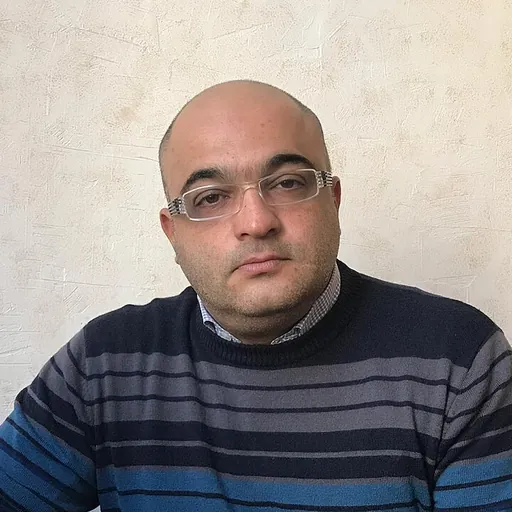
About Eynulla Fatullayev
Born 1976. Eynulla Fatullayev is an Azerbaijani journalist.
Eynulla Emin oglu Fatullayev (; born 25 September 1976) is an Azerbaijani journalist and the founder and editor-in-chief of the news website Haqqin.az. He was the editor-in-chief of the independent Russian-language weekly Realny Azerbaijan and Azerbaijani-language daily Gündəlik Azərbaycan newspapers. He was imprisoned for four years in Azerbaijan for his criticism of government's policies and for his comments on the Khojaly massacre. International PEN, and the Committee to Protect Journalists, and Amnesty International named him a prisoner of conscience and 2011 "priority case."
Career
Eynulla Fatullayev served as the editor of the Realny Azerbaijan (Russian for Real Azerbaijan) and Gündəlik Azərbaycan (Azerbaijani for Azerbaijan Daily). His editorship was notable for its criticism of the Azerbaijani government and its policies. In both publications, he criticized the government for its violations of press freedom and human rights. He has also been criticised for his article about the 2003 Azerbaijani elections which were accused of being fraudulent. On 26 September 2006, Judge Malakhat Abdulmanafova of the Yasamal District Court in Baku convicted Fatullayev of criminal libel and insult and sentenced him to a conditional two-year prison term, ordered him to publish a retraction, and pay a fine of US$11,300 in moral damages to Usubov. Fatullayev told Human Rights Watch: Starting on September 27, I personally, my family, and the paper’s commercial director got frequent phone calls warning us to stop writing critical articles against the Interior Minister Ramil Usubov, or they were going to kill me like Elmar Husseinov [investigative journalist, murdered on 2 March 2005]... They called my mother and threatened to murder the entire family if I did not stop writing.... On September 31, several unidentified, armed people kidnapped my father, blindfolded him, and took him to some kind of a country house. I received a phone call demanding that I stop publication of my newspapers or I would loose (sic) my father... The next morning I announced the closure of the papers. Only then my father was released. On 1 March 2007, 70-80 people had held a protest outside the editorial office of Fatullayev and raised posters that accused him of being a Dashnak (Armenian) agent and calling for Fatullayev to be stripped of his citizenship. After the reading the resolution, the participants threw eggs at the editorial office, breaking two windows. The police suppressed the protest. Amnesty International described the case as "trumped up charges after being critical of the government."
However, in his statement to the European Court of Human Rights Fatullayev noted that in the article "The Karabakh Diary", he had merely conveyed the statements of a local Armenian, who had told Fatullayev his version of the events during the interview. Fatullayev claimed that his article did not directly accuse any Azerbaijani national of committing any crime and that in his article, there was no statement asserting that any of the Khojaly victims had been killed or mutilated by Azerbaijani fighters.
The European Court of Human Rights ruled that "although "The Karabakh Diary" might have contained certain exaggerated or provocative assertions, the author did not cross the limits of journalistic freedom". The Court also noted that "The Karabakh Diary" did not constitute a piece of investigative journalism focusing specifically on the Khojaly events and considered that Fatullayev's statements about these events were made rather in passing, parallel to the main theme of the article.
Imprisonment While in prison for defamation, additional charges were brought against Fatullayev. In a report about a possible U.S. military strike against Iran, Fatullayev included a list of targets within Azerbaijan, which brought an additional charge of encouraging terrorism. Upon conviction in 2007, he was sentenced to eight and a half years. Amnesty International again described the charges as "fabricated."
Fatullayev was granted a pardon on 26 May 2011.
International attention In 2009, Fatullayev was awarded an CPJ International Press Freedom Award for "defending press freedom in the face of attacks, threats or imprisonment."
On 24 May 2011, U.K. journalists including Jon Snow of Channel 4 News and John Mulholland, editor of The Observer, joined Amnesty International in issuing a "mass tweet" on Fatullayev's behalf; the journalists photographed themselves with placards reading "Eynulla Fatullayevi azad et!"—meaning "Free Eynulla Fatullayev!" in Azerbaijani—and tweeted the photographs to President Ilham Aliyev. Fatullayev received a full pardon two days later, and he was released after serving four years of his eight-year sentence. He attributed his release to the work of Amnesty International activists, saying, "In my opinion, you saved me. Thank you to all those who tweeted."
Almost one year after his release, UNESCO awarded Fatullayev with its 2012 UNESCO/Guillermo Cano World Press Freedom Prize, which Fatullayev would accept on World Press Freedom Day in Tunis.
End of relationship with Amnesty International Amnesty International ended its cooperation with Fatullayev, issuing a statement on 23 January 2013, saying Fatullayev had "misled the organization about the source of funding for a project he had requested Amnesty International involvement in". Amnesty International also expressed its belief and concern on that Fatullayev and his site Haqqin.az, is used by the Government of Azerbaijan to discredit European criticism of human rights violations in Azerbaijan. Furthermore, Fatullayev tried to attract support for the event by falsely claiming that Amnesty International was involved in it. He also circulated an agenda of the event which included details of a speaker from Amnesty International, despite the refusal of the latter to participate.
Turan Information Agency has made the following comment on the case of Fatullayev vs Amnesty International: "It's no secret that in Germany, as in other developed democratic countries, there are issues of corruption and human rights violations. However, the Azerbaijani model of government and public relations is too far from Europe. Therefore, the report by Fatullayev is an attempt from the Stone Age to criticize the human rights situation in bourgeois society."
Don’t just read it —
keep it.
Full-length biographies made to live with: read them, listen on the way to work, watch them tonight.
- E-book
- Audio
- Video
Instant download · yours to keep · every purchase keeps this site free
Important facts
People in Eynulla Fatullayev's life
Named in this biography and alive at the same time


Related people
Same field, nearest in time



Contemporaries
People whose lives overlapped Eynulla Fatullayev's

Frequently asked questions
Who is Eynulla Fatullayev?
Azerbaijani journalist
When was Eynulla Fatullayev born?
Eynulla Fatullayev was born on 25 September 1976 in Baku.
What is Eynulla Fatullayev's occupation?
Eynulla Fatullayev is a journalist.
What nationality is Eynulla Fatullayev?
Eynulla Fatullayev is Azerbaijani.
Sources & further reading
· Wikipedia: Eynulla Fatullayev
Cite this page
APA: Biography.guide. (2026). Eynulla Fatullayev. https://biography.guide/eynulla-fatullayev/
MLA: "Eynulla Fatullayev." Biography.guide, https://biography.guide/eynulla-fatullayev/.
Chicago: "Eynulla Fatullayev." Biography.guide. https://biography.guide/eynulla-fatullayev/.
Data last updated: 2026-09-22 · Spot an error? Report a correction.
Portrait: Wikimedia Commons · author & licence
Page generated 2026-09-27 04:59 UTC