
About Eva Luckes
Lived 1854 – 1919 (aged 64). Eva Luckes was a British nurse.
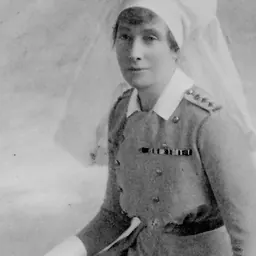
Eva Charlotte Ellis Luckes (8 July 1854 – 16 February 1919) was matron of the London Hospital from 1880 to 1919.
Early life Eva Charlotte Ellis Luckes (she spelled her name Lückes with the umlaut until World War I) was born in Exeter, Devon on 8 July 1854 into an upper middle-class family. Her father, Henry Richard Luckes, was a bank manager and entrepreneur who invested in local railways, and mines. and in Newnham, Gloucestershire. Miss Luckes, the eldest of three daughters, was educated at dame schools in Malvern, and at Cheltenham Ladies' College, and possibly in Dresden. She tried again at the Westminster Hospital, and she completing her training in August 1878. Nightingale worked strenuously behind the scenes to clear her name, notably by eliciting the help of her cousin, General Sir Lothian Nicholson, who was a governor at the hospital. Luckes was cleared of all the charges.
Luckes is given credit for the appointment of Sydney Holland to the London Hospital committee, where he later became treasurer and chair.
Reforms Luckes' reforms initiated in 1880 were built around a well-established plan of what she wanted to achieve; before that date there were Probationers, but their training consisted simply of one year's work on the wards, after which they were considered to be trained nurses, without examination. They were then expected to undertake a further two years' service. She ensured that nurses were better provided for by seeing that meals were provided, and that better accommodation was available. After the reforms, it was established that a Probationer's training should last two years, the first year being concerned with theoretical knowledge and the second with practical skills.
If successful in the examination at the end of this time, the qualified nurse was expected to serve for a further year. The training was later extended to three years and one year after qualification. In 1884 a class of "Paying Probationers" – those who could afford to pay for their training – was introduced.
Training The selection procedure for new nurses became more rigorous. After an application form had been filled in, there was a personal interview with Matron, a medical examination and a month's trial before being accepted as a probationer. Proper training was given, supplemented by lectures given by Luckes herself and two members of the medical staff. Lückes also sent several more from the hospital's Private Nursing Institution.
State registration Despite being busy with her reforms at the London, Luckes was fighting proposed reforms to the nursing profession as a whole. Correspondence was written at a turbulent time for Luckes and her contemporary, Florence Nightingale, with whom Luckes corresponded at least from 1891 – 1898. The British Nurses Association (BNA), founded in 1887, was campaigning vigorously for a statutory register of trained nurses as a way to achieve professional status. Both Florence Nightingale and Eva Luckes were opposed to registration on the grounds that the essential qualities of a good nurse would be subordinated to theory and exams. The BNA applied in 1891 to the Board of Trade to become a public company, but failed after a campaign organised by the anti-registrationists. In 1892, the BNA successfully applied for a Royal Charter of Incorporation, although the Privy Council watered down the charter by not including the power to maintain a register. State registration of nurses was not achieved until 1919.
Critics As well as campaigning against registration, Eva Luckes found herself under attack from those who criticised her method of management. Her critics complained of the long hours and heavy responsibilities she expected from probationers. The hours were demanding: 7 a.m. – 9 p.m., with half an hour for lunch and the pay was £10 a year. They disliked her two (rather than three) year training course and her opposition to nurse registration.
In 1890–91, she was called before a Select committee of the House of Lords, set up to investigate the efficiency of metropolitan hospitals. Many charges from other witnesses were made against her department. The Select Committee made its report in 1892 and found not only the charges to be unsubstantiated, but that the majority of the allegations were exaggerated.
Luckes was decorated a number of times during her career, including the medals of the RRC, the CBE and Lady of Grace of the Order of Saint John.
The 'Matron Maker' A plaque dedicated to Eva Luckes located in the Whitechapel library belonging to the Barts and The London School of Medicine and Dentistry. Luckes was referred to by her friend and mentor Florence Nightingale as "Matron of Matrons", and on her death as a Matron Maker. Several matrons at the Rous Memorial Hospital in Newmarket were trained by Luckes: Mary Winifred McDonall, Matron 1900 – – about 1910. Annie Langridge, Matron 1911 – until at least 1939. Dora Mildred Newman, Matron's Sick Relief and Holiday Duty, between about 1897 – 1911.
A second edition was published in 1898, "entirely rewritten and taken out of lecture form". These words give us some idea of her approach to her life and work and why she opposed the campaign for a Registration Scheme. There is more in the same vein. Anyone who has interest or influence in the strategy of nurse training and discipline might find value in reading, and perhaps quoting, these introductions.
The book was widely used as a teaching aid and reference book by nurses.
She also produced a volume called Hospital Sisters and their Duties, which ran to four editions. Both books were a great success.
Honours Matron Luckes's achievements were recognised by: Commander of the Order of the British Empire, Royal Red Cross and Lady of Grace of the Order of Saint John.
Portrayals Matron Luckes is played by Cherie Lunghi in the BBC series Casualty 1906, Casualty 1907 and Casualty 1909.
Matron Luckes appears as a supporting character in the opera Joseph Merrick, the Elephant Man by Laurent Petitgirard.
Don’t just read it —
keep it.
Full-length biographies made to live with: read them, listen on the way to work, watch them tonight.
- E-book
- Audio
- Video
Instant download · yours to keep · every purchase keeps this site free
Important facts
People in Eva Luckes's life
Named in this biography and alive at the same time




Related people
Same field, nearest in time


Contemporaries
People whose lives overlapped Eva Luckes's



Frequently asked questions
Who was Eva Luckes?
British nurse
When was Eva Luckes born?
Eva Luckes was born on 8 July 1854 in Exeter.
When did Eva Luckes die?
Eva Luckes died on 16 February 1919 in London.
What was Eva Luckes's occupation?
Eva Luckes was a nurse.
What nationality was Eva Luckes?
Eva Luckes was British.
Sources & further reading
Cite this page
APA: Biography.guide. (2026). Eva Luckes. https://biography.guide/eva-luckes/
MLA: "Eva Luckes." Biography.guide, https://biography.guide/eva-luckes/.
Chicago: "Eva Luckes." Biography.guide. https://biography.guide/eva-luckes/.
Data last updated: 2026-09-25 · Spot an error? Report a correction.
Page generated 2026-09-27 05:12 UTC