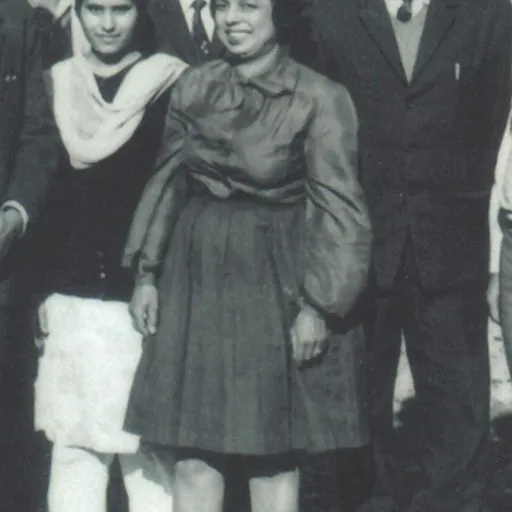
About Eulie Chowdhury
Lived 1923 – 1995 (aged 71). Eulie Chowdhury was an Indian architect, writer and docent.
Urmila Eulie Chowdhury (4 October 1923 – 20 September 1995) was an Indian architect who worked during the mid-to-late 20th century. She worked in the fields of general architecture, landscape architecture and design, and was also a teacher and writer. She was a pioneer woman architect working in India. Some sources state that she was also the first female architect in Asia. After her education she worked in close collaboration with Le Corbusier in the planning design and construction of the city of Chandigarh.
Early life and family Chowdhury was born in Shahjehanpur in Uttar Pradesh in 1923. She earned a Cambridge School Certificate from Kobe, Japan, studied architecture at the University of Sydney, and at the Conservatory of Music of the Julian Ashborn School of Art, Sydney, and earned a degree in Ceramics in Englewood, New Jersey. Her father was a diplomat, so she grew up traveling around the world. She was married to Jugal Kishore Chowdhary, who worked as a consulting architect with the Government of Punjab.
Career She is among a small group of women architects who were working in Asia during her career. While some sources credit her as the first woman architect in Asia, and women like Perin Jamsetjee Mistri and Dora Gad preceded her by a decade or more.
After working for a short time in United States, she returned to India in 1951 and became a member of a team headed by Le Corbusier for planning the design and construction of Chandigarh during 1951–63 and 1968–70. She was the only connection between Le Corbusier, Pierre Jeanneret, and the Indian architects and administrators. Her assignments included the Home Science College, the Women's Polytechnic and many residential complexes of the ministers. Her third assignment, from 1971 to 1976, was as the Chief Architect, who she worked for the second stage of Chandigarh city planning.
Urmila Eulie Chowdhury with Pierre Jeanneret and other colleagues of Chandigarh Capital Project. (1960 photo)
Chowdhury's assignment during the period 1963–65 was as the Director of the School of Architecture of Delhi. During this period she also authored a book of memories of Le Corbusier titled Those Were The Days.
Chowdhury's work, like that of the architects she worked with, was deeply impacted by the climate and the limited footprint. Chowdhury also designed furniture and adapted Jeanneret's furniture to a smaller scale. This was possibly inspired by her own petite stature. Chowdhury was a pioneer woman in Indian architecture.
Don’t just read it —
keep it.
Full-length biographies made to live with: read them, listen on the way to work, watch them tonight.
- E-book
- Audio
- Video
Instant download · yours to keep · every purchase keeps this site free
Important facts
People in Eulie Chowdhury's life
Named in this biography and alive at the same time




Related people
Same field, nearest in time

Contemporaries
People whose lives overlapped Eulie Chowdhury's

Frequently asked questions
Who was Eulie Chowdhury?
Indian architect (1923–1995)
When was Eulie Chowdhury born?
Eulie Chowdhury was born on 4 October 1923 in Shahjahanpur.
When did Eulie Chowdhury die?
Eulie Chowdhury died on 20 September 1995 in Chandigarh.
What was Eulie Chowdhury's occupation?
Eulie Chowdhury was an architect, writer and docent.
What nationality was Eulie Chowdhury?
Eulie Chowdhury was Indian.
Sources & further reading
Cite this page
APA: Biography.guide. (2026). Eulie Chowdhury. https://biography.guide/eulie-chowdhury/
MLA: "Eulie Chowdhury." Biography.guide, https://biography.guide/eulie-chowdhury/.
Chicago: "Eulie Chowdhury." Biography.guide. https://biography.guide/eulie-chowdhury/.
Data last updated: 2026-09-22 · Spot an error? Report a correction.
Portrait: Wikimedia Commons · author & licence
Page generated 2026-09-27 04:57 UTC