
Eulalia of Mérida
Early 4th-century Spanish saint
About Eulalia of Mérida
Lived 290 – 304 (aged 13–14). Eulalia of Mérida was a Roman.
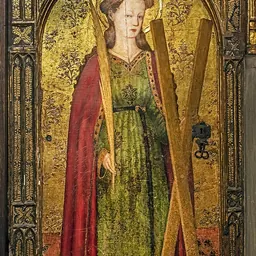
Eulalia of Mérida (Augusta Emerita in 292 - Augusta Emerita 10 December, 304) was a young Roman Christian martyred in Augusta Emerita, the capital of Lusitania (modern Mérida, Spain), during the Persecution of Christians under Diocletian. Other views place her death at the time of Trajan Decius (AD 249–51). There is debate whether Saint Eulalia of Barcelona, whose story is similar, is the same person. Up till the proclamation of James, son of Zebedee, Eulalia was invoked as the protector of Christian troops in the Reconquista and was patron of the territories of Spain during their formation.
Hagiography Saint Eulalia, by John William Waterhouse, 1885, Tate collection. Eulalia was a devout Christian virgin, aged 12–14, whose mother sequestered her in the countryside in AD 304 because all citizens were required to avow faith in the Roman gods. Eulalia ran away to the law court of the governor Dacian at Emerita, professed herself a Christian, insulted the pagan gods and emperor Maximian, and challenged the authorities to martyr her. The judge's attempts at flattery and bribery failed. According to the Spanish-Roman poet Prudentius of the fifth century, who devoted book 3 of his Peristephanon ("About martyrs") to Eulalia, she said:
Eulalia was then stripped by the soldiers, tortured with hooks and torches, and burnt at the stake, suffocating from smoke inhalation. She taunted her torturers all the while, and as she expired a dove flew out of her mouth. This frightened away the soldiers and allowed a miraculous snow to cover her nakedness, its whiteness indicating her sainthood.
A shrine over Eulalia's tomb was soon erected. Veneration of Eulalia was already popular with Christians by 350; Prudentius' poem increased her fame and relics from her were distributed through Iberia. Bishop Fidelis of Mérida rebuilt a basilica in her honor around 560. Her shrine was the most popular in Visigothic Spain. Around 780 her body was transferred to Oviedo by King Silo. It lies in a coffin of Arab silver donated by Alfonso VI in 1075. In 1639, she was made patron saint of Oviedo. She appears in Thieleman J. van Braght, Martyrs Mirror: An account of Those who Suffered in the Fourth Century (1660).
Julia of Mérida Often linked with Eulalia is Saint Julia of Mérida, as in the double dedication to Saints Eulalia and Julia. Julia is also said to have been a young girl martyred at Mérida in 304, in the same persecution by Diocletian, and her feast day is also celebrated on 10 December.
Don’t just read it —
keep it.
Full-length biographies made to live with: read them, listen on the way to work, watch them tonight.
- E-book
- Audio
- Video
Instant download · yours to keep · every purchase keeps this site free
Important facts
People in Eulalia of Mérida's life
Named in this biography and alive at the same time


Frequently asked questions
Who was Eulalia of Mérida?
early 4th-century Spanish saint
When was Eulalia of Mérida born?
Eulalia of Mérida was born in 290 in Augusta Emerita.
When did Eulalia of Mérida die?
Eulalia of Mérida died on 10 December 304 in Augusta Emerita.
What nationality was Eulalia of Mérida?
Eulalia of Mérida was Roman.
Sources & further reading
· Wikipedia: Eulalia of Mérida
Cite this page
APA: Biography.guide. (2026). Eulalia of Mérida. https://biography.guide/eulalia-of-merida/
MLA: "Eulalia of Mérida." Biography.guide, https://biography.guide/eulalia-of-merida/.
Chicago: "Eulalia of Mérida." Biography.guide. https://biography.guide/eulalia-of-merida/.
Data last updated: 2026-09-20 · Spot an error? Report a correction.
Page generated 2026-09-27 05:19 UTC