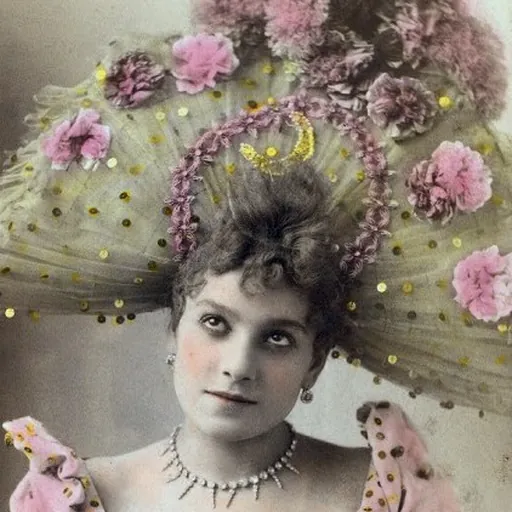
About Eugénie Fougère
Lived 1870 – 1946 (aged 75). Eugénie Fougère was a French actor.
Eugénie Fougère (12 April 1870 – 6 February 1946) was a French vaudeville and music hall dancer and singer. She was often called a soubrette − a flirtatious or frivolous woman − known for her eye-catching outfits, frisky movements, suggestive demeanor, and for her rendition of the popular "cakewalk dance," which in her own style included "negro" rhythms and paces. She should not be confused with the frequenter of the French demi-monde also named Eugénie Fougère although the two knew each other, mixed in the same circles and even lived in the same street in Paris for a while.
Fougère, despite her image as a frivolous dance-hall star, was also an innovator. According to one theatre critic "this wild little diva was always dressed in the most outlandish outfits, resplendent in the most incongruous colours" but was also "a precursor who introduced the repertoire of foreign songs and dances from every country into the café-concert well before this repertoire became fashionable".
Early life and career
Fougère's past is shrouded in mystery, not in the least because she herself contributed to the ambiguities by creating dual identities in real life and on stage. According to some sources she was either from Spanish or Spanish-Jewish descent, but it is more likely that her true identity was confused with her first artistic success as a Spanish singer and dancer, known as "fausses Espagnoles" (fake Spaniards), with the stage name Fougeros.
After the murder of her namesake in 1903, Fougère complained about the confusion over the name, about which the two ladies had argued in the past. Fougère claimed that she was the rightful bearer of the name, but according to an article in Le Petit Parisien that reported on the murder, Fougère was most likely born as Faugère, in Strasbourg. Her birth certificate shows that Fougère was born out of wedlock as Eugénie Philippine Faugère in Strasbourg, the natural daughter of Jean Faugère, a soldier in the 16th artillery regiment from Puylaurens (Tarn), and an Alsatian woman, Catherine Kistler, a seamstress born in Herrlisheim (Bas-Rhin). known as Juliette, who also was a vaudeville artist.
Eugénie became a native of Avignon in her early youth. After the 1870-1871 Franco-Prussian War, her father, who had spent twenty-one years in the army, came to Avignon in Southeastern France with the Strasbourg pontonniers regiment,
Her first appearance on stage was at the age of 12 in Avignon, ) and dancer that performed in famous theatres, such as the Folies Bergère, Alcazar d'Été, La Scala (fr) and L'Olympia. The gommeuse was regarded as a sensual object and a "symbol of madness, of Parisian life", and the frenzy of Paris in the last decade of the 19th century: She is said to have introduced the dance in Paris in 1900 in the Théâtre Marigny after she returned from a tour in the United States, where she had been filmed in 1899 in the rag-time cake-walk "Hello, Ma Baby," with which she made a sensation at the New York Theatre, filmed by Frederick S. Armitage.
The ambiguous "cake walk" became very popular quickly. For a few months in 1903, Paris was in the grip of a veritable 'cake-walk craze' (folie du cake-walk) or cake-walkomanie, after a popular song. Fougère appeared on the October 1903 cover of Paris qui Chante dancing to the song Oh ! ce cake-walk, which she performed barefoot at La Scala, much to the delight of the audience, seduced by this originality. The lyrics interconnected African and American dance, monkeys and epilepsy – reflecting the racist and colonial attitudes that prevailed at the time. A popular theorist of "negro dance," Andre Levinson, observed that it was impossible for Europeans to recreate the moves seen by African dance, and that is why the public was amazed by it.
While describing a revue at La Cigale near Place Pigalle in Paris in 1920, where she appeared in the costume of an American negro, Rae Beth Gordon, a professor in French literature, notes that "at least in this original fantasy, she told the journalist, 'I felt my old self again.' The incorporation of blackness by this white singer suggests that the motivations for adopting a black persona and the effects of such a masquerade went beyond the purposes of simple exploitation. Fougère felt more at home in a black body — or, at least, in a body ruled by black rhythms and movements — than she did in a white body deprived of the opportunity to express itself with no holding back."
In the United States
The 'audacious' Fougère made her debut in the United States on 7 September 1891 at Broadway's Koster and Bial's Music Hall in New York – the gayest night spot in town at the time – where her "scandalously risqué" performance quickly became "the craze of the hour". According to a review, "New York never saw anything to equal the performance of Fougere. Imagine an Apache in a setting of petite Parisian femininity." Not everyone was impressed; theatre critic Leander Richardson called her "the most daring interpreter of indecency" and wrote that she dealt "in just plain sexual dirt, and looks the part".
She was something of a trailblazer, launching a wave of 'unconventional' dancers and singers from across the ocean.
Fougere became one of "the high-priced music hall singers", according to Metropolitan Magazine, who was never out of an engagement, spending her time performing between New York and Paris:
Fougère toured the States for many years during the Gay Nineties and the early 1900s, but her performance was often too 'strong' for the audience. Due to complaints about the audacious performances of Fougère and other European music-hall artists, Koster and Bial's had to set new restrictive rules about the artist's dresses and song texts for the 1894 theatre season. She was a hit at the Los Angeles Orpheum, but was hissed off the stage in Kansas City. "The people think I'm — ah — what you say? Naught-ee?," she commented. "Ah. monsieur, they don't understand. They will learn. Ah, these Americans, they are just a little slow, but they all like 'the great Fougere' when they know her. But, o-o-ooh ! I'm all breathless, c'est terrible!" In 1907, impresario Willie Hammerstein paid her $700 a week while playing in his Hammerstein's Roof Garden vaudeville theatre in New York City.
Her performances often shocked the puritan North Americans and revealed their hypocrisy. In October 1907, while she was performing at the Gaiety Theater in Washington DC, she was brought to the police station where she had to pay a "cash security of $50 to insure her good behavior." Despite the fact that the police sergeant enjoyed her show on the front row, in particular her "specialty", he nevertheless said he was shocked and dragged her off to the police station. Her controversial performances in the U.S. did not stop her from parodying the Gibson Girl – the quintessential perfect archetype of the upper middle class American girl – in Parisian theatres.
"Extravagant" Eugenie Fougère at the Parisian café-concert Café des Ambassadeurs. Here she is depicted as a sexy incarnation of a spider, attracting and catching men in her web. (Poster by Alfred Choubrac) Often described as "extravagant", Fougère was a very dynamic, elusive and noisy whirlwind of talk and gestures. When she was performing there in 1902, she contacted Camorra boss Enrico Alfano to ask for help in returning some of her missing jewelry. Within a few days, Alfano tracked down the thieves and restored the jewelry. The case made headlines and Alfano was arrested for complicity in the crime, but was acquitted. The Italian comical actor Nicola Maldacea, with whom she sang duets, remembered her as:
She toured frequently in the British music halls in London, making her first appearance in 1893 at the Empire Theatre of Varieties on Leicester Square in London's West End. In 1896, she made her debut in Germany and Austria at the Apollo-Theater (de) in Berlin and the Etablissement Ronacher in Vienna. Other countries include Spain and Cuba. In 1887, at the age of 17, she first performed at the Edén Concert (es) in Barcelona along with her older sister Juliette. Years later she made her debut in Madrid. She first toured Mexico in 1911, performing at the Teatro Mexicano in Mexico City and Veracruz in 1913. While performing in Mexico City in 1914, she almost perished when her carriage's horses bolted and the carriage collided with a lamppost.
Fougère had many real or supposed romances that were widely reported in the media at the time, including with the American professional boxer James J. Jeffries ) and the Italian comic actor Vincenzo Scarpetta (it), scion of a famous Neapolitan theatre family, whose father Eduardo Scarpetta only barely prevented him from going to Paris with Fougère. In May 1906, Fougère and her husband, the actor Albert Girault (also spelled Girod), were convicted of shoplifting a night dress, lingerie, and other items one particular night after leaving a London-based textile company, Lewis & Alleby's. She was performing at the Oxford Music Hall for a substantial salary (US$400 a week She had a reputation for spending money fast. A Montreal Gazette article the next day mentioned that, "Mademoiselle Eugenie Fougère, the French music hall actress, who was announced to appear at Bennett's as headliner during this week, made her first and last appearance at that theatre yesterday afternoon. Although such acts as she presented might be quite acceptable in the music halls of London and Paris, they certainly should have no place in the bill of any Montreal theatre." The manager of the theatre told Eugénie that she would not be allowed to appear again. In 1926, they lived together at 32 Avenue des Ternes in the 17th arrondissement of Paris.
In an interview with Maurice Hamel (fr) for Comœdia in 1925 she complained she had no engagements anymore and about her lost fortune; jewelry worth FF 275,000 had been stolen from her. In a retrospective in 1934, Hamel recalled her small apartment in Paris in which the walls were covered with photographs, as if she had created her own museum, in which she reminisced about her rich career. She said she had had many difficulties to correct the false notice of her death in 1903 when she was confused with her namesake. In 1937 she played a vieille coquette in the film The Pearls of the Crown (French: Les Perles de la couronne) directed by Sacha Guitry. On 16 September 1939, two weeks after France's declaration of war on Germany at the start of World War II, her name appeared on a list of artists who volunteered to perform on stage for the benefit of other needy artists. She was not heard from again after that date.
While residing at 5 rue du Mont-Dore in the 17th arrondissement, she died at the age of 75 under the name Eugénie Fougère on 6 February 1946 at the Salpêtrière hospital
Legacy Eugénie Fougère on a cigarette trading card published by Ogdens for Ogden's Guinea Gold Tobacco. Published between 1899 and 1907. Fougère was also an early example of a pin-up model; she appeared on many postcards and on a cigarette card, advertising for the cigarette brand Ogden's Guinea Gold Cigarettes. In 1900, the American painter Louis Kronberg made a portrait of Fougère (Dancer With Tambourine). The Italian actress and singer Anna Fougez adopted her stage name as a tribute to Fougère.
Gordon notes that the popularity of performers like Fougère "was comparable to that of Elvis Presley a little more than half a century later." She was the inspiration for several noted dancers, actresses, and singers of the time to incorporate the "negro" and African style of dancing she used in their routines and shows. She was also one of the pioneer burlesque music hall and theatre performers.
After the erroneous news of her being murdered in 1903, which also made the front pages of newspapers in the U.S., a somewhat premature obituary said that "many of her songs were insults to people of refinement, but they were clever and sparkling, and her ability to express charmingly shades of more than doubtful meaning was unquestioned."
Fougère was included in a mural in the rooftop bar of the Knickerbocker Hotel at Times Square in New York City, when it re-opened in 2015, to commemorate the time the hotel was the hottest spot in town in the early 1900s. Ironically, in 1907 she had been kicked out of the hotel because she shared a room with her male manager - although they were married, as became clear later.
She was mentioned by name in the classic Frank Wedekind tragedy Erdgeist (Earth Spirit). During act I, the character Lulu stated in response to a question about her dancing, "I learned in Paris. I took lessons from Eugenie Fougère. She let me copy her costumes too." From a letter written by the playwright, one might infer that he had met Fougère personally. In a letter in 1899, he wrote: "On the first evening of my stay here, I was in Folies Bergêre, saw Eugenie Fougère, a little wild, but didn't take the opportunity to renew our acquaintance." He also referred to her in an interview with the Spanish vaudeville dancer La Tortajada for the German satirical weekly magazine Simplicissimus saying that "she was the best dancer I had seen so far in her genre."
The singer, entertainer and theatre entrepreneur, Paulus remembered her in his memoirs as "the wild and whimsical performer whose daring captivated the audience, and whose disquieting grace excused her eccentricities."
Don’t just read it —
keep it.
Full-length biographies made to live with: read them, listen on the way to work, watch them tonight.
- E-book
- Audio
- Video
Instant download · yours to keep · every purchase keeps this site free
Important facts
People in Eugénie Fougère's life
Named in this biography and alive at the same time

Related people
Same field, nearest in time


Contemporaries
People whose lives overlapped Eugénie Fougère's



Frequently asked questions
Who was Eugénie Fougère?
French entertainer
When was Eugénie Fougère born?
Eugénie Fougère was born on 12 April 1870 in Strasbourg.
When did Eugénie Fougère die?
Eugénie Fougère died on 6 February 1946 in Paris.
What was Eugénie Fougère's occupation?
Eugénie Fougère was an actor.
What nationality was Eugénie Fougère?
Eugénie Fougère was French.
Sources & further reading
Cite this page
APA: Biography.guide. (2026). Eugénie Fougère. https://biography.guide/eugenie-fougere-actor/
MLA: "Eugénie Fougère." Biography.guide, https://biography.guide/eugenie-fougere-actor/.
Chicago: "Eugénie Fougère." Biography.guide. https://biography.guide/eugenie-fougere-actor/.
Data last updated: 2026-09-23 · Spot an error? Report a correction.
Portrait: Wikimedia Commons · author & licence
Page generated 2026-09-27 05:07 UTC