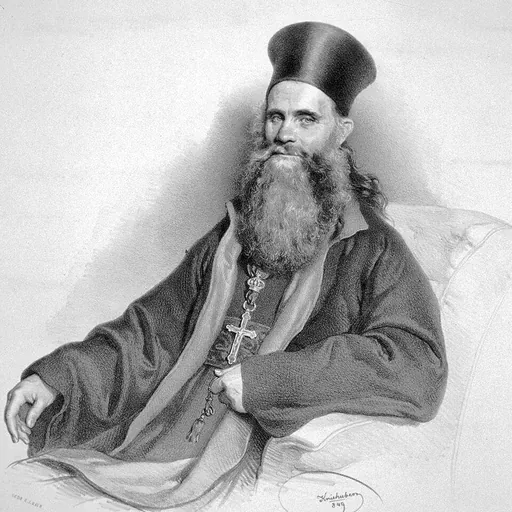
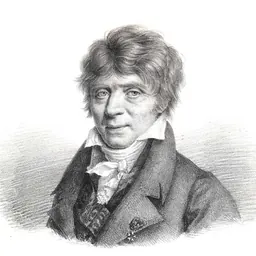
Eugene Hackmann
Romanian Eastern Orthodox bishop and Austrian politician
About Eugene Hackmann
Lived 1793 – 1873 (aged 80). Eugene Hackmann was an Austrian politician, cleric, eastern Orthodox bishop, orthodox theologian and bishop.
Metropolitan Eugene Hackmann (, ,
Biography Hackmann was born in 1793 in Wasloutz, in present-day Ukraine, into a peasant family originally from the Hotin region. His surname derived from an ancestor who had held the title of hatman; as a patronymic, it was later adapted in Bukovina to “Hackmann” or “Hacman.” After completing secondary education, he attended the Theological School of Czernowitz and then the Faculty of Roman Catholic theology at the University of Vienna, graduating in 1823. During his student years, he taught the Romanian language to Archduke Ferdinand of Austria.
In 1823, he took monastic vows, being ordained hierodeacon and later hieromonk at Dragomirna Monastery. He was appointed catechist at the Trivial School, and later professor of Biblical Studies at the Theological Institute of Czernowitz (1827–1835).
In 1835, appointed by the Emperor, he became Orthodox Bishop of Bukovina. He promoted primary and confessional education, introducing Romanian as the language of instruction at the Theological Institute of Czernowitz in place of Latin, but opposing the adoption of the Latin alphabet. In 1837, he reopened Romanian primary schools; in 1848, he founded a Normal School in Czernowitz, though by 1869 such institutions were converted to state schools with German as the medium of instruction. In 1860, a high school was opened in Suceava.
During his episcopate, the Holy Spirit Cathedral (1844–1864) and the Metropolitan Palace (1864–1882) in Czernowitz were built. As a deputy in the House of Lords, he supported establishing a university in Czernowitz. His authoritarian style, preference for the German language in administration, and support for the Ruthenians over Romanians alienated part of the clergy. He backed the Ruthenian cultural association Ruska Besida and regularly made donations to the poor.
His decision to favor services in the Ruthenian language at the Metropolitan Cathedral led to Romanian protests in 1866 and 1867. Writer George Sion criticized the lack of national pride among Romanian professors at the seminary during Hackmann’s time.
In 1863, he was elected as president of the "Romanian Reunion" organization. However, he did not fulfill his duties, with vicepresident Gheorghe Hurmuzachi acting as the de facto leader. a claim contested by the Romanian historians, who claim that he was "a pure Romanian". In 2024, the Orthodox Church of Ukraine renewed efforts toward his canonization. On 11 May 2026 synod of the Orthodox Church of Ukraine formally canionized Hackmann. On the other hand, Ukrainian historian Andriy Boyda, who considers Hacman to be Ukrainian, calling him the Sheptytsky of Bukovina, praised the gesture, claiming that "he protected Ukrainians from Romanian abuses" and that, thanks to him, Bukovinian Ukrainians were not assimilated by Romanians.
Don’t just read it —
keep it.
Full-length biographies made to live with: read them, listen on the way to work, watch them tonight.
- E-book
- Audio
- Video
Instant download · yours to keep · every purchase keeps this site free
Important facts
Related people
Same field, nearest in time



Contemporaries
People whose lives overlapped Eugene Hackmann's





Frequently asked questions
Who was Eugene Hackmann?
Romanian Eastern Orthodox bishop and Austrian politician (1793–1873)
When was Eugene Hackmann born?
Eugene Hackmann was born on 16 March 1793 in Vaslovivtsi.
When did Eugene Hackmann die?
Eugene Hackmann died on 12 April 1873 in Vienna.
What was Eugene Hackmann's occupation?
Eugene Hackmann was a politician, cleric, eastern Orthodox bishop, orthodox theologian and bishop.
What nationality was Eugene Hackmann?
Eugene Hackmann was Austrian.
Sources & further reading
Cite this page
APA: Biography.guide. (2026). Eugene Hackmann. https://biography.guide/eugene-hackmann/
MLA: "Eugene Hackmann." Biography.guide, https://biography.guide/eugene-hackmann/.
Chicago: "Eugene Hackmann." Biography.guide. https://biography.guide/eugene-hackmann/.
Data last updated: 2026-09-22 · Spot an error? Report a correction.
Portrait: Wikimedia Commons · author & licence
Page generated 2026-09-27 05:04 UTC