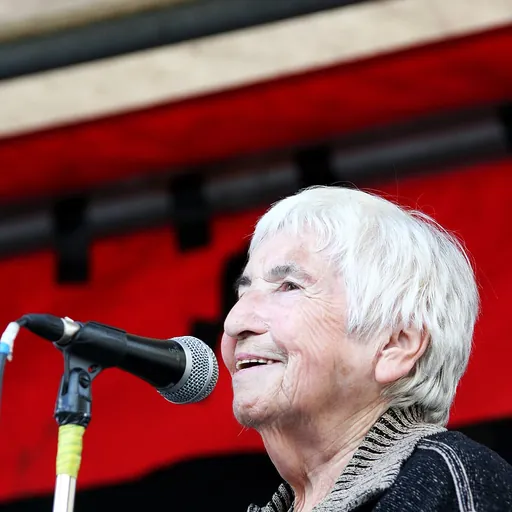
Esther Bejarano
German concentration camp survivor
About Esther Bejarano
Lived 1924 – 2021 (aged 96). Esther Bejarano was a German musician, resistance fighter and contemporary witness.
Esther Béjarano ( Löwy; 15 December 1924 – 10 July 2021) was one of the last survivors of the Auschwitz concentration camp. She survived because she was a player in the Women's Orchestra of Auschwitz. She was active in various ways, including speeches and in music, in keeping the memory of the Holocaust alive. She was a regular speaker at the International Youth Meeting organised yearly at the Max Mannheimer Study Center in Dachau.
Biography Born in 1924 as Esther Löwy, she was a daughter of Margarete (Heymann) and Rudolf Loewy, the head cantor of a Jewish municipality, in Saarlouis. Her father encouraged her to get interested in music and Esther learned to play the piano. At the beginning of the 1980s, she created the musical group Coincidence, with her daughter Edna and her son Joram. They sang songs from the ghetto and in Hebrew as well as anti-fascist songs.
Béjarano died in Hamburg on 10 July 2021, aged 96. She was one of the last surviving orchestra members.
Awards and honours Béjarano was awarded the Carl von Ossietzky Medal of the in 2004. In 2008, Béjarano became honorary president of the Union of Persecutees of the Nazi Regime. She received the Herbert Wehner Medal in 2010.
Béjarano held the Cross of Merit, First class, of the Order of Merit of the Federal Republic of Germany, since 2012. She was honoured with ethecon's 2013 "Blue Planet Award" for her "relentless activity for peace and against anti-Semitism, racism and fascism". In 2014, she was awarded the Giesbert Lewin Prize of the Cologne chapter of the Societies for Christian-Jewish Collaboration. She became honorary citizen of her birth town Saarlouis the same year on the occasion of her 90th birthday. In 2016, she received the Preis für Solidarität und Menschenwürde (Prize for solidarity and human dignity) of the . The Senate of Hamburg awarded her the in 2019. The Gemeinschaftsschule school in Wiesloch was named after her in 2020. The same year, she was awarded the Hermann Maas Prize for her activities against racism and exclusion, and for her political commitment.
Publications
Lieder für das Leben. Curio-Verlag, Hamburg 1995. Man nannte mich Krümel. Curio-Verlag, Hamburg 1989.
Film Esther che suonava la fisarmonica nell’orchestra di Auschwitz, Regia di Elena Valsania, Felìz – Edizioni SEB27, DVD allegato al volume: Esther Béjarano, "La ragazza con la fisarmonica. Dall’orchestra di Auschwitz alla musica Rap", A cura di Antonella Romeo, Prefazione di Bruno Maida, Edizioni SEB27, 2013;
Don’t just read it —
keep it.
Full-length biographies made to live with: read them, listen on the way to work, watch them tonight.
- E-book
- Audio
- Video
Instant download · yours to keep · every purchase keeps this site free
Important facts
People in Esther Bejarano's life
Named in this biography and alive at the same time


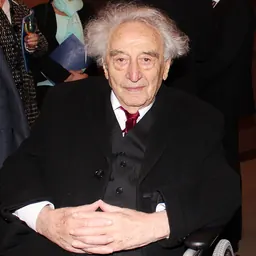
Related people
Same field, nearest in time

Contemporaries
People whose lives overlapped Esther Bejarano's



Frequently asked questions
Who was Esther Bejarano?
German concentration camp survivor (1924-2021)
When was Esther Bejarano born?
Esther Bejarano was born on 15 December 1924 in Saarlouis.
When did Esther Bejarano die?
Esther Bejarano died on 10 July 2021 in Hamburg.
What was Esther Bejarano's occupation?
Esther Bejarano was a musician, resistance fighter and contemporary witness.
What nationality was Esther Bejarano?
Esther Bejarano was German.
Sources & further reading
Cite this page
APA: Biography.guide. (2026). Esther Bejarano. https://biography.guide/esther-bejarano/
MLA: "Esther Bejarano." Biography.guide, https://biography.guide/esther-bejarano/.
Chicago: "Esther Bejarano." Biography.guide. https://biography.guide/esther-bejarano/.
Data last updated: 2026-09-23 · Spot an error? Report a correction.
Portrait: Wikimedia Commons · author & licence
Page generated 2026-09-27 05:07 UTC