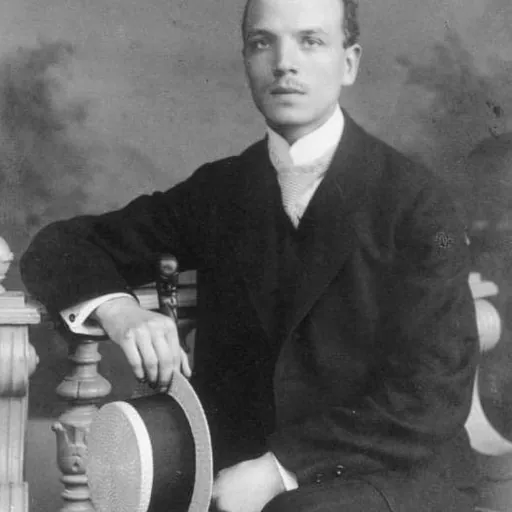
About Ernst Meyer
Lived 1887 – 1930 (aged 42). Ernst Meyer was a German journalist, politician, revolutionary and editing staff.
Ernst Meyer (10 July 1887 – 2 February 1930) was a German communist politician, journalist and activist who served as chairman of the Communist Party of Germany (KPD) from 1921 to 1922, during the united front period. A founding member and leading functionary of the KPD, he later served as leader of that party's faction in the Prussian Landtag. A political opponent of Ernst Thälmann, Meyer was removed from the party's Central Committee and Politburo in 1929 following the Wittorf Affair, not long before his death of tuberculosis-related pneumonia at the age of 42.
Early life
Ernst Meyer was born in Prostken, East Prussia on 10 July 1887, to a religiously devout working-class family. He was able to attend Realschule despite financial troubles. He then studied economics, philosophy and psychology at the University of Königsberg, from which he received a PhD in 1910.
Political career Originally opposed to socialism, Meyer was converted after studying the ideology in preparation for a counter-presentation against Hugo Haase in 1907. and again to political editor in 1913. Meyer and his Spartacist comrade, Bertha Thalheimer, did not support the resolution of the Zimmerwald Left demanding an immediate break of revolutionary socialists from the reformist wing of the Social Democratic movement.
Party chairman At the August 1921 congress of the KPD, Meyer delivered the keynote speech, the political report of the Zentrale, Meyer became one of the main architects of the "united front" tactics in Germany. The change in policy was a reflection on the failed March Action in 1921, based on "offensive" tactics. Instead of isolated uprisings, the KPD now sought to build a mass base.
Following the assassination of Walther Rathenau, the KPD came to an agreement with the SPD, the Independent Social Democratic Party of Germany (USPD), the General German Trade Union Federation (ADGB), and the General Federation of Free Employees (AFA) to defend the republic, purge monarchists from the military, police and courts, disarm right-wing paramilitaries, and secure a political amnesty. Following a mass demonstration in support of these demands, in which protestors clashed with the police, the SPD withdrew from the agreement and sought to enact the demands solely through the Reichstag. To do so they negotiated with more moderate parties, and the bill they ended up passing targeted the KPD more than monarchists. The failure of this campaign led to the Comintern removing Meyer as party chairman, returning Brandler to the position in August 1922.
Meyer again delivered the key political report to the KPD's January 1923 party congress, but this time he was not re-elected to the Central Committee. He nevertheless remained an important member of the KPD, returning to the party's higher echelons after a further factional shift in 1925.
In the spring of 1926 Meyer attended the 6th Enlarged Plenum of the Comintern, although he faced personal criticism in that body's discussion of the German question. He returned in November to participate in the 7th Enlarged Plenum of the CI.
Meyer was re-elected to the Central Committee and its Politburo by the 1927 congress of the KPD. He was one of the leaders of the Conciliator faction and a political opponent of chairman Ernst Thälmann. When Thälmann secured his position in the party following the Wittorf affair in 1928, it effectively spelled the end of Meyer's political career.
Meyer addressed the KPD's 12th Congress in June 1929, but he was removed of all party functions.
Death and legacy In the winter of 1929–30 Meyer, who had long suffered from tuberculosis, contracted a case of pneumonia. He died on 2 February 1930 at the age of 43 in Potsdam.
At the time of his death Meyer's comrade Paul Frölich remembered Meyer as a "very cool, sober, and deliberate thinker" who was valued for these characteristics during debates over party policies and tactics.
Footnotes
Don’t just read it —
keep it.
Full-length biographies made to live with: read them, listen on the way to work, watch them tonight.
- E-book
- Audio
- Video
Instant download · yours to keep · every purchase keeps this site free
Important facts
People in Ernst Meyer's life
Named in this biography and alive at the same time


Related people
Same field, nearest in time



Contemporaries
People whose lives overlapped Ernst Meyer's




Frequently asked questions
Who was Ernst Meyer?
German politician (1887-1930)
When was Ernst Meyer born?
Ernst Meyer was born on 10 July 1887 in Prostki.
When did Ernst Meyer die?
Ernst Meyer died on 2 February 1930 in Potsdam.
What was Ernst Meyer's occupation?
Ernst Meyer was a journalist, politician, revolutionary and editing staff.
What nationality was Ernst Meyer?
Ernst Meyer was German.
Sources & further reading
· DBpedia: Ernst Meyer (German politician)
Cite this page
APA: Biography.guide. (2026). Ernst Meyer. https://biography.guide/ernst-meyer/
MLA: "Ernst Meyer." Biography.guide, https://biography.guide/ernst-meyer/.
Chicago: "Ernst Meyer." Biography.guide. https://biography.guide/ernst-meyer/.
Data last updated: 2026-09-20 · Spot an error? Report a correction.
Portrait: Wikimedia Commons · author & licence
Page generated 2026-09-27 04:58 UTC