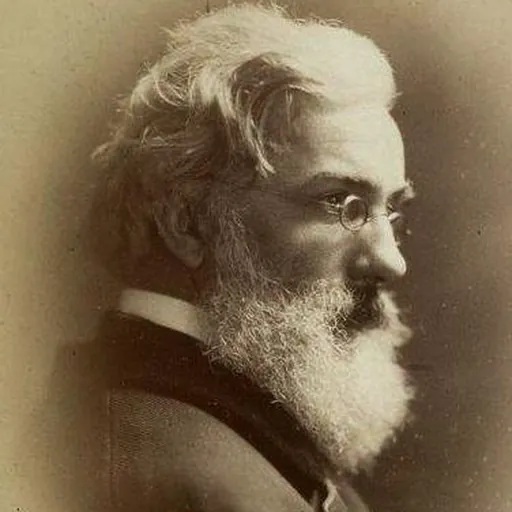
Ernst Georg Ravenstein
German-English geographer and cartographer
About Ernst Georg Ravenstein
Lived 1834 – 1913 (aged 78). Ernst Georg Ravenstein was a German cartographer, autobiographer, statistician, demographer and geographer, known for Human migration.
Ernst Georg Ravenstein (Ernest George) (30 December 1834 – 13 March 1913) was a German-English geographer and cartographer. As a geographer he was less of a traveller than a researcher; his studies led mainly in the direction of cartography and the history of geography.
Ravenstein was born in Frankfurt am Main, Germany, to a family of cartographers. He spent most of his adult life in England in a house at Lorn Road, Lambeth, but he died in Germany, his country of birth, on 13 March 1913.
Work on geography When he was 18 years old he became a pupil of Dr. August Heinrich Petermann. After moving to England, Ravenstein became a naturalised British Subject and was in the service of the Topographical Department of the British War Office for 20 years, from 1855 to 1875. A long-serving member of the councils of the Royal Statistical and Royal Geographical Societies, he was also Professor of Geography at Bedford College in 1882–83. He was the first to receive the Victoria gold medal of the Royal Geographical Society (1902) for "his efforts during 40 years to introduce scientific methods into the cartography of the United Kingdom".
His geographical statistics and projections were respected and used as a basis for official planning at the time.
Printed works His Systematic Atlas (1884) put into practice many of his ideas about methods of teaching cartography. The Philips's World Atlas was published with Ravenstein's plates and statistics for several decades. His Map of Equatorial Africa (1884) was the most notable map of a large part of the continent on a large scale that had been made up to that time, and he immediately developed it as new discoveries were made in Central and Eastern Africa.
Ravenstein also published: Vasco da Gama's First Voyage (1898) The Russians on the Amur (1861) (Full text can be found on Google Books). Handy Volume Atlas (1895; seventh edition, 1907) Martin Behaim. His Life and his Globe (1908) A Life's Work (1908) The New Census Physical, Pictorial, and Descriptive Atlas of the World (1911) Philips' Handy-Volume Atlas of the World containing seventy seven New and Specially Engraved Plates with Statistical Notes & Complete Index (Fourteenth edition, revised to date) History of cartography article for the 1911 Encyclopædia Britannica's "Map" entry.
Estimation of world population In the late 19th century, he estimated the current world population at the time. He also moderately estimates a possible maximum World population that can be sustained by Earth's resources, in the year 2072.
Commenting on Ravenstein's paper on overpopulation presented at the British Association, the Times, stated that Ravenstein "estimates the population of the world for the present year at 1,468,000,000, and, after making careful allowance for various unfavourable circumstances, he comes to the comforting conclusion that the human race may increase to the number of 5,994,000,000 without outrunning the supply of food". Based on an 8 percent increase of population per decade, "the limit of expansion will be reached in 182 years". "He had estimated the world's population for the present year to be 1,468,000,000. He found that the population of the world every 10 years increased 8 percent. The Total population of the cultivable area would be 5,850,700,000, and the total number which the earth could feed was 5,994,000,000 people".
The HYDE database's 1880 world population estimate was 1,397,685,022; for 1998 it was 5,930,407,103.
Work on gymnastics In 1861 Ravenstein established the German Gymnastics Society, a sporting association, in London. It promoted gymnastics and held annual athletic competitions, at a purpose-built German Gymnasium in St Pancras, and at The Crystal Palace. By 1866, the society had 1,100 members, drawn from more than 30 nationalities, with 650 members being Britons, mostly tradesmen. With William Penny Brookes and John Hulley, he was a founder member of the National Olympian Association in 1865, which promoted an annual series of sporting events across the country, inspired by the Olympic Games of Much Wenlock. He published a handbook on gymnastics in 1867.
Don’t just read it —
keep it.
Full-length biographies made to live with: read them, listen on the way to work, watch them tonight.
- E-book
- Audio
- Video
Instant download · yours to keep · every purchase keeps this site free
Important facts
People in Ernst Georg Ravenstein's life
Named in this biography and alive at the same time






Related people
Same field, nearest in time


Contemporaries
People whose lives overlapped Ernst Georg Ravenstein's


Frequently asked questions
Who was Ernst Georg Ravenstein?
German-English geographer and cartographer (1834–1913)
When was Ernst Georg Ravenstein born?
Ernst Georg Ravenstein was born on 30 December 1834 in Frankfurt.
When did Ernst Georg Ravenstein die?
Ernst Georg Ravenstein died on 13 March 1913 in Hofheim am Taunus.
What was Ernst Georg Ravenstein's occupation?
Ernst Georg Ravenstein was a cartographer, autobiographer, statistician, demographer and geographer.
What was Ernst Georg Ravenstein known for?
Ernst Georg Ravenstein was known for Human migration.
What nationality was Ernst Georg Ravenstein?
Ernst Georg Ravenstein was German.
Sources & further reading
· Wikipedia: Ernst Georg Ravenstein
· DBpedia: Ernst Georg Ravenstein
Cite this page
APA: Biography.guide. (2026). Ernst Georg Ravenstein. https://biography.guide/ernst-georg-ravenstein/
MLA: "Ernst Georg Ravenstein." Biography.guide, https://biography.guide/ernst-georg-ravenstein/.
Chicago: "Ernst Georg Ravenstein." Biography.guide. https://biography.guide/ernst-georg-ravenstein/.
Data last updated: 2026-09-23 · Spot an error? Report a correction.
Portrait: Wikimedia Commons · author & licence
Page generated 2026-09-27 05:06 UTC