
About Ernst Degner
Lived 1931 – 1983 (aged 51). Ernst Degner was a German motorcycle racer, engineer and businessperson.
Ernst Degner (born Ernst Eugen Wotzlawek on 22 September 1931 in Gleiwitz, Upper Silesia, Germany - died 10 September 1983 in Arona, Tenerife, Spain) was a professional Grand Prix motorcycle road racer from Eastern Germany. He defected to the west in 1961, taking MZ's and his own tuning techniques to Suzuki, and winning Suzuki's first Grand Prix championship in 1962.
Early life and early career Degner's father died just before the end of World War II. Degner, his older sister and their mother fled from their home in Gleiwitz (now Gliwice, Poland) to avoid the advancing Red Army and wound up in Luckau, German Democratic Republic (East Germany) at the end of the war. Degner's mother died shortly thereafter. Degner attended Potsdam Technical High School and was awarded a diploma in development engineering in 1950. He became an apprentice motorcycle mechanic in Potsdam.
In 1950, Degner joined the Potsdam Motorcycle Club where he met Daniel Zimmermann, a designer and engineer who had built an exceptionally fast 125cc racing motorcycle based on the DKW RT 125. It was called the ZPH, reflecting the surnames of himself and his two riders at that time (Bernhard Petruschke and Diethart Henkel). The ZPH proved faster than the East German factory IFAs (later run under the brand MZ), whose machines were also based on the DKW RT 125. Degner started racing in 1952 and after a successful season, he obtained his licence to ride in the "Ausweisklasse" in 1953. The 1953 season saw Degner record his first victories at the Leipziger Stadtpark and Bernau meetings. He ended the season as runner-up in the 125cc Ausweisklasse (Junior) Championship. Zimmermann provided him with a ZPH engine which Degner used to finish second (after Horst Fugner) in the 1955 East German 125cc Championship.
Racing with MZ Degner's racing successes on the ZPH were noted by the MZ team manager Walter Kaaden, who signed him as an engineer/rider for the Zschopau factory, but only after Degner had secured employment for his girlfriend, Gerda Bastian, at the factory. Degner started his employment with MZ on 1 March 1956, and raced successfully for the East German manufacturer, which used two-stroke engines. After 1957, Kaaden had developed existing principles invented by DKW's Erich Wolff regarding how sound waves and expansion chambers affect engine tuning for the engines. In 1957, Degner won 11 out of 14 125cc races which he competed in for the factory, and finished the season as the 1957 East German 125cc road racing national champion. From 1958 on, the factory entered Degner in all world Championship races and he scored his first world championship victory at the 1959 125cc Nations Grand Prix at Monza.
After the MZ team had discovered his defection, the East German State accused Degner of deliberately destroying his engine in the Swedish race, and the Allgemeiner Deutscher Motorsport Verband (ADMV, "General German Motorsport Federation") lodged a complaint with the FIM. At an FIM court in Geneva, Switzerland, on 25 and 26 November 1961, the court dismissed the charge by MZ that Degner had deliberately wrecked the engine of his MZ at the 1961 Swedish Grand Prix.
Racing with Suzuki In November 1961, Japanese company Suzuki hired him to fulfill his contract, which was to be paid about $25000.00 if he would obtain at least 24 HP from the new 125cc Suzuki engine, which had already been built as well as a new 50cc engine. He moved to Hamamatsu, Japan to work in the Suzuki race shop over the winter.
On 3 November 1962 at Suzuka's inaugural race meeting, Degner crashed when a gust of wind lifted the front wheel of his Suzuki 50cc racer as he rounded Turn 8. To mark Suzuka's first-ever crash, Turn 8, where Degner had crashed, was named Degner Curve.
The crash was witnessed and later reported by Suzuki Japan's racing Hiroyuki Nakano as follows:
In November (1962), the All Japan Championship Race was held at the completed Suzuka Circuit, where Degner raced alone in the lead of the 50cc race and showed great pace, but he fell and retired. The curve he fell at was named the 'Degner curve'.
At the Japanese Grand Prix of 10 November 1963, after a bad start, Degner was last off the grid and crashed his Suzuki 250cc racer on his first lap at the exit to Turn 2 of the Suzuka Circuit. His Suzuki fuel tank was full and burst into flames, enveloping the rider. In his autobiography, Degner's Suzuki teammate Hugh Anderson stated:
As we came out of the first corner on the start of the second lap, we were confronted with frantically waved yellow flags and a great cloud of smoke and flames. Ernst had crashed heavily and was lying unconscious. Frank [Perris] had stopped and marshals, after dragging Ernst from the flames, were busy with their fire extinguishers trying to control the inferno fuelled by 25 litres of petrol. The race carried on.
Degner's burns required over fifty skin grafts and he was unable to return to race in the Suzuki team until September 1964. Later that year, he won the 125cc Japanese Grand Prix.
Motorcycle Grand Prix results Sources: Position 1 2 3 4 5 6 Points 8 6 4 3 2 1
(key) (Races in italics indicate fastest lap)
Year Class Team 1 2 3 4 5 6 7 8 9 10 11 12 13 Points Rank Wins 1956 125cc MZ IOM- NED- BEL- GER0 ULS- NAT- 0 — 0 1957 125cc MZ GER6 IOM- NED- BEL- ULS- NAT- 1 13th 0 1958 125cc MZ IOM5 NED6 BEL- GER3 SWE5 ULS- NAT- 9 7th 0 250cc MZ IOM- NED- GER- SWE- ULS4 NAT- 3 14th 0 1959 125cc MZ IOMNC GER6 NED- BEL- SWE- ULS3 NAT1 13 5th 1 250cc MZ IOMNC GER- NED6 BEL- SWE4 ULS3 NAT2 14 4th 0 1960 125cc MZ IOM- NED5 BEL1 ULS3 NAT3 16 3rd 1 250cc MZ IOM- NED6 BEL- GER- ULS- NAT3 5 8th 01961 125cc MZ ESP2 GER1 FRA2 IOMNC NED- BEL4 DDR1 ULS2 NAT1 SWE- ARG- 42 2nd 3 250cc MZ ESP- GER4 FRA- IOM- NED- BEL- DDR- ULS- NAT- SWE- ARG- 3 13th 01962 50cc Suzuki ESP- FRA- IOM1 NED1 BEL1 GER1 DDR- NAT- FIN4 ARG2 47 1st 4 125 cc Suzuki ESP- FRA5 IOM8 NED4 BEL- GER- ULS- DDR- NAT- FIN- ARG- 5 11th 01963 50cc Suzuki ESP- GER3 FRA2 IOMNC NED1 BEL2 ARG2 JPN- 30 3rd 1 125cc Suzuki ESP- GER1 FRA6 IOM3 NED- BELNC ULS- DDR- FIN- NAT- ARG- JPN3 17 6th 1 1964 125cc Suzuki USA- ESP- FRA- IOM- NED- GER- DDR- ULS- FIN- NAT3 JPN1 12 6th 1 1965 50cc Suzuki USA1 GER- ESP- FRA3 IOM3 NED5 BEL1 JPN- 26 4th 2 125cc Suzuki USA2 GER4 ESP- FRA2 IOM8 NED- DDR- CZE- ULS1 FIN- NAT- JPN- 23 4th 1 1966 50cc Suzuki ESP- GER- NED- IOM4 NAT- JPN- 3 6th 0
Don’t just read it —
keep it.
Full-length biographies made to live with: read them, listen on the way to work, watch them tonight.
- E-book
- Audio
- Video
Instant download · yours to keep · every purchase keeps this site free
Important facts
People in Ernst Degner's life
Named in this biography and alive at the same time


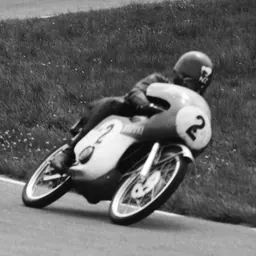

Related people
Same field, nearest in time


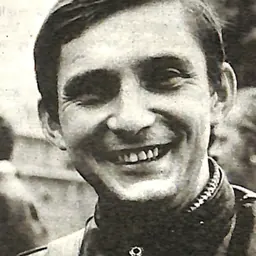
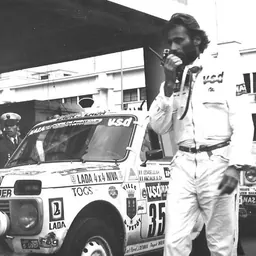
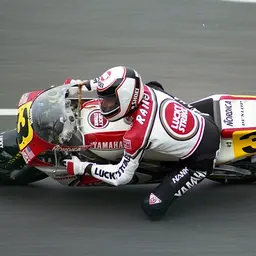
Contemporaries
People whose lives overlapped Ernst Degner's

Frequently asked questions
Who was Ernst Degner?
East German motorcycle racer (1931–1983)
When was Ernst Degner born?
Ernst Degner was born on 22 September 1931 in Gliwice.
When did Ernst Degner die?
Ernst Degner died on 10 September 1983 in Arona.
What was Ernst Degner's occupation?
Ernst Degner was a motorcycle racer, engineer and businessperson.
What nationality was Ernst Degner?
Ernst Degner was German.
Sources & further reading
Cite this page
APA: Biography.guide. (2026). Ernst Degner. https://biography.guide/ernst-degner/
MLA: "Ernst Degner." Biography.guide, https://biography.guide/ernst-degner/.
Chicago: "Ernst Degner." Biography.guide. https://biography.guide/ernst-degner/.
Data last updated: 2026-09-20 · Spot an error? Report a correction.
Page generated 2026-09-27 05:24 UTC