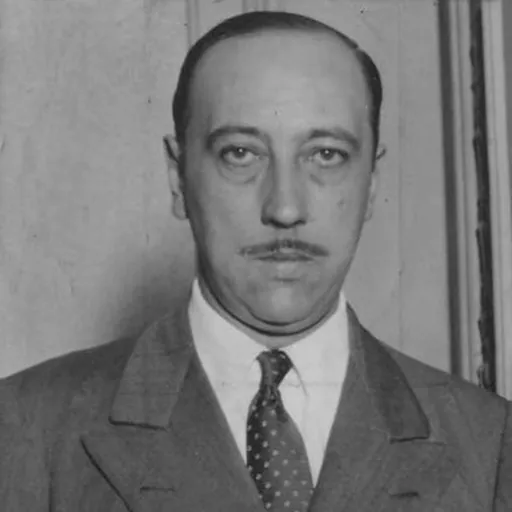
About Ernesto Palacio
Lived 1900 – 1979 (aged 78). Ernesto Palacio was an Argentine historian, politician, writer, journalist and lawyer.
Ernesto Palacio (4 January 1900 in San Martín – 3 January 1979 in Buenos Aires) was an Argentine historian and part of a generation of right-wing nationalist intellectuals active from the 1920s. Their ideology is referred to as Nacionalismo.
Early years Palacio, who was educated at the University of Buenos Aires, was a founder of the avant-garde magazine Martín Fierro and began his political life as an anarchist. However he was attracted to nationalism because the movement promised regeneration of Argentine society and at the same time he became a fervent follower of the Roman Catholic Church. The main influence in his conversion was his friend César Pico and Spanish thinker Ramiro de Maeztu, of whose writings Palacio became a follower.
Following the 1930 coup d'état, Palacio briefly held the position of Minister of the Interior and Public Education in the province of San Juan.
Nationalist activity He wrote regularly for La Nueva Republica (LNR), the right-wing journal established in 1927 that formed the basis for nationalist revival in Argentina's elite. Sharing editing duties with the likes of Juan Carulla, Rodolfo Irazusta and his brother Julio, Roberto de Laferrere and César Pico, the journal developed an Integralist platform based on the ideas of Leopoldo Lugones. He also edited the weekly journal Nuevo Orden which first appeared in July 1940 and presented hard-line Catholic opinions. An enthusiastic fascist, he sought to marry the ideology more closely with religion, arguing that a strongly religious fascist dictator could realise the dream of the "Kingdom of God on Earth". As a writer for this journal, as well as in his capacity as founder and leader of the minor Partido Libertador became a leading voice for anti-British sentiment.
Palacio was one of the members of his generation who became an enthusiast for Peronism and in 1946 he was elected to the Argentine Chamber of Deputies as a coalition candidate. Remaining a deputy until 1952, he claimed to have joined the movement because of the authoritarianism demonstrated by Juan Perón. As an academic he was chair of ancient and Argentine history at the Escuela Comercial de Mujeres from 1931 to 1938 and was appointed as professor of geography at Justo José de Urquiza College in 1942.
Works
La Inspiración y la Gracia ("Inspiration and Grace"), Buenos Aires, Editorial Gleizer, 1929. Catilina. La revolución contra la plutocracia en Roma ("Catilina. The Revolution Against the Plutocracy in Rome"), Buenos Aires, Editorial Rosso, 1935. El Espíritu y la Letra ("The Spirit and the Letter"), Buenos Aires, Editorial Serviam, 1936. Historia de Roma ("History of Rome"), Buenos Aires, Editorial Albatros, 1939. Teoría del Estado ("Theory of the State"), Buenos Aires, Editorial Política, 1949. La historia falsificada ("The Falsified History"), Buenos Aires, A. Peña Lillo Editor, 1960. Historia de la Argentina 1515-1938 ("History of Argentina 1515-1938"), Buenos Aires, Ediciones Alpe, 1954.
Don’t just read it —
keep it.
Full-length biographies made to live with: read them, listen on the way to work, watch them tonight.
- E-book
- Audio
- Video
Instant download · yours to keep · every purchase keeps this site free
Important facts
People in Ernesto Palacio's life
Named in this biography and alive at the same time



Related people
Same field, nearest in time

Contemporaries
People whose lives overlapped Ernesto Palacio's



Frequently asked questions
Who was Ernesto Palacio?
Argentine politician and academic
When was Ernesto Palacio born?
Ernesto Palacio was born on 4 January 1900 in General San Martín.
When did Ernesto Palacio die?
Ernesto Palacio died on 3 January 1979 in Buenos Aires.
What was Ernesto Palacio's occupation?
Ernesto Palacio was a historian, politician, writer, journalist and lawyer.
What nationality was Ernesto Palacio?
Ernesto Palacio was Argentine.
Sources & further reading
· DBpedia: Ernesto Palacio (writer)
Cite this page
APA: Biography.guide. (2026). Ernesto Palacio. https://biography.guide/ernesto-palacio-historian/
MLA: "Ernesto Palacio." Biography.guide, https://biography.guide/ernesto-palacio-historian/.
Chicago: "Ernesto Palacio." Biography.guide. https://biography.guide/ernesto-palacio-historian/.
Data last updated: 2026-09-22 · Spot an error? Report a correction.
Portrait: Wikimedia Commons · author & licence
Page generated 2026-09-27 05:03 UTC