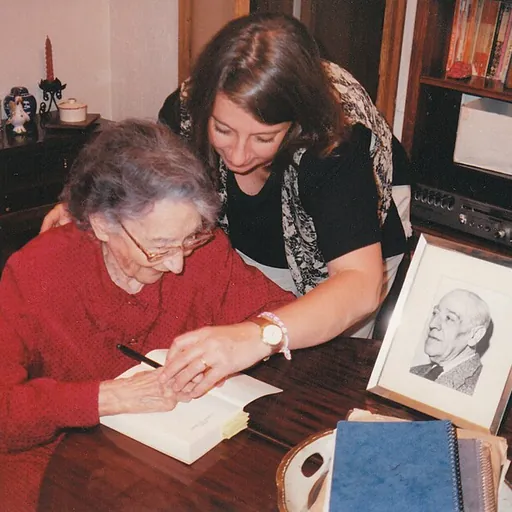
About Ernestina de Champourcín
Lived 1905 – 1999 (aged 93). Ernestina de Champourcín was a Spanish and French poet, writer, prose writer and translator.
Ernestina de Champourcín Morán de Loredo (10 July 1905 in Vitoria-Gasteiz – 27 March 1999 in Madrid) was a Spanish poet. She is most associated with the Generation of '27.
Early life Ernestina Michels de Champourcín Morán de Loredo, was born into a Catholic and traditionalist family, which offered her a thorough education (she was taught a range of different languages) as part of an aristocratic and cultured family atmosphere.
Her father was a lawyer of monarchical ideas, and despite his liberal-conservative inclination, Antonio Michels de Champourcín possessed the title of baron of Champourcín, a title which pointed to his paternal family's origin in Provence. Ernestina's mother, Ernestina Morán de Loredo Castellanos, was born in Montevideo, being the only daughter of a military man, of Asturian descent, with whom she often traveled to Europe.
Her love of reading and the cultured family atmosphere brought her into contact with the greats of universal literature from a very young age, and she grew up with the books of Victor Hugo, Alphonse de Lamartine, Vigny, Maurice Maeterlinck, Paul Verlaine and the great Castilian mystics, John of the Cross and Saint Teresa of Jesus. Later, she read Valle-Inclán, Rubén Darío, Concha Espina, Amado Nervo and, above all, Juan Ramón Jiménez. The figure of Juan Ramón Jiménez is of vital importance in the development of Ernestina as a poet, and in fact, she always considered him as her teacher. Through her acquaintance with him she also got in touch with some of the members of the Generation of '27: Rafael Alberti, Federico García Lorca, Luis Cernuda, Jorge Guillén, Pedro Salinas and Vicente Aleixandre. In addition, thanks to her mentor, she came into contact with classical and modern English poetry (Keats, Shelley, Blake, Yeats).
During the Spanish Civil War, Juan Ramón and his wife, Zenobia Camprubí, concerned about orphaned or abandoned children, founded a kind of committee called the "Junta de Protección de Menores". Ernestina de Champourcín joined as a nurse, but due to problems with some militiamen she had to leave and enter the hospital run by Lola Azaña as a nurse's assistant.
Although at first Champourcín wrote numerous verses for magazines such as Romance and Rueca , her creative activity was reduced due to her economics needs. During this time she worked as a translator for the Mexican publishing house Fondo de Cultura Económica and an interpreter for the "Association of Technical Staff of International Conferences". During this time she wrote Hai-kais espirituales (1967), Cartas cerradas (1968) and Poemas del ser y del estar (1972).
Return from exile In 1972, Champourcín returned to Spain. The return was not easy and she had to go through a new period of adaptation to her own country, an experience that gave rise to feelings that she reflected in works such as Primer exilio (1978). Feelings of loneliness and old age and an invasion of memories of the places she had been in and the people she had lived with flooded each of her later poems: La pared transparente (1984), Huyeron todas las islas (1988), Los encuentros frustrados (1991), Del vacío y sus dones (1993) and Presencia del pasado (1996).
Death and legacy Champourcin died in Madrid on 27 March 1999.
It could be said that de Champourcín suffered the bad luck of the so-called " third ways ", since she was not clearly on the right or left, as was also the case in very different circumstances, with Ortega y Gasset, who was rejected by some as an atheist and by others as an elitist, and simultaneously accused of being on the right and being on the left. A first stage, that of the poetry of human love, includes the four books published before the civil war: from En silencio (1926) to Cántico inútil (1936). In these works the author evolves from origins that could be described as pertaining to late-romanticism and modernism to a “pure poetry” very close to that of Juan Ramón Jiménez.
Third stage: poetry of the memory of love The stage of the poetry of the memory of love (1974–1991) begins with her return from exile, at which time new concerns arose for the author: namely to be able to adapt to her new situation, and to be reunited with places both known and unrecognizable. Her final books, like Huyeron todas las islas (1988), are a memory and an epilogue of a poetry that is both intimate and transcendent.
Works
En silencio. Madrid, Espasa-Calpe, 1926. Ahora. Madrid, Imprenta Brass, 1928. La voz en el viento. Madrid, Compañía Ibero-Americana de Publicaciones, 1931. Cántico inútil. Madrid, Aguilar, 1936. Presencia a oscuras. Madrid, Rialp, 1952. El nombre que me diste.... México, Finisterre, 1960. Cárcel de los sentidos. México, Finisterre, 1964. Hai-kais espirituales. México, Finisterre, 1967. Cartas cerradas. México, Finisterre, 1968. Poemas del ser y del estar. Madrid, Alfaguara, 1972. Primer exilio. Madrid, Rialp, 1978. Poemillas navideños. México, 1983. La pared transparente. Madrid, Los Libros de Fausto, 1984. Huyeron todas las islas. Madrid, Caballo Griego para la Poesía, 1988. Antología poética, (prologue by Luz María Jiménez Faro). Madrid, Torremozas, 1988. Ernestina de Champourcín. Málaga, Centro Cultural de la Generación del 27, 1991. Los encuentros frustrados. Málaga, El Manatí Dorado, 1991. Poesía a través del tiempo. Barcelona, Anthropos, 1991. Del vacío y sus dones. Madrid, Torremozas, 1993. Presencia del pasado (1994–1995) . Málaga, Poesía circulante, núm. 7, 1996. Cántico inútil, Cartas cerradas, Primer exilio, Huyeron todas las islas. Málaga, Centro Cultural de la Generación del 27, 1997. Epistolario (1927–1995) (2007). Correspondencia con Carmen Conde. Edición a cargo de Rosa Fernández Urtasun. . Poesía esencial (2008). Fundación Banco Santander. Colección Obra Fundamental. . Al fin de la tarde
Don’t just read it —
keep it.
Full-length biographies made to live with: read them, listen on the way to work, watch them tonight.
- E-book
- Audio
- Video
Instant download · yours to keep · every purchase keeps this site free
Important facts
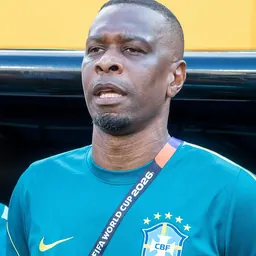
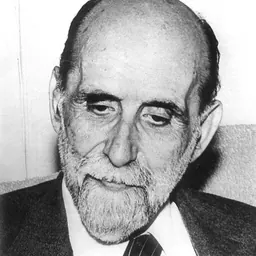
People in Ernestina de Champourcín's life
Named in this biography and alive at the same time

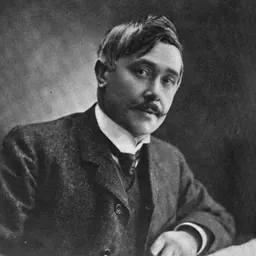
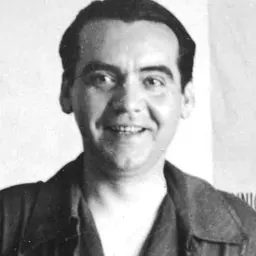

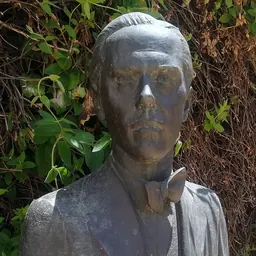
Related people
Same field, nearest in time

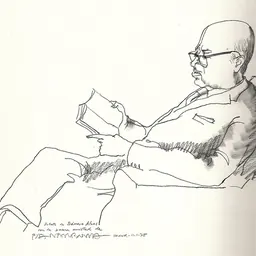

Contemporaries
People whose lives overlapped Ernestina de Champourcín's



Frequently asked questions
Who was Ernestina de Champourcín?
Spanish poet (1905-2019)
When was Ernestina de Champourcín born?
Ernestina de Champourcín was born on 10 July 1905 in Vitoria-Gasteiz.
When did Ernestina de Champourcín die?
Ernestina de Champourcín died on 27 March 1999 in Madrid.
What was Ernestina de Champourcín's occupation?
Ernestina de Champourcín was a poet, writer, prose writer and translator.
What nationality was Ernestina de Champourcín?
Ernestina de Champourcín was Spanish and French.
Sources & further reading
· Wikipedia: Ernestina de Champourcín
· DBpedia: Ernestina de Champourcín
Cite this page
APA: Biography.guide. (2026). Ernestina de Champourcín. https://biography.guide/ernestina-de-champourcin/
MLA: "Ernestina de Champourcín." Biography.guide, https://biography.guide/ernestina-de-champourcin/.
Chicago: "Ernestina de Champourcín." Biography.guide. https://biography.guide/ernestina-de-champourcin/.
Data last updated: 2026-09-22 · Spot an error? Report a correction.
Portrait: Wikimedia Commons · author & licence
Page generated 2026-09-27 05:02 UTC