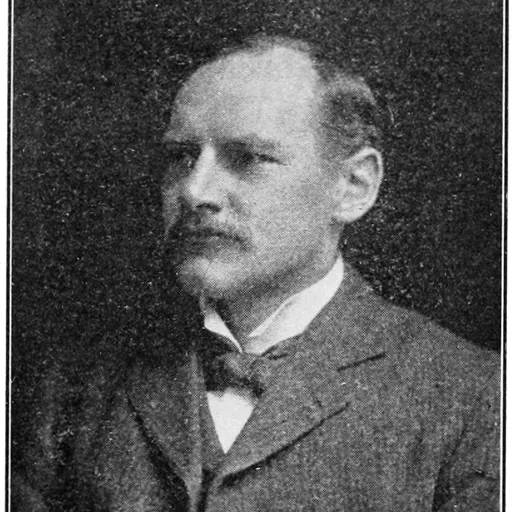
Ernest William Brown
English-American astronomer and mathematician
About Ernest William Brown
Lived 1866 – 1938 (aged 71). Ernest William Brown was a British and American mathematician and astronomer, known for Celestial mechanics and Lunar theory.
His life's work was the study of the Moon's motion (lunar theory) and the compilation of extremely accurate lunar tables. He also studied the motion of the planets and calculated the orbits of Trojan asteroids.
Life and career Brown was born in Hull, England, the second of four children of William and Emma Brown (née Martin). His father was originally a farmer and later became a timber merchant. His mother and younger brother died of scarlet fever in 1870, when Brown was not quite 4 years old. He and his two sisters were then looked after by a maiden aunt, until his father remarried five years later.
Education and early career Brown was educated at Totteridge Park School, Hertfordshire (now part of Dorset House School) and Hull and East Riding College. After leaving school, he entered Christ's College, Cambridge, where he graduated with first-class honours as sixth Wrangler in mathematics in 1887. He continued with post-graduate studies at Cambridge and worked under the direction of George Howard Darwin. In the summer of 1888, Darwin suggested that he study the papers of George William Hill on the lunar theory. As it turned out, this idea for a line of research was to have a major impact on the remainder of Brown's life.
Brown was made a fellow of Christ's College in 1889 and was elected as a Fellow of the Royal Astronomical Society in the same year. He received his master's degree in 1891 and then left Cambridge to take up a place as a mathematics instructor at Haverford College, Pennsylvania. There, he rose rapidly to the position of Professor of Mathematics in 1893. However, he continued most years to return to Cambridge during the summer, often staying with his old tutor, Darwin.
Work on the motion of the Moon At Haverford, Brown continued with his studies of the lunar theory, and made a thorough review of the work of earlier researchers, such as Hill, de Pontécoulant, Delaunay and Hansen. His mastery of the field was shown by the publication of his first great work, An Introductory Treatise on the Lunar Theory, in 1896, when Brown was still less than 30 years of age. The following year, he was elected as a Fellow of the Royal Society. Later work has shown this to be true, and astronomers now make a distinction between Universal Time, which is based on the Earth's rotation, and Terrestrial Time (formerly Ephemeris time), which is a uniform measure of the passage of time (see also ΔT).
Later work and collaborations Brown was an active member of the American Mathematical Society and served as its president from 1915 to 1916.
He retained his professorship at Yale until he retired in 1932. As well as continuing his work on the Moon, he also worked on the motion of the planets around the Sun. In 1933, he published the book, Planetary Theory, co-authored with Clarence Shook, which contained a detailed exposition of resonance in planetary orbits and examined the special case of the Trojan asteroids. In 1937, he was awarded the Watson Medal by the US National Academy of Sciences.
One of Brown's post-graduate pupils was Wallace John Eckert, who became an instructor at Columbia University while finishing his doctorate. Eckert would improve the pace of astronomical calculations by automating them with digital computers.
Private life British Association members on the voyage to South Africa, 1905. Brown is seated at bottom right. Brown never married, and for most of his adult life lived with his unmarried younger sister, Mildred, who kept house for him. She made it her job to shield him from "cares and disturbances" and succeeded in "utterly spoiling him."
His daily routine was unusual, and was described as follows:
By the middle of the 20th century, the difference between Universal and Ephemeris Time had been recognised and evaluated, and the troublesome empirical terms were removed.
Eventually, in 1984, Brown's work was replaced by results gained from more modern observational data (including data from lunar laser ranging) and altogether new computational methods for calculating the Moon's ephemeris.
Honours
Awards Adams Prize (1907) Gold Medal of the Royal Astronomical Society (1907) Bruce Medal (1920) James Craig Watson Medal (1936)
Named after him The crater Brown on the Moon Asteroid 1643 Brown Brown lunation number
Don’t just read it —
keep it.
Full-length biographies made to live with: read them, listen on the way to work, watch them tonight.
- E-book
- Audio
- Video
Instant download · yours to keep · every purchase keeps this site free
Important facts
People in Ernest William Brown's life
Named in this biography and alive at the same time




Related people
Same field, nearest in time



Contemporaries
People whose lives overlapped Ernest William Brown's



Frequently asked questions
Who was Ernest William Brown?
English-American astronomer and mathematician
When was Ernest William Brown born?
Ernest William Brown was born on 29 November 1866 in Kingston upon Hull.
When did Ernest William Brown die?
Ernest William Brown died on 22 July 1938 in New Haven.
What was Ernest William Brown's occupation?
Ernest William Brown was a mathematician and astronomer.
What was Ernest William Brown known for?
Ernest William Brown was known for Celestial mechanics and Lunar theory.
What nationality was Ernest William Brown?
Ernest William Brown was British and American.
Sources & further reading
· Wikipedia: Ernest William Brown
· DBpedia: Ernest William Brown
Cite this page
APA: Biography.guide. (2026). Ernest William Brown. https://biography.guide/ernest-william-brown/
MLA: "Ernest William Brown." Biography.guide, https://biography.guide/ernest-william-brown/.
Chicago: "Ernest William Brown." Biography.guide. https://biography.guide/ernest-william-brown/.
Data last updated: 2026-09-21 · Spot an error? Report a correction.
Portrait: Wikimedia Commons · author & licence
Page generated 2026-09-27 04:59 UTC