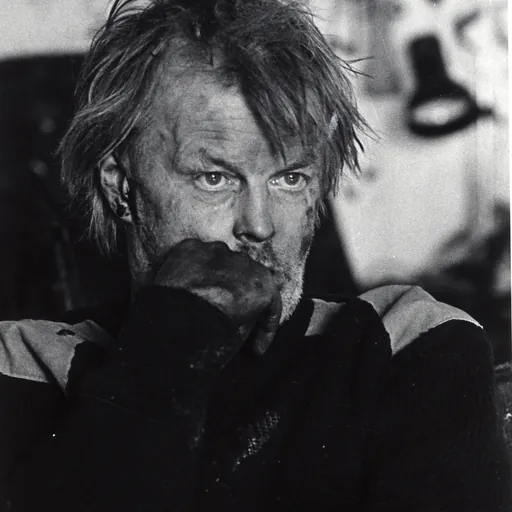
About Erland Cullberg
Lived 1931 – 2012 (aged 81). Erland Cullberg was a Swedish painter.
Johan Erland Cullberg (5 April 1931 – 13 April 2012) was a Swedish artist. He lived and worked in the city of Sollentuna, Sweden. He was the son of Eva Carin Maria Virgin (who worked in a manner similar to a Chinese "barefoot doctor") and Bishop John Cullberg, a professor and theologian.
Cullberg studied from 1955 until 1957 at the Academy of Fine Arts in Stockholm and also at Valand Art Academy in Gothenburg in 1956. Cullberg also studied under and maintained a friendship with the artist Evert Lundquist who is considered to be a central figure in Swedish art.
Cullberg has continually been represented in various national and international auctions during his lifetime, and since his death, however, his works have recently garnered renewed interest culminating in the highest auction records to date. In 2021, Cullberg's "Red Figures", a large scale and richly colored work, reached a world record for the artist. Similar records have been achieved since 2020.
Inspiration, style and method of artistic work Cullberg found inspiration in the works of El Greco, Carl Fredrik Hill, and Ernst Josephson but was particularly inspired by Edvard Munch. Artist and art critic Leif Mattsson has written, much like Munch, Cullberg repeated his forms so that they became forms the viewer "had experienced". Cullberg had stated that he used color like Munch and that he was an "apostate" of Picasso. His method, or style of painting, was unusual. When, or if, the motif of the painting had become too realistic, Cullberg would begin a process of painting over them. His style/method of painting motif over motif and his dense and copious use of color over color earned him the moniker of "the over-painter". While the moniker "over-painter" was a somewhat humorous one, it was not derogatory; Cullberg was also termed "Sweden's Rembrandt". Cullberg stated that the process of modulating the colors through over-painting, and thereby achieving his desired result, gave him a "tremendous satisfaction." The only problem Cullberg found with this method was in obtaining the necessary amounts of raw materials to create a large number of works. Art critic Anders Olsson suggested that Cullburg's over-painting was something of a controlled destructive process which ultimately allowed, "a new vision upon the by now soiled vision." Cullberg had become his artwork's creator, destroyer and then its re-creator.
Cullberg's "The Scream" Cullberg's "The Scream" demonstrates his inspiration from, and his admiration of, Edvard Munch's artistry. "The Scream" is generally interpreted as a visual metaphor used by Munch to express his own mental instability, personal failures, and anxieties. The exact nature of the work and subsequently its interpretations continue to make for a lively discourse. Shortly after painting "The Scream", Munch entered a mental health facility as he had been hearing "voices". Perhaps beyond an artistic kinship, given his own mental health issues, Cullberg may have felt a level of identification with the intent and circumstances which led Munch to produce "The Scream". In Cullberg's version, the central motif is recreated within his own style, becoming a work of Cullberg, as opposed to Cullberg reproducing only a copy of Munch's work. The Northern European "Romanticists" produced "intensity meditative images" which sought to channel their own inner spiritual truth(s). Perhaps, the concept was taken the furthest by Hilma af Klint. Klint produced the first truly abstract artworks known; she developed her artwork in what she believed was direct communication with the metaphysical world through seance and automatic writing. Art critic Susanna Slöör shares one story about Cullberg and the metaphysical world. Cullberg had received a visit from a fellow artist who commented on the success of a particular painting. Cullberg is said to have stated, emphatically, that the work was an "Ängladyk". "Ängla, dyk", translated to English, means "angel dive" (the work was driven by angels/metaphysical forces). Slöör, in writing about the possible connotation of this suggestion by Cullberg, compared it to a belief held by monks who painted religious pictures with the faith, or hope, that the divine would lead them to successfully produce their religious artworks. The monks had thus become a channel for use by the divine. In applying the concept to modern day artists who might attribute their work to such a metaphysical interaction, Slöör suggests such a moment usually occurs when the artist completes a successful work but is not able to explain precisely to themselves or others how they achieved it. In 1977, Cullberg perhaps returned to, or confirmed this belief when he produced a work titled "Ängladyk". "Ängladyk" was included in his exhibition at Konstakademien, Salarna, Stockholm. Other works in the exhibition included "Shelly's Death" (1979), "Unknown Poet" (1982) and "The Wizard's Pupil" (2007).
Emergence of mental difficulties In 2018, Cullberg's sibling Dr. Johan Cullberg recalled the night in 1956 when Erland Cullberg was discovered outside his home in Stockholm. Erland, barely able to speak, had claimed he had spoken to both Picasso and Mozart. Johan began the process to commit Erland for psychiatric care. Erland was placed in Beckomberga, a mental facility in Bromma. When Johan next visited Erland, he was horrified to find him tied to a bed and in an unsanitary state. This would cause Johan to have a deep dislike of Beckomberga and may have contributed to his lifelong passion for developing supportive and reasonable care for those facing mental issues. Erland would receive in excess of one hundred Electroconvulsive therapy sessions along with high doses of medication. Despite the treatment, Erland remained depressed. In 1961, Johan would become a psychiatrist and eventually would take over Erland's treatment and successfully lower his medication levels. Throughout the ordeal, Erland continued to paint.
Cullberg interview highlights In 1980, Anders Widoff spoke with Cullberg in his studio. The artist spoke about his personal life and his artwork. Cullberg recalled his father and what he seemed to feel were his own failings in regards to his father's teaching. Cullberg's father was a Bishop of the Diocese of Västerås. Cullberg felt he was born in the same light as Jesus but had now become inferior to him saying, "if you step off that light, then it's down to hell direct". Cullberg went on to suggest that such a theme might be a good one for a painting. He imagined the motif as a "machine that gobbles up people." Cullberg claimed that he did not distinguish between good and evil himself. A total of forty-seven solo exhibitions were held between the years of 1961 and 1985. His breakthrough with the general public occurred during the 1980s. He participated in a traveling exhibition that was shown in Sweden at numerous art institutes and was well received by the public. The exhibition then traveled to Centre Culturel Suédois in Paris. was filmed at the artist's studio. The film addressed Cullberg's near obsession with painting, his work, his method of painting and his schizophrenia.
In May, 2019, siblings Staffan and Johan established the Erland Cullberg scholarship for young artists.
Museum representation Nationalmuseum, Stocholm, Sweden; Moderna Museum, Stockholm, Sweden; Göteborgs konstmuseum, Göteborgs, Sweden; Borås konstmuseum, Borås, Sweden; Östergötland Länsmuseum, Linköping, Sweden; Norrköpings Museum, Norrköping, Sweden; Västerås konstmuseum, Västerås, Sweden; Åbo konstmuseum, Turku, Finland; Statens Museum, Copenhagen, Denmark; Museum für Kunst und Kulturgeschichte der hansestadt Lübeck, Lübeck, Germany.
Don’t just read it —
keep it.
Full-length biographies made to live with: read them, listen on the way to work, watch them tonight.
- E-book
- Audio
- Video
Instant download · yours to keep · every purchase keeps this site free
Important facts
People in Erland Cullberg's life
Named in this biography and alive at the same time




Related people
Same field, nearest in time




Contemporaries
People whose lives overlapped Erland Cullberg's

Frequently asked questions
Who was Erland Cullberg?
Swedish artist (1931–2012)
When was Erland Cullberg born?
Erland Cullberg was born on 5 April 1931 in Uppsala Cathedral Assembly.
When did Erland Cullberg die?
Erland Cullberg died on 13 April 2012 in Stockholm, Sollentuna parish.
What was Erland Cullberg's occupation?
Erland Cullberg was a painter.
What nationality was Erland Cullberg?
Erland Cullberg was Swedish.
Sources & further reading
Cite this page
APA: Biography.guide. (2026). Erland Cullberg. https://biography.guide/erland-cullberg/
MLA: "Erland Cullberg." Biography.guide, https://biography.guide/erland-cullberg/.
Chicago: "Erland Cullberg." Biography.guide. https://biography.guide/erland-cullberg/.
Data last updated: 2026-09-20 · Spot an error? Report a correction.
Portrait: Wikimedia Commons · author & licence
Page generated 2026-09-27 04:57 UTC