
About Erik Jorpes
Lived 1894 – 1973 (aged 78). Erik Jorpes was a Swedish and Finnish physician, chemist and biochemist, known for Heparin.
Johan Erik Jorpes (born Johansson, 15 July 1894 – 10 July 1973 ) was a Finnish-born Swedish physician and biochemist. He identified the chemical structure of heparin and developed its clinical applications. Jorpes was the professor of medical chemistry in the Karolinska Institute in Stockholm in 1946–1963.
Early life Erik Jorpes was born as Johan Erik Johansson to a poor fisherman's family in the village of Överboda in Kökar in Åland. The family lived in a house called Jorpes, which he later adopted as his last name to replace the patronyme Johansson. After the primary school, his parents send the talented kid to high school in Turku. Other students of the Swedish-language school Svenska klassiska lyceum came mostly from wealthy upper-class families, Jorpes was bullied of his social status and dialect. As a result, Jorpes got interested in socialist ideas in the early 1910s. He joined the local Social Democratic student organization and wrote marxist articles to the newspaper Arbetet. Jorpes was then shipped to his parents home in Kökar by local fishermen who soon smuggled him to Vaxholm in Sweden. The fisherman who smuggled Jorpes were fined later for helping a criminal escape. The police visited the family a day after Jorpes had left.
Life in Sweden Jorpes arrived Stockholm in October 1919. He had no money, but managed to find a place to live and with the help of the prominent Social Democrat politician Hjalmar Branting, Jorpes was able to continue his medical studies in the Karolinska Institute. after promising to quit the politics. In 1923, Jorpes was granted the Swedish citizenship. Three years later he was appointed assistant professor in the Department of Chemistry and Pharmacology, and in 1946 Jorpes was named the professor of medical chemistry. Jorpes retired in 1963 and continued as a professor emeritus until his death in 1973. In 1949–1951, Jorpes and his predecessor, the professor Einar Hammarsten had a major influence on the architectural design of the building of chemistry of the Karolinska Institute Campus in Solna. The drawings were originally made in 1937 by the architect Tore Rydberg but the construction was postponed due to the World War II.
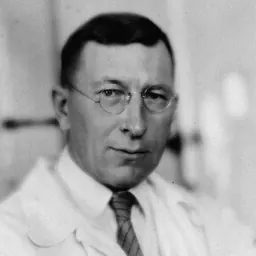
His first research involved pancreatic nucleic acids. Jorpes completed his German dissertation Über Pentosennucleinsäuren im Tierorganismus unter besonderer Berücksichtigung der Pancreasnucleinsäuren in 1928. After earning his doctorate, Jorpes received a scholarship from the Rockefeller Foundation and spent the academic year 1928–1929 in the Rockefeller University in New York City. He also visited the University of Toronto, where Jorpes studied the preparation of insulin in the Connaught Laboratories under the guidance of the Nobel-winning biochemists Frederick Banting and John Macleod. After returning Sweden, Jorpes launched the production of insulin in the laboratory of the pharmaceutical company Vitrum AB. The royalties soon made him a multimillionaire, but Jorpes gave most of his income to academic research or charity.
Jorpes was known as a strong personality. There was often tensions between Jorpes and his students and colleagues. He was also a workaholic who enjoyed his time in the laboratory.
In 1945, he became a member of the Royal Swedish Academy of Sciences. During his late years, Jorpes translated Russian literature to Swedish, wrote biographies of Nobel-awarded scientists, and published popular science articles in the Social Democratic newspaper Arbetarbladet.
Personal life Erik Jorpes was married with Ida Elvira Ståhl (1896–1976) in 1930.
Jorpes was a biography author, and wrote multiple biographies over famous chemists. His most well known biography was written over Swedish chemist Jöns Berzelius, whom Jorpes wrote about in 1960. He also helped to redesign the Berzelius museum in his free time in the 1970s. He also wrote biographies on chemists Alexander Schmidt, Alfred Nobel, and Carl Linnæus.
Jorpes often took his family on summer holiday to their vacation house on Runmarö, a Stockholm island, where he would to teach his sons about the birds, flowers, and fish on the island. Jorpes and his wife are buried on Runmarö.
Don’t just read it —
keep it.
Full-length biographies made to live with: read them, listen on the way to work, watch them tonight.
- E-book
- Audio
- Video
Instant download · yours to keep · every purchase keeps this site free
Important facts
People in Erik Jorpes's life
Named in this biography and alive at the same time






Related people
Same field, nearest in time
Contemporaries
People whose lives overlapped Erik Jorpes's


Frequently asked questions
Who was Erik Jorpes?
Finnish-Swedish physician and biochemist
When was Erik Jorpes born?
Erik Jorpes was born on 15 July 1894 in Kökar.
When did Erik Jorpes die?
Erik Jorpes died on 10 July 1973 in Finnish church parish, Stockholm.
What was Erik Jorpes's occupation?
Erik Jorpes was a physician, chemist and biochemist.
What was Erik Jorpes known for?
Erik Jorpes was known for Heparin.
What nationality was Erik Jorpes?
Erik Jorpes was Swedish and Finnish.
Sources & further reading
Cite this page
APA: Biography.guide. (2026). Erik Jorpes. https://biography.guide/erik-jorpes/
MLA: "Erik Jorpes." Biography.guide, https://biography.guide/erik-jorpes/.
Chicago: "Erik Jorpes." Biography.guide. https://biography.guide/erik-jorpes/.
Data last updated: 2026-09-25 · Spot an error? Report a correction.
Page generated 2026-09-27 05:12 UTC