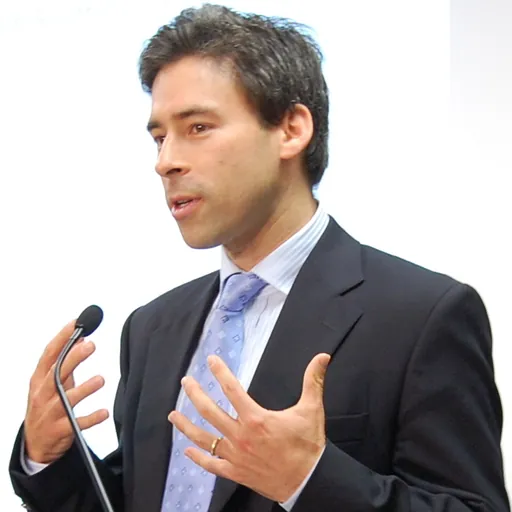
Eric Kaufmann
Canadian scholar and Political science professor
About Eric Kaufmann
Born 1970. Eric Kaufmann is a Canadian political scientist, university teacher, writer and sociologist, known for Whiteshift (book).
Eric Peter Kaufmann (born 11 May 1970) is a Canadian professor of politics and writer at the University of Buckingham. He was appointed in October 2023, following his resignation from his post at Birkbeck, University of London, after two decades of work, citing political differences. He is a specialist on Orangeism in Northern Ireland, nationalism, and political and religious demography. He has authored, co-authored, and edited books and other publications on these subjects.
Early life and education Eric Kaufmann was born in Hong Kong and raised in Vancouver, British Columbia, Canada, and Japan. His ancestry is half Jewish, one-quarter Chinese and one-quarter Costa Rican. His father Steve Kaufmann is of Jewish descent, He received his BA from the University of Western Ontario in 1991. He received his MSc from the London School of Economics in 1994 where he subsequently also completed his PhD in 1998.
Career and contributions Kaufmann was lecturer in comparative politics at the University of Southampton from 1999 to 2003. He was a fellow at the Belfer Center, Kennedy School of Government, Harvard University, for the 2008–09 academic year. Kaufmann joined Birkbeck College, University of London, in 2003. He became professor of politics there in 2011. He has been an adjunct fellow of the conservatarian Manhattan Institute think tank since 2020. In 2023, Kaufmann resigned from Birkbeck College after two decades in his posts and joined the University of Buckingham in October.
Political demography Kaufmann has argued that in the Western world, as the second demographic transition occurred during the 1960s, people began moving away from traditional, communal values towards more expressive, individualistic outlooks, owing to access to and aspiration for higher education. These changing values were also influenced by the spread of lifestyles once practiced only by a tiny minority of cultural elites. The first demographic transition resulted from falling fertility due to urbanization and decreased infant mortality rates, which diminished the benefits and increased the costs of raising children. In other words, it made more economic sense to invest more in fewer children, as economist Gary Becker argued. Although the momentous cultural changes of the 1960s leveled off by the 1990s, the social and cultural environment of the very late twentieth-century was quite different from that of the 1950s. Such changes in values have had a major effect on fertility: member states of the European Economic Community saw a steady increase in not just divorce and out-of-wedlock births between 1960 and 1985 but also falling fertility rates.
In 1981, a survey of countries across the industrialized world found that while more than half of people aged 65 and over thought that women needed children to be fulfilled, only 35% of those between the ages of 15 and 24 (younger Baby Boomers and older Generation X) agreed. According to the World Religious Database, the proportion of the human population identifying with a religion increased from 81% in 1970 to 85% in 2000 and is predicted to rise to 87% in 2025. In addition, the Catholic Church has gained 12% additional followers between 2000 and 2010, mainly from Asia and Africa. Meanwhile, the expansion of secularism will slow in Europe as the twenty-first century progresses. Ultra-Orthodox Jewish women in Israel had on average 7.5 children compared to their more mainstream counterparts with just over two in the early 2000s. He has called "woke" ideas "a battle for the foundations of our civilisation" and has expressed support for Florida governor Ron DeSantis, arguing at the 2022 British Conservative Party conference that the party should follow DeSantis's lead. For Kaufmann, although some of his educational policies "go too far", "DeSantis is the future of conservatism".
Books Rise and Fall of Anglo-America (2004)
Here, Kaufmann offers his views on how the Anglo-Protestants, the founding stock and once dominant ethnocultural group of the United States of America, lost its status of dominance. He rejects the conventional view that this is due primarily to comparatively low fertility rates, large-scale international migration, and the growth in cultural prominence of ethnically diverse newcomers. Nor have the Anglo-Protestants maintained their dominant status by incorporating other groups of European descent into their midst, Kaufmann argues. Rather, the fall of Anglo-America is a consequence of the characteristics that have come to define this group, namely expressive individualism and egalitarianism, which are antithetical to maintaining dominance.
Historically, the early Anglo-Protestant settlers in the seventeenth century were the most successful, creating numerous surviving written records and political institutions that last till this day. For this reason, they became the dominant group, culturally, economically, and politically, and they maintained their dominance till the early twentieth century. Commitment to the ideals of the Enlightenment meant that they sought to assimilate newcomers from outside of the British Isles, but few were interested in adopting a pan-European identity for the nation, much less turning it into a global melting pot. But in the early 1900s, liberal progressives and modernists began promoting more inclusive ideals for what the national identity of the United States should be. While the more traditionalist segments of society continued to maintain their Anglo-Protestant ethnocultural traditions, universalism and cosmopolitanism started gaining favor among the elites. These ideals became institutionalized after the Second World War, and ethnic minorities started to gain rough institutional parity with the once dominant Anglo-Protestants.
He observed that moderate faith of the Abrahamic variety is under pressure from both secularists and fundamentalists as they find themselves living in the secularizing societies of the West. If it were only true that the religious were having more children than secular people, Kaufmann argues that the effects of the incoming demographic transformation would only be national, but because those who are having the most children tend to be intensely religious, he predicted that there would also be ramifications for international relations. However, Kaufmann rejected the increasingly popular notion that Islam will become the dominant religion in Europe by the end of the twenty-first century; rather, he suggests that Muslims will stabilize at around a fifth of the European population by 2100.
Whiteshift (2018)
Whiteshift: Populism, Immigration and the Future of White Majorities. Harry N. Abrams, 2018.
In the late twentieth and early twenty-first century, Kaufmann argues that, unlike Japan, the nations in Western Europe, North America, and Oceania did not experience a population decline despite having mostly sub-replacement fertility. This was due to a combination of extended longevity and international migration, and the latter comes with its own political risks. Eric Kaufmann's Whiteshift is an extensive study of how the migration-driven demographic transformation of the West affects the ballot box. The title of the 2018 book encodes Kaufmann's predictions that, as a result of international migration, Western countries will become ever more ethnically diverse and a growing number of people will be of mixed heritage. He further argues that the category of 'white people' will be enlarged to include more ethnically diverse individuals. For Kaufmann, one of the major schisms in the political landscape of the West at the time of writing is due to factions that want to speed up this process and those who want to slow it down. He suggested that the surge of nationalism and populism observed in many Western countries is due to the latter group. For decades, the norms of acceptable political demands had been established by the media, institutions of higher education, and mainstream political groups. Such norms include what he called "left modernism," a more precise term for what is commonly referred to as political correctness, and "asymmetrical multiculturalism," or the idea that all cultures present in a given society deserve to be preserved except the host culture. These norms have prevented mainstream politicians and political parties from responding to the concerns of large swathes of the voting population, giving nationalist populists an opportunity to rise to the front. Despite an emphasis on white reaction to demographic change and mass migration, Kaufmann gave Proposition 187, a 1994 California ballot initiative aimed at preventing taxpayers' money from going to illegal aliens, as an example of opposition from non-whites. Proposition 187 received support from a majority of Asians and blacks and a third of Hispanics. who called it "a big controversial book about a big controversial subject". Publishers Weekly said it was "likely to make a big splash", and The Financial Times listed it as one of the 'Best books of 2018' in the politics genre. The New Yorker wrote that Kaufmann's Whiteshift was defending white identity politics. Daniel Trilling, in the London Review of Books, was critical of the book, describing Kaufmann's frame of reference as "both too broad and too narrow".
Kenan Malik wrote that "Whiteshift is a hefty work crammed with data and graphs. The trouble with viewing the world primarily in demographic terms, though, is that, for all the facts and figures, it is easy to be blind to the social context."
In a review symposium about Whiteshift published in the journal Ethnicities, political scientist Rob Ford wrote that "There is much to admire here. Kaufmann is methodologically catholic and draws on a rich range of different resources to examine and interrogate evolving white identity politics." However, he also noted "Kaufmann’s rather Manichean account of white ethnic politics involves some curious omissions and misunderstandings" and that "lack of balance is a recurring feature of Kaufmann’s discussions about the competing claims of ethno-cultural whites, cosmopolitan whites and ethnic minorities." Sociologist John Holmwood argued that the lack of any discussion of "settler colonialism or of the place of first Nation populations and enslavement of African Americans and Jim Crow segregation in the USA" represent "serious – in fact, fatal – omissions in a book concerned to rehabilitate symbols of white identity." Holmwood writes that "It is a very large book – 619 pages – but it is also poorly edited, repetitive and, I have suggested, partial."
Other selected publications Authored The Orange Order: A Contemporary Northern Irish History. Oxford University Press, Oxford, 2007. Unionism and Orangeism in Northern Ireland Since 1945: The Decline of the Loyal Family with Henry Patterson. Manchester University Press, Manchester, 2007. The Third Awokening. Bombardier Books, 2024.
Co-authored and edited Rethinking Ethnicity: Majority Groups and Dominant Minorities. Routledge, 2004. Political Demography: How Population Changes Are Reshaping International Security and National Politics with Jack Goldstone and Monica Duffy Toft. Oxford University Press, 2012. Whither the Child: Causes and Consequences of Low Fertility with W. Bradford Wilcox. Paradigm, 2012. Nationalism and Conflict Management with Robert Schertzer and Eric Taylor Woods. Routledge, 2012.
Don’t just read it —
keep it.
Full-length biographies made to live with: read them, listen on the way to work, watch them tonight.
- E-book
- Audio
- Video
Instant download · yours to keep · every purchase keeps this site free
Important facts
People in Eric Kaufmann's life
Named in this biography and alive at the same time







Related people
Same field, nearest in time




Contemporaries
People whose lives overlapped Eric Kaufmann's




Frequently asked questions
Who is Eric Kaufmann?
Canadian scholar and Political science professor
When was Eric Kaufmann born?
Eric Kaufmann was born on 11 May 1970 in British Hong Kong.
What is Eric Kaufmann's occupation?
Eric Kaufmann is a political scientist, university teacher, writer and sociologist.
What is Eric Kaufmann known for?
Eric Kaufmann is known for Whiteshift (book).
What nationality is Eric Kaufmann?
Eric Kaufmann is Canadian.
Sources & further reading
Cite this page
APA: Biography.guide. (2026). Eric Kaufmann. https://biography.guide/eric-kaufmann/
MLA: "Eric Kaufmann." Biography.guide, https://biography.guide/eric-kaufmann/.
Chicago: "Eric Kaufmann." Biography.guide. https://biography.guide/eric-kaufmann/.
Data last updated: 2026-09-20 · Spot an error? Report a correction.
Portrait: Wikimedia Commons · author & licence
Page generated 2026-09-27 04:58 UTC