
About Eric Betts
Lived 1897 – 1971 (aged 74). Eric Betts was a flying ace.
Eric Bourne Coulter Betts (24 January 1897 – 30 October 1971) was an Irish air officer of the British Royal Air Force. He began his career in the Royal Naval Air Service during the First World War. He became a flying ace credited with six aerial victories, although acedom was incidental to his more important mission of long range photographic reconnaissance, for which he was decorated.
He remained in military service post-war, rising through the ranks of the Royal Air Force to group captain just before the Second World War began. As that war started, he was an influential participant in the United Kingdom's effort to gear up for the conflict; his sixteen early forecasts of needed personnel and logistic requirements for the Royal Air Force were accurate within a five percent margin.
Later in the war, having been promoted to air vice marshal, he was in charge of administration for Middle East Command. He retired in that rank post-war, on 10 March 1946.
He was seconded for duty in the Royal Naval Air Service, and assigned to No. 2 (Naval) Squadron as an aerial observer. He gained his first confirmed aerial victory on 1 February 1917, while manning the guns in the rear seat of a Sopwith 1½ Strutter on a long range reconnaissance mission. By June, he was assigned to Hendon NAS; the Admiralty planned long range photographic reconnaissance of German naval bases to the west of the Kiel Canal, and Betts was selected to fly in the Airco DH.4 modified for this mission. Although the mission was cancelled, and the aircraft and air crews were reassigned to Great Yarmouth in August 1917, Betts' award citation for the Distinguished Flying Cross (DFC) credited him with more than 20 successful long range photo-reconnaissance missions. and remained with No. 2 Naval Squadron when it became No. 202 Squadron of the newly formed Royal Air Force on 1 April 1918. On 5 December 1919 he was posted to observer duty aboard the carrier , receiving promotion to flight lieutenant on 30 June 1921. On 28 February 1922 Betts left Pegasus, and was posted to the RAF Depot (Inland Area) as a supernumerary, before attending the RAF Staff College, Andover from 3 April 1922.
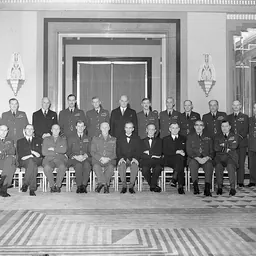
Staff and students at the first RAF Staff College course, 7 December 1922.(Flt. Lt. Betts, middle row far right.) He was one of the first students at the Staff College, which had only just opened under the command of Air Commodore Robert Brooke-Popham. The Directing Staff included Air Commodore Robert Clark-Hall, Group Captain Philip Joubert de la Ferté, Wing Commanders Wilfrid Freeman and Charles Edmonds, and Squadron Leader Bertine Sutton, while Betts' fellow students included Wing Commanders Jack Baldwin and Richard Peirse, Squadron Leaders Conway Pulford, Keith Park, Wilfred McClaughry and Charles Portal, and Flight Lieutenants Harold Kerby and John Cole-Hamilton.
On 4 April 1923, he began pilot's training at No. 1 Flying Training School. On 17 September 1923, he began staff duty at Headquarters, Inland Area. From there, he moved on to become a Qualified Flying Instructor While there, he was promoted to squadron leader on 29 May 1929.
Betts went upon foreign service next, being assigned to the Air Staff at Headquarters, British Forces Aden on 16 November 1929. He would remain there until being returned to Britain and deemed supernumerary on 5 March 1932. he returned to staff duty, this time in the Wessex Bombing Area, starting on 8 August 1932. After that, he was given command of No. 101 (Bomber) Squadron RAF on 21 December 1933.
On 1 January 1936, he was promoted to wing commander. On 14 January, he returned to staff work, in the Deputy Directorate of War Organization. On 1 April 1939, Betts was promoted to group captain, becoming the Deputy Director of War Organisation. A promotion to temporary air commodore followed, on 1 April 1941.
Later in 1941, before the attack on Pearl Harbor brought the United States into the war, he was involved in high level negotiations for ferrying Lend Lease aircraft from the U. S. to British control.
He was promoted to acting air vice-marshal on 14 March 1943, and served as Air Officer in Charge of Administration, Middle East Command, from 26 March. and then to air commodore on 1 December 1944, retaining his rank of acting air vice-marshal until 16 December 1944, following his return to England early that month. He received a mention in despatches on 1 January 1945.
Betts finally retired from the RAF on 10 March 1946, retaining the rank of air vice-marshal. He died on 30 March 1971,
Honours and awards Distinguished Service Cross – 21 April 1917. Sub-Lieutenant (now Lieutenant) Eric Bourne Coulter Betts, RNVR. "In recognition of his services on the 1 February 1917, when he carried out a long reconnaissance and returned with extremely important information, shooting down an enemy scout machine which attacked him on his way back." Croix de Guerre (France) – 20 July 1917. Observer-Lieutenant E. B. C. Betts, RNAS. "Conferred by the President of the French Republic for distinguished services rendered during the war". Distinguished Flying Cross – 21 September 1918. Captain Eric Bourne Coulter Betts, DSC. (Sea Patrol). "An observer officer of great skill who has carried out over 20 long-distance photographic reconnaissances during the past four months, and in conjunction with his pilot, has brought home about 1,000 photographs of enemy positions of inestimable value, in addition to destroying eight enemy machines." Croix de Guerre with Palm (France) – 16 December 1919. Commander of the Order of the British Empire – 2 June 1943. Mentioned in Despatches – 1 January 1945. Grand Officer of the Order of the Phoenix (Greece) – 6 September 1946.
Don’t just read it —
keep it.
Full-length biographies made to live with: read them, listen on the way to work, watch them tonight.
- E-book
- Audio
- Video
Instant download · yours to keep · every purchase keeps this site free
Important facts
People in Eric Betts's life
Named in this biography and alive at the same time





Related people
Same field, nearest in time



Contemporaries
People whose lives overlapped Eric Betts's

Frequently asked questions
Who was Eric Betts?
Irish flying ace (1897-1971)
When was Eric Betts born?
Eric Betts was born on 24 January 1897 in Dalkey.
When did Eric Betts die?
Eric Betts died on 30 October 1971.
What was Eric Betts's occupation?
Eric Betts was a flying ace.
Sources & further reading
Cite this page
APA: Biography.guide. (2026). Eric Betts. https://biography.guide/eric-betts/
MLA: "Eric Betts." Biography.guide, https://biography.guide/eric-betts/.
Chicago: "Eric Betts." Biography.guide. https://biography.guide/eric-betts/.
Data last updated: 2026-09-20 · Spot an error? Report a correction.
Page generated 2026-09-27 05:01 UTC