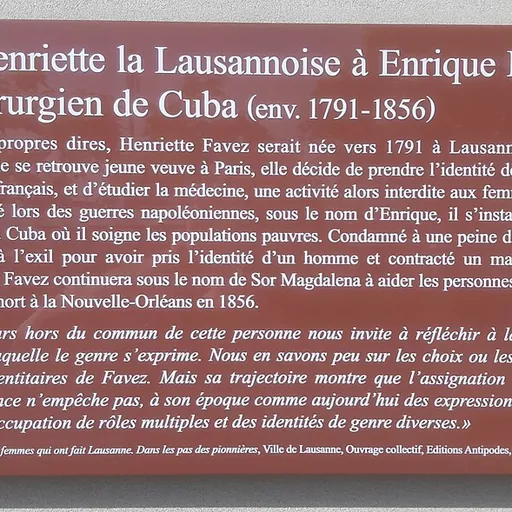
About Enriqueta Favez
Lived 1791 – 1856 (aged 64–65). Enriqueta Favez was a Swiss physician and military officer.
Enriqueta Favez (c. 1791 – 1856) also known as Enrique Favez, Henriette Favez and Henrietta Faber, was a Swiss medical doctor and surgeon who practiced medicine in the Napoleonic Wars and in Cuba. Although born female, Favez lived as a male surgeon for approximately four years in Cuba—a fact that culminated in a well-documented trial and expulsion from the Spanish territories. Following his expulsion, he lived the remainder of her life as Sor Magdalena, a nurse for Daughters of Charity Services in New Orleans, eventually rising to the position of Mother Superior for that congregation.
Biography Enriqueta Favez may have been born into a bourgeois family in Lausanne, Switzerland, around 1791. His family origin is unverifiable, and undocumented. According to his own testimony, collected during a trial in Cuba, his parents died while she was an infant, and he was married to a French soldier at the age of 15 (c. 1806) by an uncle. Three years later, both his husband and infant daughter died. The former allegedly died in battle, the latter died for unknown reasons at eight days old.
Favez remained in Paris and took up the study of medicine at the Sorbonne, taking on the dress and identity of a male army officer with his deceased husband's rank. After Favez's graduation, he worked as a French army surgeon during the Napoleonic Wars, allegedly alongside his uncle, until he was captured by Wellington's forces in Spain, and imprisoned.
After the war, Favez left for Cuba. He was licensed by the medical board in Habana, and started a practice in Baracoa, then a small outpost in eastern Cuba. His clients included the largely poor local population.
Eventually, Favez married an impoverished, mestizo woman from a neighboring town, Juana de Léon. Although Juana was most likely aware of the fact that Favez was biologically female, there is lingering speculation about whether Juana knew of that fact when they were married.
Four years after his marriage to Juana, and successful integration into the elite in Baracoa, speculation about Favez' biological sex surfaced. Despite efforts to stem rumors, Favez was found inebriated, with his shirt unbuttoned, by a servant, who promptly informed the local authorities. Favez was arrested, imprisoned, and put on trial. The charges cited by the court included the illegal practice of medicine by a woman, fraud against the medical board and local authorities, and coercing a woman into disreputable marriage. Forcible examinations by local doctors revealed his sexual anatomy, and several accusatory letters allegedly written by Juana de Léon surfaced throughout his trial. Historical documents at his trial record that he defended himself against the charges by stating that he was a male spirit in a female body. Favez was declared guilty, and his marriage to Juana de Léon was annulled.
After deliberations, the court in Baracoa sought to place Favez in the Hospital de Paula de la ciudad de La Habana, in Havana, to serve a four-year sentence. The Hospital rejected this arrangement, and requested that Favez be transferred to La Casa de Recogidas de San Francisco de Paula, a secure institution housing female criminals, citing concerns over its own lack of security and "proper" supervision.
Following his second recorded suicide attempt, Favez was barred from the institution, as well as the Spanish territories, and placed on a ship to New Orleans, where he joined the Daughters of Charity Services as a nun. As Sor Magdalena, he continued to provide medical aid to the poor, and later became the Mother Superior of her Congregation. He died in New Orleans at the age of 65, having never returned to Cuba.
Legacy
Favez's story is documented in several books, including For Dressing Like a Man by Cuban historian Julio Cesar Gonzáles Pagés, whose publication was supported by the Swiss Agency for Development and Cooperation. The present article is based on documentary evidence and news digests of that book. Pagés, though referring to Favez as a woman confronting the challenges of her time and Favez's marriage as a lesbian one, also raised the possibility in an interview that Favez may have been a trans man.
The life of Favez is also the subject of a 2005 documentary film by director Lídice Pérez (see ) and a theatre play by the group Rita Montaner. In 2018, the Cuban-Swiss film Insumisas was released, with Sylvie Testud in the role of Enriqueta Favez.
Don’t just read it —
keep it.
Full-length biographies made to live with: read them, listen on the way to work, watch them tonight.
- E-book
- Audio
- Video
Instant download · yours to keep · every purchase keeps this site free
Important facts
Related people
Same field, nearest in time




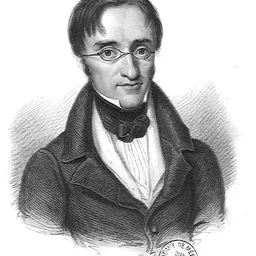
Contemporaries
People whose lives overlapped Enriqueta Favez's
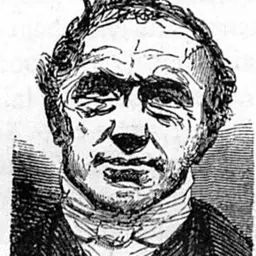
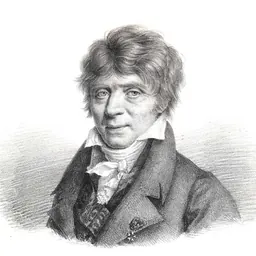



Frequently asked questions
Who was Enriqueta Favez?
Swiss physician (1791-1856)
When was Enriqueta Favez born?
Enriqueta Favez was born in 1791 in Lausanne.
When did Enriqueta Favez die?
Enriqueta Favez died in 1856 in New Orleans.
What was Enriqueta Favez's occupation?
Enriqueta Favez was a physician and military officer.
What nationality was Enriqueta Favez?
Enriqueta Favez was Swiss.
Sources & further reading
Cite this page
APA: Biography.guide. (2026). Enriqueta Favez. https://biography.guide/enriqueta-favez/
MLA: "Enriqueta Favez." Biography.guide, https://biography.guide/enriqueta-favez/.
Chicago: "Enriqueta Favez." Biography.guide. https://biography.guide/enriqueta-favez/.
Data last updated: 2026-09-22 · Spot an error? Report a correction.
Portrait: Wikimedia Commons · author & licence
Page generated 2026-09-27 04:59 UTC