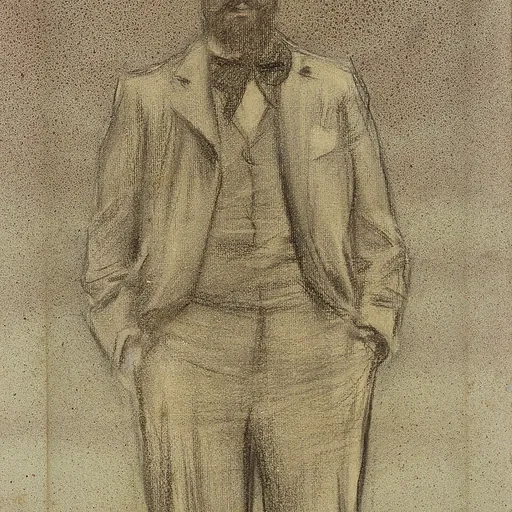
About Enric Clarasó
Lived 1857 – 1941 (aged 83–84). Enric Clarasó was a Spanish sculptor.
Enric Clarasó i Daudí (14 September 1857, Sant Feliu del Racó, now a suburb of Castellar del Vallès, Barcelona – 1941, Barcelona) was a modernist Catalan sculptor.
Biography He was born into a family of artisans. When he was only two, his family moved to Barcelona where he later became an apprentice in a perfume store. After a bout with yellow fever in 1869, he found a position in the workshop of sculptor . While there, he studied drawing and clay modeling at the Escola de la Llotja. In 1880, he shared his first studio with the painter Miquel Carbonell. When Carbonell moved to Madrid, Clarasó had studios in several different locations, including a space he briefly shared with Santiago Rusiñol that later became the Cau Ferrat Museum.
It was during this period that he had his first exhibit at the Sala Parés. He also provided decorations for the Teatre Principal. He also displayed some minor works at the 1888 Barcelona Universal Exposition and took a brief study trip to Paris, This seems to have resulted from a combination of his father's death and his 1896 marriage to Pilar Serrat, who was extremely devout. Shortly after, he lost a contract for work on a memorial in the main cemetery of Seville, but was awarded one for an allegorical group at the Palace of Justice in Pamplona. He also became a member of the Cercle Artístic de Sant Lluc, a group that was noted for its defense of Catholic morality. By 1904, he had become sufficiently successful to build his own home in Sarrià, which he called "La Torre de Sant Francesc".
Over the following three decades, he largely abandoned the smaller pieces that had characterized his work, choosing to focus on public commissions and works for religious organizations. Perhaps his most notable work, an equestrian statue of James I of Aragon in Palma, dates from this period. Many of his works may be seen in the Montjuïc Cemetery.
In 1932, he built a large studio next to his home but, the following year, stopped accepting public commissions and creating works for exhibition, concentrating instead on writing his memoirs, which were published in 1934. He ceased working entirely a few years later, near the end of the Civil War, when a group of Rojos broke into his workshop and destroyed the figures of saints he had stored there. He was buried next to his father in the Sant Gervasi Cemetery on Tibidabo.
Don’t just read it —
keep it.
Full-length biographies made to live with: read them, listen on the way to work, watch them tonight.
- E-book
- Audio
- Video
Instant download · yours to keep · every purchase keeps this site free
Important facts
more
Enrique Clarasó y Dandi, Enric Claraso, Enrique Clarasso Daudi, Enric Claraso y Daudi, Enric Claraso Daudi, Enrique Clarasso, Enric Clarasso Daudi, Enrique Claraso y Daudi, Enrique Claraso y DandiRelated people
Same field, nearest in time




Contemporaries
People whose lives overlapped Enric Clarasó's





Frequently asked questions
Who was Enric Clarasó?
Spanish artist (1857–1941)
When was Enric Clarasó born?
Enric Clarasó was born on 14 September 1857 in Castellar del Vallès.
When did Enric Clarasó die?
Enric Clarasó died in 1941 in Barcelona.
What was Enric Clarasó's occupation?
Enric Clarasó was a sculptor.
What nationality was Enric Clarasó?
Enric Clarasó was Spanish.
Sources & further reading
Cite this page
APA: Biography.guide. (2026). Enric Clarasó. https://biography.guide/enric-claraso/
MLA: "Enric Clarasó." Biography.guide, https://biography.guide/enric-claraso/.
Chicago: "Enric Clarasó." Biography.guide. https://biography.guide/enric-claraso/.
Data last updated: 2026-09-23 · Spot an error? Report a correction.
Portrait: Wikimedia Commons · author & licence
Page generated 2026-09-27 05:04 UTC