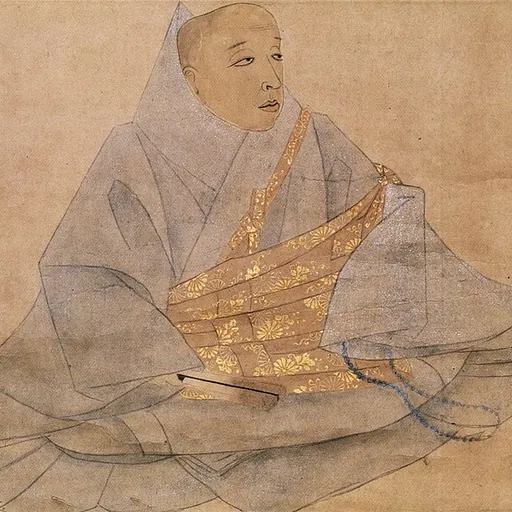
About Emperor Hanazono
Lived 1297 – 1348 (aged 51). Emperor Hanazono was a Japanese sovereign.
was the 95th emperor of Japan, according to the traditional order of succession. His reign spanned the years from 1308 through 1318.
Genealogy Before his ascension to the Chrysanthemum Throne, his personal name (his imina) was Tomihito-shinnō (富仁親王).
He was the fourth son of the 92nd Emperor, Fushimi. He belonged to the Jimyōin-tō branch of the Imperial Family.
Consort: Ogimachi Michiko (正親町実子) later Senkomon'in (宣光門院, 1297–1360), Ogimachi Saneakira's daughter First Daughter: Imperial Princess Hisako (1318–1358; 寿子内親王) later Kianmon-in (徽安門院), married Emperor Kogon Second Son: Imperial Prince Nobunaga (業永親王; 1327–1353) later Imperial Prince priest Genshi (源性入道親王) Third son: Imperial Prince Naohito (直仁親王; 1335–1398) Daughter: Imperial Princess Noriko (儀子内親王; d. 1348) Priest Shōgoin Daughter married to Kazan'in clan Consort: Ichijo-no-Tsubone (d. 1325), Ogimachi Saneakira's daughter First Son: Imperial Prince Priest Kakuyo (1320–1382; 覚誉法親王) Lady-in-waiting: Wamuro Yoriko (葉室頼子), Wamuro Yorito's daughter Fifth Daughter: Imperial Princess Noriko (祝子内親王) – Nun Princess
Events of Hanazono's life Tomihito-shinnō became emperor upon the death of his second cousin, the Daikakuji-tō Emperor Go-Nijō. Tokuji 3, in the 8th month (1308): In the 8th year of Go-Nijo-tennō reign (後二条天皇八年), the emperor died at the young age of 24; and the succession (senso) was received by his cousin. Shortly thereafter, Emperor Hanazono is said to have acceded to the throne (sokui). Tokuji 3, in the 10th month (1308): The nengō was changed to Enkyō to mark the accession of Emperor Hanazono.
Hanazono's father, the retired-Emperor Fushimi, and Hanazono's brother, the retired-Emperor Go-Fushimi, both exerted influence as cloistered emperors during this reign.
In these years, negotiations between the Kamakura Bakufu and the two imperial lines resulted in an agreement to alternate the throne between the two lines every 10 years (the Bumpō Agreement). This agreement was not long-lasting. The negotiated provisions would soon be broken by Hanazono's successor.
In 1318, he abdicated to his second cousin, the Daikakuji-tō Emperor Go-Daigo, who was Nijō's brother.
After his abdication, he raised his nephew, the future Northern Pretender Emperor Kōgon.
In 1335, he became a Buddhist monk of the Zen sect, and under his sponsorship, his palace became the temple of Myōshin-ji, now the largest network in Rinzai Buddhism. Many places and institutions in the area are named for him, including Hanazono University (the Rinzai university) and Hanazono Station.
He died in 1348. Hanazono's imperial tomb is known as Jurakuin no ue no misasagi; it is located in Higashiyama-ku, Kyoto.
He excelled at waka composition, and was an important member of the Kyōgoku School. He also left behind a diary, called Hanazono-in-Minki (Imperial Chronicles of the Flower Garden Temple or Hanazono-in) (花園院宸記). He was a very religious and literate person, never missing his prayers to the Amitabha Buddha.
Kugyō is a collective term for the very few most powerful noble men attached to the imperial court of the Emperor of Japan in pre-Meiji eras. Even during those years in which the court's actual influence outside the palace walls was minimal, the hierarchic organization persisted.
In general, this elite group included only three to four men at a time. These were hereditary courtiers whose experience and background would have brought them to the pinnacle of a life's career. During Hanazono's reign, this apex of the Daijō-kan included: Sesshō, Kujō Moronori, 1308 Sesshō, Takatsukasa Fuyuhira, 1308–1311 Kampaku, Takatsukasa Fuyuhira, 1311–1313 Kampaku, Konoe Iehira, 1313–1315 Kampaku, Takatsukasa Fuyuhira, 1315–1316 Kampaku, Nijō Michihira, 1316–1318 Sadaijin Udaijin Nadaijin Dainagon
Eras of Hanazono's reign The years of Hanazono's reign are more specifically identified by more than one era name or nengō. Tokuji (1306–1308) Enkyō (1308–1311) Ōchō (1311–1312) Shōwa (1312–1317) Bumpō (1317–1319)
Don’t just read it —
keep it.
Full-length biographies made to live with: read them, listen on the way to work, watch them tonight.
- E-book
- Audio
- Video
Instant download · yours to keep · every purchase keeps this site free
Important facts
Family & relationships
People in Emperor Hanazono's life
Named in this biography and alive at the same time



Related people
Same field, nearest in time


Contemporaries
People whose lives overlapped Emperor Hanazono's

Frequently asked questions
Who was Emperor Hanazono?
95th emperor of Japan (r. 1308–1318)
When was Emperor Hanazono born?
Emperor Hanazono was born on 14 August 1297.
When did Emperor Hanazono die?
Emperor Hanazono died on 2 December 1348 in Myōshin-ji Temple.
What was Emperor Hanazono's occupation?
Emperor Hanazono was a sovereign.
What nationality was Emperor Hanazono?
Emperor Hanazono was Japanese.
Sources & further reading
Cite this page
APA: Biography.guide. (2026). Emperor Hanazono. https://biography.guide/emperor-hanazono/
MLA: "Emperor Hanazono." Biography.guide, https://biography.guide/emperor-hanazono/.
Chicago: "Emperor Hanazono." Biography.guide. https://biography.guide/emperor-hanazono/.
Data last updated: 2026-09-22 · Spot an error? Report a correction.
Portrait: Wikimedia Commons · author & licence
Page generated 2026-09-27 05:02 UTC