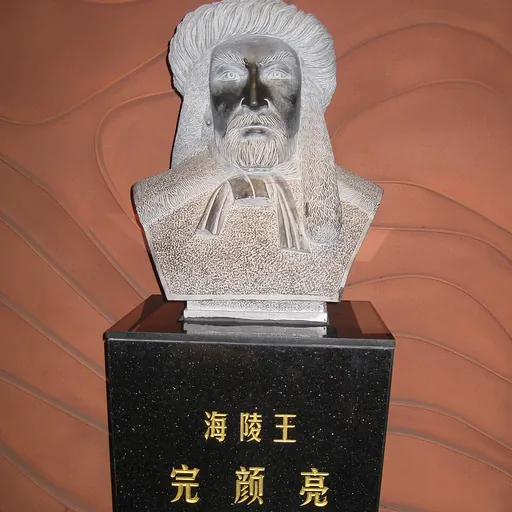
About Emperor Hailingwang of Jin
Lived 1122 – 1161 (aged 39). Emperor Hailingwang of Jin was a Chinese aristocrat.
Digunai (24 February 1122 – 15 December 1161), also known by his sinicised name Wanyan Liang and his formal title Prince of Hailing (, Hǎilíng Wáng), was the fourth emperor of the Jurchen-led Jin dynasty of China. He was the second son of Wanyan Zonggan, the eldest son of the dynastic founder Wanyan Aguda (Emperor Taizu). He came to power in 1150 after overthrowing and murdering his predecessor, Emperor Xizong, in a coup d'état. During his reign, he moved the Jin capital from Shangjing (present-day Acheng District, Harbin, Heilongjiang Province) to Yanjing (present-day Beijing), and introduced a policy of sinicisation. In 1161, after the Jin dynasty lost the Battle of Caishi against the Southern Song dynasty, Digunai's subordinates rebelled against him and assassinated him. After his death, even though he ruled as an emperor during his lifetime, he was posthumously demoted to the status of a prince – "Prince Yang of Hailing" – in 1162 by his successor, Emperor Shizong. However, in 1181, Emperor Shizong further posthumously demoted him to the status of a commoner, hence he is also known as the "Commoner of Hailing" .
Background
Digunai was the second son of Woben (; also known as Wanyan Zonggan ), a son of Aguda (Emperor Taizu), the founder of the Jin dynasty. His mother, Lady Da, came from a pretigous family of Balhae descent. Emperor Taizu's brother and successor, Emperor Taizong, started a series of wars between the Jin and Song dynasties. During the reign of Emperor Xizong, who succeeded Emperor Taizong, Wanyan Zonggan was described as the most influential man in the Jin imperial court.
Digunai, who was an army marshal under Emperor Xizong, overthrew the emperor in a coup d'état in 1150 and replaced him. Having seized the throne through illegitimate means, Digunai was suspicious of other members of the Jurchen aristocracy, and, immediately upon taking the throne, started eliminating potential rivals. He ordered the massacre of the descendants of Emperor Taizong, so as to secure the position of the lineage of Emperor Taizu, to which he belonged.
Reign Digunai capitalised on the Jin dynasty's "superior status" vis-à-vis the Song dynasty after its victory over the latter in 1141, and sought to make the Jin dynasty the sole Chinese empire. To legitimise himself as a sinicised ruler, in 1150 he lifted Emperor Taizong's prohibition of wearing Han Chinese dress, and adopted an array of Han Chinese practices and institutions, such as holding of sacrificial ceremonies in the northern and southern suburbs of his capital in 1149 (cf. ceremonies conducted at the Temple of Earth and Temple of Heaven in Beijing during the Ming and Qing dynasties), the use of the imperial carriage in 1151, a system of feudal rights in 1156, and the Song dynasty's shan-hu style of court ceremonies in 1157. Digunai also introduced the imperial examination system in 1150 and set up the Imperial Academy in the following year. at the battles of Tangdao and Caishi in 1161. Many of his officers defected and in some places the people rebelled against him. His subordinates conspired against him and assassinated him on 15 December 1161 in a military camp near the Yangtze River. Digunai's cousin, Wulu, who had led a rebellion against Digunai's rule, was proclaimed the new emperor. personal name Nailahu First Consort, of the Da clan of Bohai , Wanyan Yuanshou, Prince of Chong (, d. 1151), 1st son Noble Consort, of the Tangkuo clan , personal name Dingge Consort Li, of the Tangukuo clan , personal name Shigge Wanyan Shensi'abu, Prince of Su (, 1156 – 1158), 3rd son Consort Chen, of the Xiao clan Consort Li, of the Yelü clan Consort Zhao, of the Pucha clan , personal name Alihu Consort Zhao, of the Wanyan clan , personal name Alan Consort Rou, of the Yelü clan Consort Zhao, of the Wanyan clan , personal name Shigu Consort Shu, of the Wanyan clan , personal name Pula Consort Shu, of the Wanyan clan , personal name Shigu'er Consort Gui, of the Wanyan clan , personal name Shaliguzhen Consort Zhao, of the Wanyan clan , personal name Chongjie Consort Li, of Tanguko clan , personal name Puluhuzhi Zhaoyuan, of the Yelü clan Xiuyi, of the Gao clan Cairen, of the Nan clan Wanyan Guangyang, Prince of Teng , 4th son Lady, of the Pucha clan , personal name Chacha Unknown: Princess of Rong , personal name Henü married Tushan Sila Unnamed Princess married Xiao Yu's son Unnamed Princess married Wugulun Yi
Don’t just read it —
keep it.
Full-length biographies made to live with: read them, listen on the way to work, watch them tonight.
- E-book
- Audio
- Video
Instant download · yours to keep · every purchase keeps this site free
Important facts
Family & relationships
Related people
Same field, nearest in time


Contemporaries
People whose lives overlapped Emperor Hailingwang of Jin's




Frequently asked questions
Who was Emperor Hailingwang of Jin?
emperor of the Jin Dynasty (1115–1234)
When was Emperor Hailingwang of Jin born?
Emperor Hailingwang of Jin was born on 24 February 1122.
When did Emperor Hailingwang of Jin die?
Emperor Hailingwang of Jin died on 15 December 1161.
What was Emperor Hailingwang of Jin's occupation?
Emperor Hailingwang of Jin was an aristocrat.
What nationality was Emperor Hailingwang of Jin?
Emperor Hailingwang of Jin was Chinese.
Sources & further reading
· Wikipedia: Emperor Hailingwang of Jin
Cite this page
APA: Biography.guide. (2026). Emperor Hailingwang of Jin. https://biography.guide/emperor-hailingwang-of-jin/
MLA: "Emperor Hailingwang of Jin." Biography.guide, https://biography.guide/emperor-hailingwang-of-jin/.
Chicago: "Emperor Hailingwang of Jin." Biography.guide. https://biography.guide/emperor-hailingwang-of-jin/.
Data last updated: 2026-09-20 · Spot an error? Report a correction.
Portrait: Wikimedia Commons · author & licence
Page generated 2026-09-27 05:01 UTC