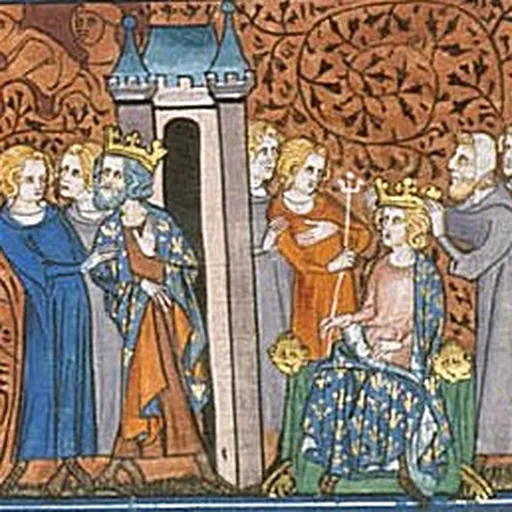
About Emma of France
Lived 894 – 934 (aged 39–40). Emma of France was a French consort.
Emma of France (894 – 934 or 935) was a Frankish queen. The daughter of Robert I of France, she was a descendant of the powerful aristocratic Robertian family; her younger half-brother was Hugh the Great, the duke of the Franks and count of Paris.
In 921, she married Duke Raoul (Rudolf) of Burgundy. After assuming the crown, Raoul did not relinquish his duchy unlike his Robertian predecessor Odo (Eudes) of France, who had stepped down as count of Paris upon being elected king of West Francia in 888. Her conflicting loyalties afforded her a position of substantial ambiguity and great power. In 931, Emma captured the fortress of Avallon; in 933, she conducted a successful siege of Château-Thierry, the stronghold of her brother-in-law, Count Herbert II of Vermandois. The Robertians' rise to prominence began with Emma’s grandfather, Robert the Strong. Descended from Austrasian nobility, he was a royal military commander and administrative official favored by the Carolingian emperor and king of West Frankish king, Charles the Bald. He defended royal lands in Neustria, as well as several other parts of the region, and was involved in defending against Viking attacks. Despite brief moments of rebellion, he ultimately was made lay abbot of the monastery of St-Martin at Tours, an office that signaled and enhanced his political status within the realm. Although the identity of his wife is contested, he is believed to have been married to a woman named Adelaide, the daughter of Count Hugh of Tours, with whom he had two sons (Odo and Robert) before his death defending Francia against the Vikings north of Angers at Brissarthe in 866. Two significant focuses of Odo's reign lay in balancing Carolingian and Robertian leadership and preventing further Viking attacks. When Odo died a decade later with no heirs, Charles the Bald's grandson, Charles the Simple, was recognized as his successor.
Parents and Early Life King Robert I had two daughters. The first is often called Adela by scholars, but her actual name remains unknown. She is the daughter of Robert I’s first wife and she married Herbert II of Vermandois.
Robert I’s second daughter was Emma. Scholars are divided over whether she was the child of Robert’s first wife, or his second wife, Beatrix of Vermandois. Due to the age gap between her and her younger brother, Hugh the Great, who was the son of Beatrix, scholars have largely inferred that she was Robert I’s by his first wife. As a result, the kingdom became a kind of “conglomeration” of independent principalities, rather than a united territory.
Despite his powerful position, Robert I exhibited very little interest in gaining the throne, and actively supported Charles the Simple's claim to it. In 920, Robert I joined forces with Charles's opponents, a move met with much criticism; his contemporaries called him a tyrant and usurper, and claimed he was envious of Charles’ power. After defeating Charles in 920 and again in 922, Robert I was elected king by an assembly of West Frankish magnates on 29 June 922. A wife such as Emma, powerful and clever, was therefore the ideal partner for a new ruler like Raoul, who many considered a usurper due to his lack of direct relation to previous rulers. Marriage to the “beautiful and intelligent’ Emma offered significant advantages.
Not only did Emma provide Raoul significant support in terms of political allies, but she also proved a capable military and political strategist.
Military campaigns, 927-933 Emma was active in a number of military campaigns and political maneuvers. As the historian Simon MacLean writes, one of her influential contemporaries, the scholar Flodoard of Reims, “mentions Emma’s direct involvement in the politics and military affairs of her kingdom as if it were normal, without gendered criticism,” implying that women wielding such substantial political power was at this point normalized in Francia. Laon was a strategically important stronghold in the north of Francia, built atop a large, steep hill; it also was one of Raoul’s favourite royal residences. Therefore, Raoul, who had already allowed Herbert his seizure of Rheims, granted Laon to Count Roger’s son instead. Neither of their children would succeed them on the throne, and little evidence about them survives in the years following Emma and Raoul's death. The Coronation of Hugues Capet (941-996), 988. Miniature from a manuscript of the 13th or 14th century. Hugh's substantial political and military power eventually led to several conflicts with Louis IV and numerous other powerful men in the kingdom. Louis IV, however, remained king until his death, and Hugh the Great supported his son, Lothar, as the next ruler. When Hugh the Great died, his son Hugh Capet took over his father’s position and proved an ally to Lothar. However, the king's policies antagonized Hugh Capet, which precipitated conflict between the two. Following a vision from Saint Valery, in which the saint told Hugh his family would rule for seven generations, Hugh formed an official alliance against Lothar.
While the rebellion was unsuccessful and Hugh and Lothar reluctantly made peace, they never achieved the same partnership they had once exhibited. When Lothar's son, Louis V, became king, he only ruled for one year (986-987) and died childless. While there was some competition for the West Francia throne, Hugh Capet became king with relatively little opposition. Emma’s family, then, found survival in West Francia through her younger brother’s line, and the founding of the Capetian dynasty.
Don’t just read it —
keep it.
Full-length biographies made to live with: read them, listen on the way to work, watch them tonight.
- E-book
- Audio
- Video
Instant download · yours to keep · every purchase keeps this site free
Important facts
People in Emma of France's life
Named in this biography and alive at the same time

Related people
Same field, nearest in time




Contemporaries
People whose lives overlapped Emma of France's

Frequently asked questions
Who was Emma of France?
French princess
When was Emma of France born?
Emma of France was born in 894.
When did Emma of France die?
Emma of France died on 2 November 934.
What was Emma of France's occupation?
Emma of France was a consort.
What nationality was Emma of France?
Emma of France was French.
Sources & further reading
Cite this page
APA: Biography.guide. (2026). Emma of France. https://biography.guide/emma-of-france/
MLA: "Emma of France." Biography.guide, https://biography.guide/emma-of-france/.
Chicago: "Emma of France." Biography.guide. https://biography.guide/emma-of-france/.
Data last updated: 2026-09-29 · Spot an error? Report a correction.
Portrait: Wikimedia Commons · author & licence
Page generated 2026-10-05 02:31 UTC