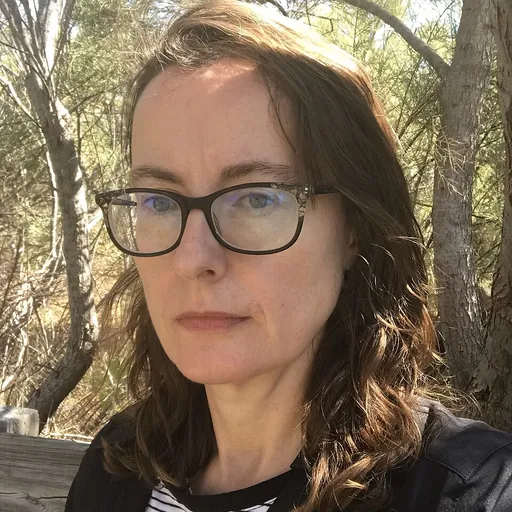
Emily Wilson
British-American classicist, author and translator
About Emily Wilson
Born 1971. Emily Wilson is a British and American classical philologist, university teacher and translator.
Emily Wilson (born 1971) is a British and American classicist and translator. She is a professor of classical studies at the University of Pennsylvania. Her translation of Homer's Odyssey, published in 2017, is the first by a woman into English verse. Her translation of the Iliad was published in 2023.
Wilson is the author of several books, including Mocked with Death: Tragic Overliving from Sophocles to Milton (2004), The Death of Socrates: Hero, Villain, Chatterbox, Saint (2007) and The Greatest Empire: A Life of Seneca (2014).
Early life and education Wilson was born in 1971 in Oxford, England. Her mother, Katherine Duncan-Jones, was a scholar of Elizabethan literature. Her father, A. N. Wilson, is a writer.
Career
Wilson has taught in the Classical Studies department at the University of Pennsylvania since 2002.
In 2006 Wilson received a Rome Prize fellowship from the American Academy in Rome for Renaissance and Early Modern Studies. Carolyne Larrington called Wilson's next book, The Death of Socrates: Hero, Villain, Chatterbox, Saint (2007), "a sprightly and illuminating account of the events surrounding Socrates' execution by means of a self-administered drink of hemlock; the probable historical reasons for his trial and judgment; and the ways in which later ages—from Socrates' immediate successors among the Greeks, through the Romans, Christian apologists, Renaissance thinkers, Enlightenment sages and anxious moderns—have understood the death of Socrates".
Wilson's next books focused on the Roman tragic playwright Seneca the Younger. In 2010, she translated Seneca's tragedies, with an introduction and notes, in Six Tragedies of Seneca. In 2014, she published The Greatest Empire: A Life of Seneca, which is also published with the alternate title Seneca: A Life. In a review of Seneca: A Life for Literary Review, Tim Whitmarsh wrote: "This clever and learned book is not just a study of a protean and conflicted individual. It is also intended as a lesson for our own time. Seneca, Wilson argues, was 'Rome's most perceptive analyst of consumerism and luxury'."
Wilson became internationally known for her translation of the Odyssey in 2017, with media attention on her becoming the first woman to publish a translation of the work into English. The New York Times named Wilson's Odyssey as one of its 100 notable books of 2018, and it was shortlisted for the 2018 National Translation Award. Online commentators objected to the simpler, more modern language Wilson used, deriding her as "woke". John Semley at Wired characterized the various controversies as part of a broader online culture war. In the face of online harassment, Wilson deleted her X (formerly Twitter) account in 2024.
In 2019 Wilson received a MacArthur Fellowship for her work bringing classical literature to new audiences, and she was appointed the College for Women Class of 1963 Term Professor in the Humanities at the University of Pennsylvania.
In 2020 Wilson joined the Booker Prize judging panel, alongside Margaret Busby (chair), Lee Child, Sameer Rahim and Lemn Sissay. Also in 2020, she was awarded a Guggenheim Fellowship to support her work translating the Iliad.
In September 2023 W. W. Norton & Company published Wilson's English translation of the Iliad. Wilson includes an introduction, maps, family trees, a glossary and text notes. She had developed the book over the previous six years. In a review for the London Review of Books, Colin Burrow discusses "the challenging task of translating the poem into the same number of iambic pentameter lines as there are hexameters in the original", writing: "In order to achieve that level of compression she has to rely heavily on monosyllables, and to make sharp and sometimes simplifying decisions about which of Homer's implications to make explicit."
In a review for NPR, Annalisa Quinn wrote: "Wilson's project is basically a progressive one: to scrape away all the centuries of verbal and ideological buildup—the Christianizing (Homer predates Christianity), the nostalgia, the added sexism (the epics are sexist enough as they are), and the Victorian euphemisms—to reveal something fresh and clean." In Wilson's translation, enslaved characters are often called "slaves" rather than "maids" or "servants", with translator notes explaining the word choices; discussing older translations of the Odyssey with journalist Anna North, Wilson said: "It sort of stuns me ... how much work seems to go into making slavery invisible."
Miller also discussed Wilson's word choices, including "slave", and wrote, "Perhaps more controversial will be her translation of the famous first line, which Wilson gives as 'Tell me about a complicated man'" In the London Review of Books, Wilson harshly criticised the film, writing that she "would be ashamed to have written any part of this script" and that it "lacked psychological, emotional, political and ethical depth" and "many of the elements that make the poem great". She wrote that the film featured the "usual combination of grandiosity and superficiality" and prioritised plot action over a "human scale". Wilson also criticised Nolan's decision to film in Western Sahara as "normalizing the ongoing violence against the indigenous Sahrawi people",
Iliad translation In a review of Wilson's Iliad for The Washington Post, Naoíse Mac Sweeney wrote: "Wilson avoids the two traps that most translations of The Iliad fall into when navigating the inevitable gaps between ancient Greek and English—an unwarranted glorification of violence on the one hand and tedium on the other. This allows Wilson to more effectively bring out the real themes of the poem: the human relationships that bind us into communities, made bittersweet by mortality and loss."
According to Charlotte Higgins, "Reading the Iliad in the midst of Russia's full-scale invasion of Ukraine, which I have reported on, brought the poem home to me in new and disturbing ways." In the New Statesman, Rowan Williams, the former Archbishop of Canterbury, wrote: "The decision to use unrhymed iambic pentameter for the translation is a highly successful one; it is a kind of default rhythm for so much English poetry, especially for long narrative poems, a metre that unobtrusively maps on to ordinary speech patterns and holds our attention just enough to keep us in the circle during the less vivid passages."
Kirkus Reviews noted the "shortness of Wilson's lines" as compared to other translators, which, "abetted by her unfussy diction and lyricism, are easy on the reader's eye and seem to help the mind grasp the breadth of Homer's canvas at any given moment while still marveling at details".
In The Atlantic, Graeme Wood wrote, "her modern language sometimes feels distractingly modern".
Selected publications
As author Books (2004). (2007). (2014). Alternate title: (2026).
Periodicals (2013). (2013). (2013).
As translator (2010). (2016). "Electra"; "Trojan Women"; "Helen"; "Bacchae". In (2017). (2022). (2023).
Personal life Wilson lives in Pennsylvania, near the University of Pennsylvania campus. She has three daughters and was previously married to writer Marco Roth.
Wilson became a United States citizen in 2022.
Don’t just read it —
keep it.
Full-length biographies made to live with: read them, listen on the way to work, watch them tonight.
- E-book
- Audio
- Video
Instant download · yours to keep · every purchase keeps this site free
Important facts
Family & relationships
People in Emily Wilson's life
Named in this biography and alive at the same time







Related people
Same field, nearest in time


Contemporaries
People whose lives overlapped Emily Wilson's




Frequently asked questions
Who is Emily Wilson?
British-American classicist, author and translator
When was Emily Wilson born?
Emily Wilson was born in 1971 in Oxford.
What is Emily Wilson's occupation?
Emily Wilson is a classical philologist, university teacher and translator.
What nationality is Emily Wilson?
Emily Wilson is British and American.
Sources & further reading
· DBpedia: Emily Wilson (classicist)
Cite this page
APA: Biography.guide. (2026). Emily Wilson. https://biography.guide/emily-wilson/
MLA: "Emily Wilson." Biography.guide, https://biography.guide/emily-wilson/.
Chicago: "Emily Wilson." Biography.guide. https://biography.guide/emily-wilson/.
Data last updated: 2026-09-23 · Spot an error? Report a correction.
Portrait: Wikimedia Commons · author & licence
Page generated 2026-09-27 05:07 UTC