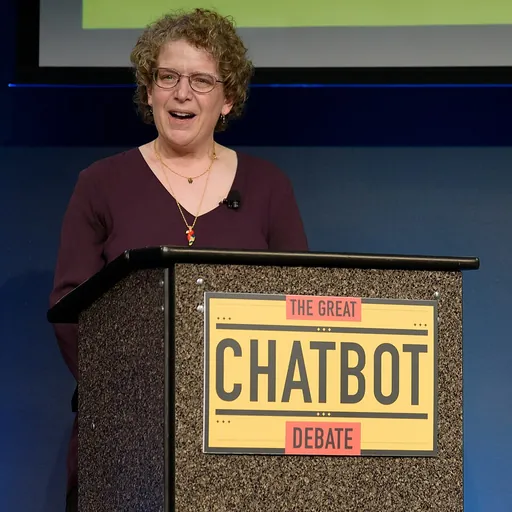
About Emily M. Bender
Born 1973. Emily M. Bender is an American computational linguist, university teacher and linguist.
Emily Menon Bender (born 1973) is an American linguist and professor at the University of Washington where she directs its Computational Linguistics Laboratory. She specializes in computational linguistics and natural language processing.
She has published several papers on the risks of large language models and on ethics in natural language processing and co-authored the 2025 book The AI Con: How to Fight Big Tech's Hype and Create the Future We Want.
Education Bender earned an AB in Linguistics from the University of California, Berkeley in 1995. She received her MA from Stanford University in 1997 and her PhD from Stanford in 2000 for her research on syntactic variation and linguistic competence in African American Vernacular English (AAVE). She was supervised by Tom Wasow and Penelope Eckert.
Career and research Before working at University of Washington, Bender held positions at Stanford University, UC Berkeley and worked in industry at YY Technologies. She holds several positions at the University of Washington, where she has been faculty since 2003, including professor in the Department of Linguistics, adjunct professor in the Department of Computer Science and Engineering, faculty director of the Master of Science in Computational Linguistics, and director of the Computational Linguistics Laboratory. Bender is the Howard and Frances Nostrand Endowed Professor.
Bender was president of the Association for Computational Linguistics in 2024. She was elected a Fellow of the American Association for the Advancement of Science in 2022.
Contributions Bender has published research papers on the linguistic structures of Japanese, Chintang, Mandarin, Wambaya, American Sign Language and English.
Bender has constructed the LinGO Grammar Matrix, an open-source starter kit for the development of broad-coverage precision Head-driven phrase structure grammar (HPSG) grammars. In 2013, she published Linguistic Fundamentals for Natural Language Processing: 100 Essentials from Morphology and Syntax, and in 2019, she published Linguistic Fundamentals for Natural Language Processing II: 100 Essentials from Semantics and Pragmatics with Alex Lascarides, which both explain basic linguistic principles in a way that makes them accessible to NLP practitioners.
In 2021, Bender presented a paper, "On the Dangers of Stochastic Parrots: Can Language Models Be Too Big? 🦜" co-authored with Google researcher Timnit Gebru and others at the ACM Conference on Fairness, Accountability, and Transparency that Google tried to block from publication, part of a sequence of events leading to Gebru departing from Google, the details of which are disputed. The paper concerned ethical issues in building natural language processing systems using machine learning from large text corpora. Since then, she has invested efforts to popularize AI ethics and has taken a stand against hype over large language models.
The Bender Rule, which originated from the question Bender repeatedly asked at the research talks, is research advice for computational scholars to "always name the language you're working with".
She draws a distinction between linguistic form versus linguistic meaning. Form refers to the structure of language (e.g. syntax), whereas meaning refers to the ideas that language represents. In a 2020 paper, she argued that machine learning models for natural language processing which are trained only on form, without connection to meaning, cannot meaningfully understand language. Therefore, she has argued that tools like ChatGPT have no way to meaningfully understand the text that they process, nor the text that they generate.
Published books
Published articles
On the Dangers of Stochastic Parrots: Can Language Models Be Too Big? 🦜
Don’t just read it —
keep it.
Full-length biographies made to live with: read them, listen on the way to work, watch them tonight.
- E-book
- Audio
- Video
Instant download · yours to keep · every purchase keeps this site free
Important facts
People in Emily M. Bender's life
Named in this biography and alive at the same time



Related people
Same field, nearest in time





Contemporaries
People whose lives overlapped Emily M. Bender's






Frequently asked questions
Who is Emily M. Bender?
American linguist
When was Emily M. Bender born?
Emily M. Bender was born on 10 October 1973.
What is Emily M. Bender's occupation?
Emily M. Bender is a computational linguist, university teacher and linguist.
What nationality is Emily M. Bender?
Emily M. Bender is American.
Sources & further reading
Cite this page
APA: Biography.guide. (2026). Emily M. Bender. https://biography.guide/emily-m-bender/
MLA: "Emily M. Bender." Biography.guide, https://biography.guide/emily-m-bender/.
Chicago: "Emily M. Bender." Biography.guide. https://biography.guide/emily-m-bender/.
Data last updated: 2026-09-22 · Spot an error? Report a correction.
Portrait: Wikimedia Commons · author & licence
Page generated 2026-09-27 05:04 UTC