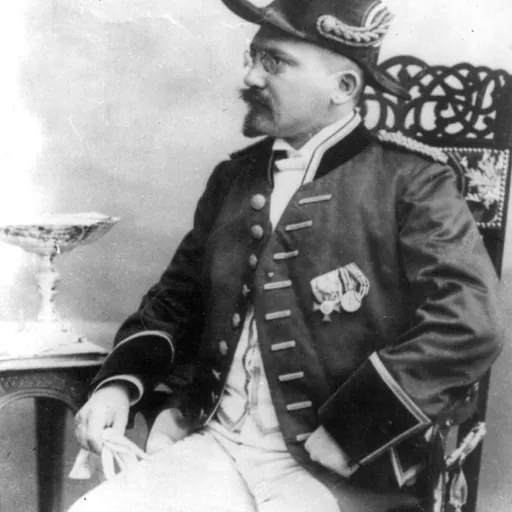
About Emil Krebs
Lived 1867 – 1930 (aged 62). Emil Krebs was a German diplomat, translator, sinologist, polyglot, university teacher and interpreter.
Emil Krebs (15 November 1867 – 31 March 1930) was a German polyglot and sinologist. He was reportedly able to speak and write 68 languages and studied 120 other languages.
Life
Early life Born in Freiburg in Silesia, Kingdom of Prussia (now Świebodzice, Poland) on 15 November 1867, Emil Krebs was the son of a master carpenter named Gottlob Krebs and his wife Pauline Scholz. In 1870 he moved with his parents to Esdorf, where he attended primary school. From 1878 to 1880 he attended the Freiburger Realschule (secondary school), and from 1880 to 1887 he studied at the gymnasium in Schweidnitz. The curriculum included Latin, French, Hebrew and Classical Greek, but in addition he studied Modern Greek, English, Italian and later Spanish, Russian, Polish, Arabic and Turkish. He left the Schweidnitz gymnasium on 17 March 1887, after passing the Abitur. Thereafter he enrolled in the theology course of the University of Breslau for the summer semester. At that point he already spoke twelve languages .
The following semester Krebs enrolled as a law student at the University of Berlin. The newly founded Oriental seminar department captivated Krebs, who had concluded he wished to make the study of foreign languages the primary objective of his education. He turned first to the study of Mandarin Chinese, because it was regarded by many to be the most difficult language to learn. He began Chinese courses in 1887, and on 24 July 1890 he passed the interpreter's examination in Chinese at the seminar for eastern languages of Berlin University with "good" marks . His work gained him fame due to his impressive fluency. In November 1897, the German Reich took the murder of two missionaries in Shandong Province as a pretext to occupy Qingdao. From 10 November 1897 to February 1898, Krebs joined the occupation of Kiautschou (Jiaozhou). He was accompanied by German troops
While in China, Krebs devoted his time to the study of different languages, and had a greater interest in this than in doing his job, often sleeping during the day due to staying up at night studying languages. He would study different languages in strict rotation, assigning one for each day of the week . During this time, he also plunged himself into language study. . He was buried in the Stahnsdorf South-Western Cemetery (Epiphanien Gartenblock I, garden place 81). His brain was recovered and preserved by the researcher Oskar Vogt in Washington, D.C. From the compilation and the range of literature written in the respective national languages and a language list personally written by him, it can be inferred that Krebs had mastered all the languages of today's European Union, as well as other languages such as "Egyptian" (possibly Coptic), Ainu, Albanian, Arabic, Armenian, Burmese, Chinese, Georgian, Hebrew, Japanese, Javanese, Korean, Latin, Manchu, Mongolian, Nivkh, Persian, Russian, Sanskrit, "Syrian" (possibly Aramaic), Tibetan, Turkish, and Urdu.
His writings and books of language studies prove that he learned foreign languages not only through his native German, but also through previously mastered foreign languages. For example, through English he learned "Afghan" (Pashto or Dari), Burmese, Gujarati, Hindi, Irish, Sinhalese, and Portuguese, through Russian he learned Buryat, Finnish, Tatar, and Ukrainian, and through Spanish he learned the Basque dialects of Gipuzkoan, Biscayan, Lapurdian, and Zuberoan. Besides German, Krebs predominantly spoke English, French, Russian, Chinese, Greek, Italian, Turkish, Latin, Spanish, and Arabic for learning and improving his knowledge of a new language. He passed official government language tests in Chinese, Turkish, Japanese, and Finnish. Sixty-one different translations of the New Testament provided additional aid in his studies .
Works Krebs produced an extended translation of the Chinese Shade Plays by Wilhelm Grube (Munich: 1915).
Don’t just read it —
keep it.
Full-length biographies made to live with: read them, listen on the way to work, watch them tonight.
- E-book
- Audio
- Video
Instant download · yours to keep · every purchase keeps this site free
Important facts
People in Emil Krebs's life
Named in this biography and alive at the same time


Related people
Same field, nearest in time

Contemporaries
People whose lives overlapped Emil Krebs's



Frequently asked questions
Who was Emil Krebs?
German polyglot and sinologist (1867–1930)
When was Emil Krebs born?
Emil Krebs was born on 15 November 1867 in Świebodzice.
When did Emil Krebs die?
Emil Krebs died on 31 March 1930 in Berlin.
What was Emil Krebs's occupation?
Emil Krebs was a diplomat, translator, sinologist, polyglot, university teacher and interpreter.
What nationality was Emil Krebs?
Emil Krebs was German.
Sources & further reading
Cite this page
APA: Biography.guide. (2026). Emil Krebs. https://biography.guide/emil-krebs/
MLA: "Emil Krebs." Biography.guide, https://biography.guide/emil-krebs/.
Chicago: "Emil Krebs." Biography.guide. https://biography.guide/emil-krebs/.
Data last updated: 2026-09-20 · Spot an error? Report a correction.
Page generated 2026-09-27 05:09 UTC