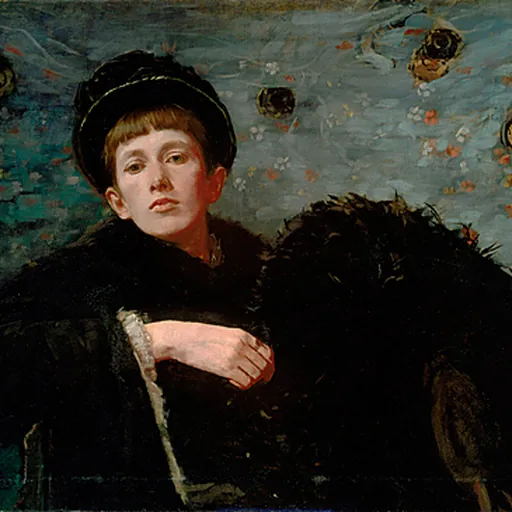
About Ellen Day Hale
Lived 1855 – 1940 (aged 85). Ellen Day Hale was an American painter, printmaker, artist and etcher.
Ellen Day Hale (February 11, 1855 – February 11, 1940) Her brother was Philip Leslie Hale, a celebrated artist and art critic, and he married Lilian Westcott Hale, an Impressionist painter. One of Hale's first cousins was writer and social reformer Charlotte Perkins Gilman, best known for her short story "The Yellow Wallpaper".
Education In 1873, Hale began her formal art education and training in Boston with painter William Rimmer. Although the changing cultural and social landscape of Boston provided many new opportunities for women, female students were still segregated from their male counterparts. Hale attended the Academy while it was directed by Thomas Eakins, who, like William Rimmer, emphasized the study of human anatomy as the basis for figure painting. Although Hale never married, she found a lifelong partner in fellow artist Gabrielle de Veaux Clements, whom she met in 1883. Hale and Clements became close friends in 1885 while they were enrolled at the Académie Julian in Paris. While traveling and studying in Europe together, Clements taught Hale how to etch. In 1893, the two artists returned to the United States. They moved into a house near Gloucester, Massachusetts, together and named it "The Thickets". The exact nature of their relationship is uncertain, but during this time, lifelong relationships between women were not uncommon and often referred to as "Boston marriages". As an unmarried woman, Hale did what was expected of her and devoted herself to the need of her parents. Despite these familial obligations, however, Hale never gave up her passion for art and continued to paint and make etchings for the rest of her life.
Hale was a distant cousin of the painter Margaret Lesley Bush-Brown, with whom she visited France and Belgium in 1881.
Career Hale was an Impressionist painter, best known for her figure paintings, including many portraits and self-portraits. She made sophisticated, aesthetic paintings with good command of light, shadow and technical skill. in 1885 her paintings An Old Retainer and Un Hiver Americain. In London's Royal Academy of Arts, she exhibited A New England Girl. In the United States she lived in Boston, and her work is associated with the Boston School. She made increasingly Impressionistic paintings, but like "many of her Boston colleagues, she did not compromise her dedication to painting the human form." Hale was very active in exhibiting her work, but only achieved marginal recognition of her art.
From 1918 to 1940, Hale and Clements wintered in Charleston, South Carolina, a city that was experiencing a burgeoning arts renaissance. Hale was fascinated by the local culture, as seen in the work she created during these residencies. She and Clements assisted in the organization of the Charleston Etchers' Club, a group established in 1923 to offer instruction on printmaking, encourage intellectual exchange, art criticism, and exhibition planning. Founding members of the club include Charleston Renaissance artists Elizabeth O'Neill Verner, Alfred Hutty, and Alice Ravenel Huger Smith. According to Verner's daughter, Hale and Clements stated: “We want to leave Charleston some of our skills . . . Get together a group so you can buy a press and we will show you how to use it . . . We’ll teach you, so you can teach them.”
Hale exhibited her work at the Palace of Fine Arts at the 1893 World's Columbian Exposition in Chicago, Illinois.
Notable works
Self-Portrait Hale began painting her self-portrait in 1884, working on it at her family's home in Roxbury, Massachusetts, and at their summer home in Matunuck, Rhode Island. The painting, Self-Portrait, depicts Hale gazing confidently at the viewer with her right hand dangling slightly over the chair. Dressed in all black, Hale wears a dress with buttons and a fur collar, covered by a loose jacket. Peeking out of a round black hat are Hale's bangs, which at the time were praised as a youthful hairstyle but could also connote promiscuity. who set the standard for new generation of etchers. Clements first introduced Hale to etching while the pair was traveling in Europe. In terms of the etching process, Hale, like her contemporaries, used copper plates to produce clean, well-defined impressions. Hale experimented with a variety of etching techniques, including hard-ground, soft-ground, aquatint, and color inking. Lady with a Fan An Old Retainer A New England Girl Beppo
Don’t just read it —
keep it.
Full-length biographies made to live with: read them, listen on the way to work, watch them tonight.
- E-book
- Audio
- Video
Instant download · yours to keep · every purchase keeps this site free
Important facts
People in Ellen Day Hale's life
Named in this biography and alive at the same time







Related people
Same field, nearest in time
Contemporaries
People whose lives overlapped Ellen Day Hale's





Frequently asked questions
Who was Ellen Day Hale?
American Impressionist painter (1855-1940)
When was Ellen Day Hale born?
Ellen Day Hale was born on 11 February 1855 in Worcester.
When did Ellen Day Hale die?
Ellen Day Hale died on 11 February 1940 in Brookline.
What was Ellen Day Hale's occupation?
Ellen Day Hale was a painter, printmaker, artist and etcher.
What nationality was Ellen Day Hale?
Ellen Day Hale was American.
Sources & further reading
Cite this page
APA: Biography.guide. (2026). Ellen Day Hale. https://biography.guide/ellen-day-hale/
MLA: "Ellen Day Hale." Biography.guide, https://biography.guide/ellen-day-hale/.
Chicago: "Ellen Day Hale." Biography.guide. https://biography.guide/ellen-day-hale/.
Data last updated: 2026-09-22 · Spot an error? Report a correction.
Portrait: Wikimedia Commons · author & licence
Page generated 2026-09-27 05:04 UTC