
About Ella Ehlers
Lived 1904 – 1985 (aged 80). Ella Ehlers was a German educator and politician.
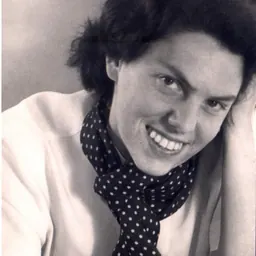
Ella Ehlers (born Ella Schimpf: 30 May 1904 – 9 April 1985) was a German Kindergarten teacher. Through her work, in 1926 she met Adolf Ehlers (1898–1978), a political activist who at around the same time was readmitted to the Communist Party. She became his secretary and then, in 1928, his wife. Ella Schimpf had grown up in a heavily politicised family, and she now participated energetically with her husband in the increasingly polarised politics of the time. After 1933 she engaged in dangerous (and illegal) anti-government resistance, but she nevertheless survived the twelve Hitler years.
Life Provenance and early years Ella Schimpf was born in Dresden, the youngest of her parents' three children. Karl Schimpf, father worked as a glazier and cabinet maker. At the age of eight Ella would join her brother to deliver the pro-SPD Leipziger Volkszeitung (Newspaper), in order to be able to contribute to the family housekeeping budget.
War In 1914, when she was ten both her parents resigned from the SPD, horrified by the decision of the party leadership in the Reichstag (national parliament) to vote in favour of war credits to help finance the war which had broken out in July. That decision was contentious with many party members; and by the time the war ended four years later had led to a party split and thereby, indirectly, the launch of the Communist Party of Germany During December/January 1918/1919. Her parents joined the Communist Party in 1920. Neither of the Ehlers was able to find work, and they stayed with the Deisen's, accommodated in an improvised apartment in the attic, for longer than any of those involved might have anticipated. A particular difficulty was that Adolf Ehlers had fallen seriously ill. He remained unemployed for six and a half years. In connection with her courier work during the war years Ella Ehlers also established firm and lasting friendships both with Irmgard Enderle and with the future Berlin mayor and West German chancellor Willy Brandt, who after 1940 assumed an increasingly prominent role among the German socialist resistance activists based in Norway and Sweden.
Although most of north-western Germany was placed in the British occupation zone in 1945, Bremen was administered by the US occupation forces for logistical reasons connected with the need by the US military for a large port into which they could ship men and supplies to support their operations in the US occupation zone to the south. To the east lay the Soviet occupation zone. In the immediate post war period those with access to transport were able to move relatively freely between the four occupation zones, and in May 1946 Adolf Ehlers and Hermann Wolters together attended the Leipzig Trade Fair. During their visit they clashed bitterly with comrade Walter Ulbricht, who was emerging as the Soviet-backed leader of a new kind of German one-party dictatorship in the central region of Germany which between 1945 and 1949 was administered under Soviet military control. Political developments during April 1946 had recalled pre-war concerns across the west that the German communist party, like its new successor party in the Soviet zone, risked becoming nothing more than a proxy for Moscow's all-too traditional imperialist ambitions. Towards the end of May 1946 Adolf and Ella Ehlers switched their political allegiance to the Social Democratic Party. In the austerity of the immediate postwar years there were major programmes for distributing food, clothes, heating fuel and so-called "CARE-packages" to be planned and implemented. As part of the AHW operation she organised children's convalescence cures in the village of Lankenau, a short distance outside Bremen to the west. She organised sewing rooms for women who had no prospect of visiting shops to replace their families' worn out clothes and established another much needed programme which involved as necessary/possible sorting, cleaning, mending and redistributing donated second-hand clothes to those who needed them most urgently.
"Arbeiterwohlfahrt" (AWO) By 1947 much of the rubble had been cleared from the city, and following the departure of its communist members the "Bremer Arbeiterhilfswerk" decided to subsume itself into the national Workers' Welfare organisation ("Arbeiterwohlfahrt" / AWO. After that change took effect, in 1948, Ella Ehlers continued to play an important part in the AWO, accepting the chairmanship of its Bremen branch in 1961. Gröpelingen was a central traditionally working class district of the city, particularly badly affected by the war. The choice of Bremen for the generous donation from North America is attributed to the excellent US contacts that Adolf and Ella Ehlers had established and cultivated. It was a major project, on which Ella Ehlers worked closely with Helene Kaisen, wife of Bremen's first post-war mayor, and chairwoman of the association committee that was set up to administer the funding. She was in her mid-70s: she appeared fit and healthy, but was nevertheless becoming more withdrawn. She would still attend executive committee meetings of the Bremen AWO (of which she remained honorary president) if she was asked to do so, but no longer turned up uninvited. There were a few occasions on which Scherf himself persuaded her to accompany him to political events. As a young ambitious senator he enjoyed the kudos to be gained by turning up with "an old lady with such a biography". But on those occasions he was too preoccupied with her celebrity to notice that she was actually becoming more and more lonely. 1980 Marie-Juchacz-Plakette award for service to workers' welfare from the AWO.
Don’t just read it —
keep it.
Full-length biographies made to live with: read them, listen on the way to work, watch them tonight.
- E-book
- Audio
- Video
Instant download · yours to keep · every purchase keeps this site free
Important facts
People in Ella Ehlers's life
Named in this biography and alive at the same time


Related people
Same field, nearest in time


Contemporaries
People whose lives overlapped Ella Ehlers's




Frequently asked questions
Who was Ella Ehlers?
German politician (1904–1985)
When was Ella Ehlers born?
Ella Ehlers was born on 30 May 1904 in Dresden.
When did Ella Ehlers die?
Ella Ehlers died on 9 April 1985 in Bremen.
What was Ella Ehlers's occupation?
Ella Ehlers was an educator and politician.
What nationality was Ella Ehlers?
Ella Ehlers was German.
Sources & further reading
Cite this page
APA: Biography.guide. (2026). Ella Ehlers. https://biography.guide/ella-ehlers/
MLA: "Ella Ehlers." Biography.guide, https://biography.guide/ella-ehlers/.
Chicago: "Ella Ehlers." Biography.guide. https://biography.guide/ella-ehlers/.
Data last updated: 2026-09-22 · Spot an error? Report a correction.
Page generated 2026-09-27 05:02 UTC