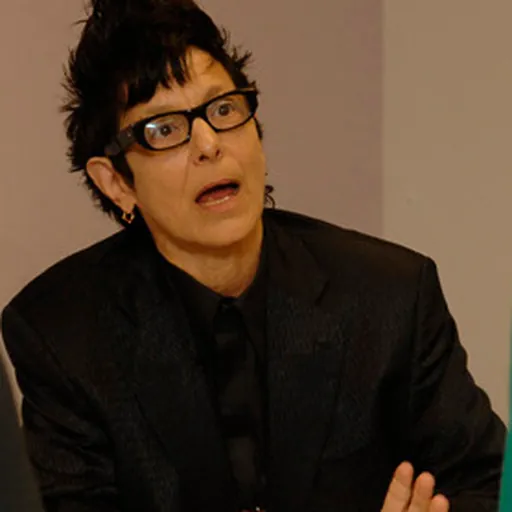
Elizabeth Streb
American choreographer and dancer (born 1950)
About Elizabeth Streb
Born 1950. Elizabeth Streb is an American choreographer, dancer, television actor and sTREB Lab for Action Mechanics.
Elizabeth Streb (born February 23, 1950) is an American choreographer, performer, and teacher of contemporary dance.
Background Streb was born and raised in Rochester, New York and, after graduating from the dance program of State University of New York at Brockport in 1972, she was interested in experimental works and worked and performed for many years with investigational groups including Molissa Fenley's. She also worked and performed with Margaret Jenkins in San Francisco for two years before relocating back to New York City In 1975, upon her arrival in New York City, Streb created her dance company STREB/ Ringside.
Streb received a 1996 Foundation for Contemporary Arts Grants to Artists Award. In 1997, she was awarded a fellowship from the John D. and Catherine T. MacArthur Foundation (sometimes called a “Genius” grant), two New York Dance and Performance (Bessie) Awards, and grants from John Simon Guggenheim Foundation, Creative Capital, The National Endowment for the Arts, the New York Foundation for the Arts and the Mellon Foundation.
In 2003, Streb established SLAM (Streb Lab for Action Mechanics) in Williamsburg, Brooklyn which created a new outlet for the community where people could come and watch rehearsals and even participate in classes. She also published her documentary "Streb: Pop Action" showcasing some of the rehearsals and dances she has created at SLAM and giving insight into her life and career. In 2010, Streb's book, How to Become an Extreme Action Hero, was published by The Feminist Press.
Career advancements Streb is known for “A preoccupation with movement and itself was symptomatic of a trend that was altering the traditional profile of modern dance.”
She has been creating works from 1975 to the present and is known for her outrageous risk taking and experimental shows she puts on. Streb includes risk into all of her choreography, giving the audience sensations of extreme feelings while watching the performers. She inquired about movement and the suppositions that the dance world created; and integrated actions and principles of the circus, rodeo, and daredevil “stunts.” She is interested in the effects of gravity, math, and physics on her choreography. And has said, “A question like: Can you fall up? This is the bedrock of my process” and that she tries “to notice what questions have not been asked in a particular field that need to be asked and answered.” She grew up participating in extreme sports, therefore she associates a lot of her work with athletics; for example, skiing and motorcycling, and has also expressed her interest in the circus and performance artists such as Chris Burden, Marina Abramović, and admires Trisha Brown.
She wanted to gain a better understanding of the effects of movement on matter so she studied math, physics, and philosophy as Dean's Special Scholar at New York University. Streb explains that "'Pop-Action' is all about the popping of the muscles, training to utilize them over the movement of the skeleton." Custom-made trapezes, trusses, trampolines, and a flying machine give Streb a way to discover new ways for the body to move in space while being subjected to gravity. Moves consist of diving off metal scaffolding, also known as a "truss," landing level on a mat. The performers also can be found launching through the air in “Quick succession with timing so precise that they just miss occupying the same space at the same time.” With her newer choreography, Streb incorporates music as a part of the show being experienced by the audience. However, she has always upheld that "ovement has its own timing, unrelated to music.” Streb has always tried to reach more than just the usual audiences for dance.
Streb has expressed her philosophy thus: “Go to the edge and peer over it. Be willing to get hurt, but not so hurt that you can’t come back again.” She has also said that, “Movement is causal; it’s a physical happening. You can stick a high C next to a low F-flat, whereas you couldn’t connect a move where you’re 30 feet in the air and falling, then skip a spot in space, land on the ground, and walk away. So I thought the arbiters of dance training and presentation were lying at the first basic step. Dance does not address its compositional methodology. It’s not true to the form. This form is movement.”
Don’t just read it —
keep it.
Full-length biographies made to live with: read them, listen on the way to work, watch them tonight.
- E-book
- Audio
- Video
Instant download · yours to keep · every purchase keeps this site free
Important facts
Family & relationships
People in Elizabeth Streb's life
Named in this biography and alive at the same time





Related people
Same field, nearest in time





Contemporaries
People whose lives overlapped Elizabeth Streb's


Frequently asked questions
Who is Elizabeth Streb?
American choreographer and dancer (born 1950)
When was Elizabeth Streb born?
Elizabeth Streb was born on 23 February 1950 in Rochester.
What is Elizabeth Streb's occupation?
Elizabeth Streb is a choreographer, dancer, television actor and sTREB Lab for Action Mechanics.
What nationality is Elizabeth Streb?
Elizabeth Streb is American.
Sources & further reading
Cite this page
APA: Biography.guide. (2026). Elizabeth Streb. https://biography.guide/elizabeth-streb/
MLA: "Elizabeth Streb." Biography.guide, https://biography.guide/elizabeth-streb/.
Chicago: "Elizabeth Streb." Biography.guide. https://biography.guide/elizabeth-streb/.
Data last updated: 2026-09-23 · Spot an error? Report a correction.
Portrait: Wikimedia Commons · author & licence
Page generated 2026-09-27 05:07 UTC