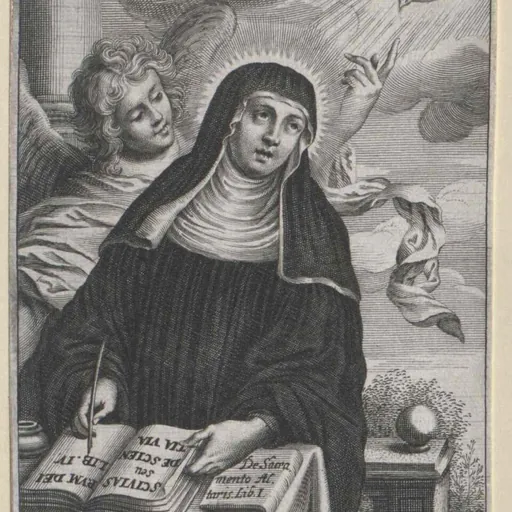
About Elizabeth of Schönau
Lived 1129 – 1164 (aged 34–35). Elizabeth of Schönau was a German writer, abbess, mystic and christian nun.
Elisabeth of Schönau (c. 1129 – 18 June 1164) was a German Benedictine visionary. She was an abbess at the Schönau Abbey in the Duchy of Nassau, and reportedly experienced numerous religious visions, for which she became widely sought after by many powerful men as far away as France and England.
Life Altar of St. Elisabeth of Schönau (with the reliquary in which Elisabeth's skull is kept) in the monastery church of St. Florin, Kloster Schönau im Taunus Elisabeth was born about 1129, of family named Hartwig of the Middle Rhine. She was educated at the double monastery of Schönau in Nassau and made her profession as a Benedictine in 1147. In 1157 she became abbess of the nuns under the supervision of Abbot Hildelin. F.W.E. Roth points out that in the 12th century only women of noble birth were promoted to spiritual offices in the Benedictine order; it seems probable that Elisabeth was of noble birth.
Her hagiography describes her as given to works of piety from her youth, much afflicted with bodily and mental suffering, a zealous observer of the Rule of Saint Benedict and of the regulation of her convent, and devoted to practices of mortification. These visions generally occurred on Sundays and Holy Days at Mass or Divine Office or after hearing or reading the lives of saints. At first she hesitated fearing lest she be deceived or be looked upon as a deceiver; but she obeyed. Eckebert (who became a monk of Schönau in 1155 and eventually succeeded Hildelin as second abbot) put everything in writing, later arranged the material at leisure, and then published all under his sister's name. While this relationship between brother and sister allowed for Elisabeth's wide broadcasting of her visionary experiences, it is evident that Eckebert attempted to have a degree of authority over Elisabeth.
Thus came into existence three books of "Visions". Of these, the first is written in very simple language and an unaffected style. The other two are more elaborate and replete with theological terminology, so that they show more of the work of Eckebert than of Elisabeth. Elisabeth had a vision in which she saw the virgin emerging with the sun surrounding her on all sides, and the virgin's great brilliance seemed to illuminate the entire earth. As ordered by Abbot Hildelin, Elisabeth revealed her vision to Eckebert.
Eckebert was struck with confusion after hearing this vision; he could not understand the purpose of the Lord's humanity being represented by a virgin instead of a man. Elisabeth relayed the answer provided to her by the Angel, explaining that "the humanity of Christ was symbolized by a female figure so that the symbol could also refer to the Virgin Mary".
During the Thirty Years' War, Swedish and Hessian soldiers attacked Schönau Monastery. The Swedes expelled the monks, plundered the monastery, broke into the grave of Elisabeth and scattered her bones; only the skull was saved. It is now preserved in a reliquary on the right side of the altar of the church.
The parish of St. Florin Schönau Monastery annually celebrates the traditional Elisabethen-Fest on the Sunday after 18 June.
Elisabeth wrote to powerful men when they did not ask for it, as well. Elisabeth scolded the archbishop, Hillin, of the city of Trier for not telling her divine message of condemnation to the people of Rome. She commanded that he, "Rise up in the spirit of humility and fear of the Lord your God." Throughout the letter it is evident that Elisabeth's Angel has spoken to her, and she is relaying this message to the archbishop. The letter is filled with anger and shows great disappointment in the archbishop of Trier, for God has taken notice of his failure to carry out his episcopal duties. Elisabeth informs him that if he does not tell the people of Rome the divine message in which Elisabeth has revealed to him, he will suffer on the final judgment day. Again, as in her letter to the abbot of Busendorf, her authority and belief in herself of a vessel of God is evident, and she has clearly gone above and beyond the limits of the traditional female gender role.
Translations Critical Edition (Latin): Ferdinand Wilhelm Emil Roth, ed. (Brunn, 1884) Modern English Translation: Elisabeth of Schönau: the complete works, Anne L. Clark, trans. and intro., Barbara J. Newman, preface (New York: Paulist Press, 2000) Modern German translation: Die Werke der Heiligen Elisabeth von Schönau, Peter Dinzelbacher, trans. (Verlag Ferdinand Schöningh, 2006) Translations have been published in modern Italian (Venice, 1859) and French (Tournai, 1864), as well as medieval Icelandic (ca. 1226–1254)
Don’t just read it —
keep it.
Full-length biographies made to live with: read them, listen on the way to work, watch them tonight.
- E-book
- Audio
- Video
Instant download · yours to keep · every purchase keeps this site free
Important facts
Related people
Same field, nearest in time



Contemporaries
People whose lives overlapped Elizabeth of Schönau's




Frequently asked questions
Who was Elizabeth of Schönau?
German Benedictine visionary
When was Elizabeth of Schönau born?
Elizabeth of Schönau was born in 1129 in Cologne.
When did Elizabeth of Schönau die?
Elizabeth of Schönau died on 19 June 1164 in Schönau Abbey in Nassau.
What was Elizabeth of Schönau's occupation?
Elizabeth of Schönau was a writer, abbess, mystic and christian nun.
What nationality was Elizabeth of Schönau?
Elizabeth of Schönau was German.
Sources & further reading
· Wikipedia: Elizabeth of Schönau
· DBpedia: Elisabeth of Schönau
Cite this page
APA: Biography.guide. (2026). Elizabeth of Schönau. https://biography.guide/elizabeth-of-schonau/
MLA: "Elizabeth of Schönau." Biography.guide, https://biography.guide/elizabeth-of-schonau/.
Chicago: "Elizabeth of Schönau." Biography.guide. https://biography.guide/elizabeth-of-schonau/.
Data last updated: 2026-09-23 · Spot an error? Report a correction.
Portrait: Wikimedia Commons · author & licence
Page generated 2026-09-27 05:06 UTC