About Elizabeth Ferris
Lived 1940 – 2012 (aged 71). Elizabeth Ferris was a British competitive diver and physician.
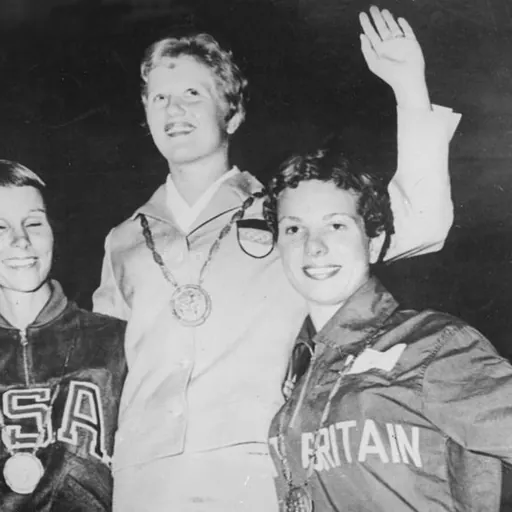
Elizabeth Anne Esther "Liz" Ferris (19 November 1940 – 12 April 2012) was a British diver. She was the third of four children (including actress Barbara Ferris) to Roy Ferris, a dairyman and Dorothy Philomena. Raised in central London, she attended Francis Holland School and was a member of the Mermaids Swimming Club which was notable for training female athletes for the Olympics. Ferris won a bronze Olympic medal in the women's 3 metre springboard event at the 1960 Rome Summer Olympics.
After her diving career, she worked in medicine and was an advocate for changing perceptions of women in sport. Her efforts were recognised by an Olympic order medal in 1980 and a lifetime achievement award by the British Olympic Association in 2011. Ferris's legacy was in her steadfast work to enhance women's opportunities in the Olympic games, as well as her work on gender biology, which encouraged the IOC to revise their definition of male and female bodies.
Ferris had one daughter to husband Julian Steven. She suffered with breast cancer from 2008 and died at home four years later in April 2012. At the time of her death, no other British female diver had won an Olympic medal in diving since her bronze medal in 1960.
Early life Ferris was born on 19 November 1940 in Bridgwater, Somerset at the Mary Stanley Nursing Home. She was the third of four children to her dairyman father Roy Ferris (1903–1975) and his wife Dorothy Philomena (1904–1990). Ferris was raised in central London, attending the private Francis Holland School. She was a member of the Mermaids Swimming Club, which had a strong tradition of training female swimmers and divers for the Olympics.
Career Diving
Ferris had an unfavourable introduction to diving, belly-flopping on her first effort, however with training she flourished, winning her first national title in 1957. She won a bronze medal in the 3 metre springboard event at the 1960 Summer Olympics, while training as a medical student in Greenford, Middlesex. Despite being sent to bed with a throat infection days before she was due to compete, she made a good recovery and became the first British woman since 1920 to win a medal in a diving event. She said that she was unaware of her medal win or even that she was in contention, as she did not keep track of marks awarded for each dive, believing that doing so might have affected her performances.
Medicine While competing internationally, Ferris was also studying medicine at the University of London. After competing in Perth in 1962, she retired from diving to focus on her medical career. In 1965, she qualified as a doctor as Middlesex Hospital and worked across hospitals in London and Gloucestershire. She was a delegate to the International Olympic Committee (IOC) in 1976, at the time its first conference on women in sport, during a period when less than 21 percent of competitors across both summer and winter Olympics were women. Ferris advocated for change, as considerably less sports were available for women than men, achieving this through conferences and commissions. In her 1979 article Sportswomen and medicine, she challenged long-held beliefs about the impact of motherboard and hormones on female sports performances, while criticizing the IOC's gender testing system introduced during the 1960s as 'ineffective'. Some sporting bodies chose to review their gender verification procedures in the 1980s due to Ferris's advocacy. and in 1983, suggested that pregnant women should not participate in sports. Ferris was known to work on gender equality, notably from 1995 as part of the IOC's women and sport commission, while she also advocated sport and exercise at grassroots. In 2011, she was awarded the British Olympic Association's first lifetime achievement award. Ferris's legacy was in her steadfast work to enhance women's opportunities in the Olympic games, as well as her work on gender biology, which encouraged the IOC to amend their restrictive definition of male and female bodies. When recognising gender equity in the Olympic games and scientifically understanding the body's gender can be partly attributed to the work and advocacy by Ferris's. Through her sister Barbara, she was the sister-in-law of film director and producer John Quested.
Ferris married Robert Tyson Knights (b. 1942) on 8 May 1968, but the marriage was short-lived and on 12 November 1973, she married Canadian-born university lecturer Julian Steven (b. 1940), who later worked in investment banking. They had one daughter, Sophie, in 1978. At the time of her death, no other British woman had won an Olympic diving medal since Ferris's 1960 bronze.
Don’t just read it —
keep it.
Full-length biographies made to live with: read them, listen on the way to work, watch them tonight.
- E-book
- Audio
- Video
Instant download · yours to keep · every purchase keeps this site free
Important facts
People in Elizabeth Ferris's life
Named in this biography and alive at the same time






Related people
Same field, nearest in time



Contemporaries
People whose lives overlapped Elizabeth Ferris's

Frequently asked questions
Who was Elizabeth Ferris?
English diver (1940-2012)
When was Elizabeth Ferris born?
Elizabeth Ferris was born on 19 November 1940 in Bridgwater.
When did Elizabeth Ferris die?
Elizabeth Ferris died on 12 April 2012 in London.
What was Elizabeth Ferris's occupation?
Elizabeth Ferris was a competitive diver and physician.
What nationality was Elizabeth Ferris?
Elizabeth Ferris was British.
Sources & further reading
· DBpedia: Elizabeth Ferris (diver)
Cite this page
APA: Biography.guide. (2026). Elizabeth Ferris. https://biography.guide/elizabeth-ferris/
MLA: "Elizabeth Ferris." Biography.guide, https://biography.guide/elizabeth-ferris/.
Chicago: "Elizabeth Ferris." Biography.guide. https://biography.guide/elizabeth-ferris/.
Data last updated: 2026-09-24 · Spot an error? Report a correction.
Portrait: Wikimedia Commons · author & licence
Page generated 2026-09-27 05:08 UTC