
Elizabeth Bruce
Daughter of Robert I of Scotland
About Elizabeth Bruce
Lived 1317 – 1364 (aged 46–47). Elizabeth Bruce was a Scottish.
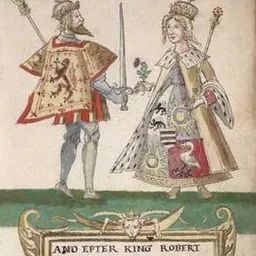
Elizabeth Bruce was a daughter of King Robert the Bruce and was married to Sir Walter Oliphant (Olifaunt) of Aberdalgie and Dupplin.
Legitimacy Her legitimacy was brought into question by Sir David Dalrymple (Lord Hailes) in his work The Annals of Scotland volume 2. Dalrymple first read about Elizabeth Bruce in Crawford's Peerage. and "dilecte sorori nostre" - "our beloved sister". which thus remove that doubt. In all, there are similar charters for the lands and baronies of Gask, Dupplin, Ochtertyre, Newtyle, Kynprony (Kinpurnie), Turyngs (Turin) and Dromy (Drimmie). The reason for the existence of so many charters was that Sir Walter Olifaunt and Elizabeth Bruce his wife had obtained reconfirmation of their landholdings and baronies from her brother King David II in 1364.
When Dalrymple was shown one of the charters he promised to correct future editions of his publication. Dalrymple died in 1792 and the correction was never made. The slab can be dated by the design of the armour of the recumbent figure of Sir William Oliphant (Olifaunt/Olifard) to circa 1360. Oliphant was the father of Elizabeth's husband Walter, and died in 1329, some thirty years prior to the creation of the Tournai marble slab depicting him. The most likely reason for the creation of the effigy was to create a tomb fit for a princess (Elizabeth). Elizabeth and her husband would eventually be buried there.
Succession to the Scottish throne The most likely reason for Elizabeth not being mentioned by either Fordun or his successors is the fact that Elizabeth was probably born shortly before her mother's death in 1327 (which in turn was followed two years later by the death of her father, King Robert the Bruce in 1329). More important events therefore overshadowed her birth and early childhood. Her late birth would explain in part why she outlived four and possibly all of her siblings. As the youngest child of King Robert the Bruce and Elizabeth de Burgh, Elizabeth Bruce would have been sixth in line of succession to the Scottish throne.
Kellie Castle In 1360, Elizabeth Bruce and Sir Walter Oliphant were given the estate and lands of Kellie in Fife by Helena Maxwell, wife of Isaac Maxwell and daughter of Richard Siward. No explanation for their creation is known other than the fact that of the royal connection (in the same way that King David II raised each of Sir Walter and Elizabeth's lands to baronies).
Don’t just read it —
keep it.
Full-length biographies made to live with: read them, listen on the way to work, watch them tonight.
- E-book
- Audio
- Video
Instant download · yours to keep · every purchase keeps this site free
Important facts
People in Elizabeth Bruce's life
Named in this biography and alive at the same time
Contemporaries
People whose lives overlapped Elizabeth Bruce's
Frequently asked questions
Who was Elizabeth Bruce?
daughter of Robert I of Scotland
When was Elizabeth Bruce born?
Elizabeth Bruce was born in 1317 in Scotland.
When did Elizabeth Bruce die?
Elizabeth Bruce died in 1364.
What nationality was Elizabeth Bruce?
Elizabeth Bruce was Scottish.
Sources & further reading
Cite this page
APA: Biography.guide. (2026). Elizabeth Bruce. https://biography.guide/elizabeth-bruce/
MLA: "Elizabeth Bruce." Biography.guide, https://biography.guide/elizabeth-bruce/.
Chicago: "Elizabeth Bruce." Biography.guide. https://biography.guide/elizabeth-bruce/.
Data last updated: 2026-09-20 · Spot an error? Report a correction.
Page generated 2026-09-27 05:21 UTC