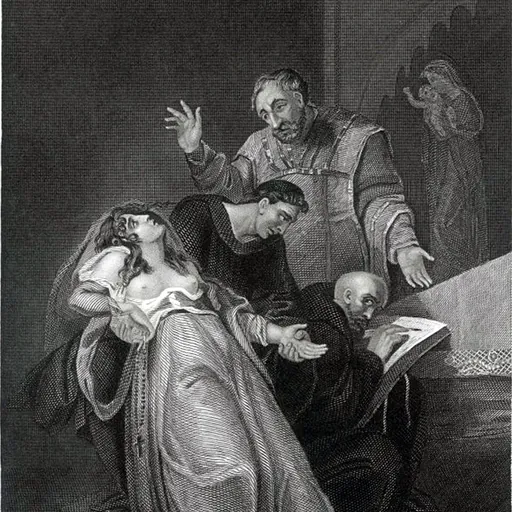
Elizabeth Barton
English Catholic nun and martyr
About Elizabeth Barton
Lived 1506 – 1534 (aged 27–28). Elizabeth Barton was an English religious sister.
Early life Little is known about Barton's early life. She was born in 1506 in the parish of Aldington, about 12 miles from Canterbury, and appears to have come from a poor background. She was working as a servant in 1525 when she said her visions began. This followed her suffering for some months from "an impostume in her stomach, which divers times redounded upwards to her throat and was like to stop her breath", during which time she could not eat or drink, as well as seizures and periods of paralysis.
Visions On Easter of 1525, at the age of 19, while working as a domestic servant in the household of Thomas Cobb, a farmer of Aldington, who worked for Archbishop William Warham, Barton claimed to have had very vivid visions and to have received divine revelations that predicted events. This included the death of a child living in her household or, more frequently, pleas for people to remain in the Catholic Church. Her revelations followed a similar pattern of Catholic orthodoxy seen in previous 'holy maids' in the later medieval period.
When some events that Barton foretold apparently occurred, her reputation spread. Barton's revelations became publicly known and matters were brought up by Archbishop William Warham.
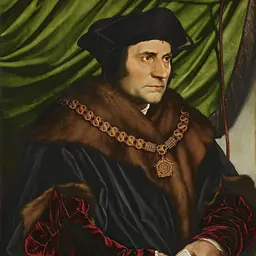
In 1528, Barton held a private meeting with Cardinal Thomas Wolsey, the second most powerful man in England after Henry VIII, and she soon thereafter met twice with Henry himself. Henry accepted Barton because her prophecies supported the existing order. She also consulted with Richard Reynolds, a Bridgettine monk of Syon Abbey. He arranged a meeting between Barton and Thomas More, who was impressed by her fervour. Her prophecies warned against heresy and condemned rebellion at a time when Henry was attempting to stamp out Lutheranism and was afraid of possible uprising or even assassination by his enemies.
Conflict with Henry VIII
By 1534, Barton's prophecies were less in tune with the interests of Henry VIII, becoming more about political affairs of both state and religion. She was condemned by a bill of attainder, the (25 Hen. 8. c. 12), an act of the Parliament of England authorising punishment without trial. This was the first, but by no means the last, use of attainder by Henry and his government.
Barton was attainted for treason by act of Parliament, on the basis that she had maliciously opposed Henry VIII's divorce from Catherine of Aragon, and had prophesied that the king would lose his kingdom. Barton had also asserted that God had revealed to her that he no longer recognised Henry VIII's monarchy. The act of attainder argued that Barton was at the centre of a conspiracy against the King. Barton was viewed as a false prophet who was encouraged to profess fake revelations to persuade others to go against the monarchy.
MacCulloch shows that when it came to frame charges against her there was a difficulty. Treason required hard evidence, preferably in writing, and that was lacking. A new offence, misprision of treason, had recently been introduced which was wider in scope than the Treason Act but had lesser penalties. Not only would that have been retrospective but it would have been possible to argue that a very much wider range of people should be charged as well as they had listened and talked to Barton over some time. Attainder was much simpler. Treason, for a woman, also meant a sentence of being burnt at the stake, however the Barton attainder only specified that the named prisoners should be "put to death". There is some evidence that Cromwell, in this case as in others, preferred a quicker death for the prisoners.
On 20 April 1534 Elizabeth Barton was hanged at Tyburn for treason. Henry Gold, priest
Barton was buried at Greyfriars Church in Newgate, but her head was put on a spike on London Bridge. She is the only woman in English history to have this final indignity imposed upon her.
Legacy Churches such as the Anglican Catholic Church of St Augustine of Canterbury continue to venerate Barton.
Popular culture Barton's case is dealt with in the 2009 historical novel Wolf Hall by Hilary Mantel, and in its television adaptation, where she is played by Aimee-Ffion Edwards. Barton and her prophecies are also mentioned in Philippa Gregory’s 2014 novel The King's Curse; the sixth and final book in The Cousins' War series.
Barton is personally interrogated by Thomas Cromwell, Thomas Cranmer and Nicòla Frescobaldi in Shaking the Throne by author Caroline Angus.
In the play A Man for All Seasons by Robert Bolt, Barton is referenced during the interrogation of Thomas More as having been executed (she was executed about 15 months before More).
Barton is mentioned as the "Holy Maid" in the 1905 novel The King's Achievement by Robert Hugh Benson.
Barton is the subject of The Lost Book of Elizabeth Barton, a novel about a modern-day historian recovering a copy of Barton's prophecies and subsequently becoming entangled in a murder investigation in an English manor near St Sepulchre's Priory.
Don’t just read it —
keep it.
Full-length biographies made to live with: read them, listen on the way to work, watch them tonight.
- E-book
- Audio
- Video
Instant download · yours to keep · every purchase keeps this site free
Important facts
People in Elizabeth Barton's life
Named in this biography and alive at the same time




Related people
Same field, nearest in time


Contemporaries
People whose lives overlapped Elizabeth Barton's


Frequently asked questions
Who was Elizabeth Barton?
English Catholic nun and martyr
When was Elizabeth Barton born?
Elizabeth Barton was born in 1506 in Aldington.
When did Elizabeth Barton die?
Elizabeth Barton died on 20 April 1534 in Tyburn.
What was Elizabeth Barton's occupation?
Elizabeth Barton was a religious sister.
What nationality was Elizabeth Barton?
Elizabeth Barton was English.
Sources & further reading
Cite this page
APA: Biography.guide. (2026). Elizabeth Barton. https://biography.guide/elizabeth-barton/
MLA: "Elizabeth Barton." Biography.guide, https://biography.guide/elizabeth-barton/.
Chicago: "Elizabeth Barton." Biography.guide. https://biography.guide/elizabeth-barton/.
Data last updated: 2026-09-20 · Spot an error? Report a correction.
Page generated 2026-09-27 05:10 UTC