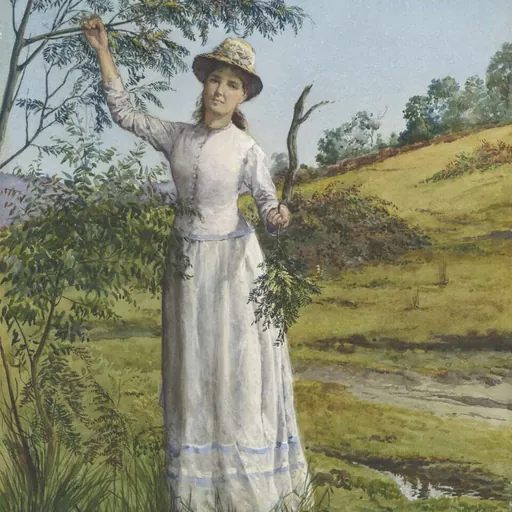
Eliza Ann Pugh
Australian journalist, literary critic and social reformer
About Eliza Ann Pugh
Lived 1851 – 1900 (aged 48–49). Eliza Ann Pugh was a British journalist, activist, social reformer and literary critic.
Eliza Ann Ashton ( Pugh; 1851 or 185215 July 1900) was an English-born Australian journalist and social reformer. She wrote for The Sydney Morning Herald and The Daily Telegraph under the names Faustine and Mrs Julian Ashton. She was a founding member of the Womanhood Suffrage League of New South Wales.
Early life Eliza Ann Pugh was born in Stoke Newington, England in either 1851 or 1852. Her father was a manager at J.S. Morgan & Co. She attended a college for girls in North London, followed by a boarding school in France. She married the artist Julian Ashton on 1 August 1876 and moved with him to Australia in 1878.
Career Ashton was a journalist, writer and literary critic for The Sydney Morning Herald and The Daily Telegraph of Sydney. She also wrote an article on the education of girls in the Centennial Magazine.
Under the pseudonym Faustine she wrote mainly social commentary pieces while under the name Mrs Julian Ashton she was known as a literary critic with a keen analysis. She was described by a writer in Table Talk as a practical philosopher with no sympathy for the purely sentimental.
At a league meeting on 11 November 1891, she presented a paper calling for radical changes to the laws of marriage. One of the reported proposals was to require both parties to renew their marriage vows each year; if either party refused they would have an automatic divorce. News of the proposal prompted a wave of criticism in the press and accusations that Ashton was trying to promote concepts of "free love," "concubinage" and prostitution. One of her critics was Lady Jersey, the wife of the Governor of New South Wales. Lady Jersey banned Ashton from visiting Government House, the Governor's official residence (a significant handicap for her role as a journalist) and called on the league to distance themselves from Ashton. The league, represented by their secretary Rose Scott, quickly disassociated themselves from Ashton's views on marriage, however, Ashton remained as a member of the league.
Ashton's views were defended by her husband in a letter of 16 November, in which he expressed regret and astonishment of society's inability to debate the subject. On 25 November her own letter was published in The Daily Telegraph and The Sydney Morning Herald, in which she described the public response as a "storm of abuse and misrepresentation." At the same time she published the full text of her paper and challenged readers to identify the position she was claimed as advocating.
On 10 April 1892, Ashton gave another lecture on marriage, which was summarised by the Daily Telegraph and repeated later in the month by The Kerang Times. This prompted renewed criticism from other press sources, such as The Evening News. On 26 April, writing under the name L. A. Ashton, she gave an account of a subsequent debate on the subject with Scott and Frank Cotton, a Labour politician. While they opposed her views, she welcomed their polite opposition rather than the rudeness and anonymity she faced from others.
In 1899 Lady Jersey wrote to the wife of the new Governor, Lady Beauchamp, advising her to allow Ashton to again visit Government House. Lady Jersey explained that she had felt forced to counter such publicly expressed views but had never heard anything negative about Ashton's personal character. Bertha Rossi Ashton (1882 – 6 February 1970) married William Charlton Hubble in July 1923. Rupert Rossi Ashton (1885 – 4 March 1895) Arthur Roy Ashton (1886 – 2 October 1917) killed in action in Belgium.
Death On 11 July 1900, Ashton became ill with what was described as nervous prostration, before falling into unconsciousness the following day. Her condition deteriorated and she died on 15 July of a brain haemorrhage. She was buried at Waverley Cemetery.
Footnotes
Don’t just read it —
keep it.
Full-length biographies made to live with: read them, listen on the way to work, watch them tonight.
- E-book
- Audio
- Video
Instant download · yours to keep · every purchase keeps this site free
Important facts
Family & relationships
People in Eliza Ann Pugh's life
Named in this biography and alive at the same time

Related people
Same field, nearest in time

Contemporaries
People whose lives overlapped Eliza Ann Pugh's



Frequently asked questions
Who was Eliza Ann Pugh?
Australian journalist, literary critic and social reformer
When was Eliza Ann Pugh born?
Eliza Ann Pugh was born in 1851 in Stoke Newington.
When did Eliza Ann Pugh die?
Eliza Ann Pugh died on 15 July 1900 in Bondi.
What was Eliza Ann Pugh's occupation?
Eliza Ann Pugh was a journalist, activist, social reformer and literary critic.
What nationality was Eliza Ann Pugh?
Eliza Ann Pugh was British.
Sources & further reading
Cite this page
APA: Biography.guide. (2026). Eliza Ann Pugh. https://biography.guide/eliza-ann-pugh/
MLA: "Eliza Ann Pugh." Biography.guide, https://biography.guide/eliza-ann-pugh/.
Chicago: "Eliza Ann Pugh." Biography.guide. https://biography.guide/eliza-ann-pugh/.
Data last updated: 2026-09-23 · Spot an error? Report a correction.
Portrait: Wikimedia Commons · author & licence
Page generated 2026-09-27 05:04 UTC